Kumar Ashutosh, Sardhara Jayesh, Mishra Prabhaker, Kapoor Vishwas, Mehrotra Anant, Raiyani Vandan, Singh Mayank, Goyal Nishant, Kulkarni Arvind G, Srikantha Umesh, Bhaisora Kamlesh Singh, Das Kuntal Kanti, Srivastava Arun K, Behari Sanjay
Department of Neurosurgery, Sanjay Gandhi Post Graduate Institute of Medical Sciences, Lucknow, Uttar Pradesh, India.
Department of Biostatistics and Health Informatics, Sanjay Gandhi Post Graduate Institute of Medical Sciences, Lucknow, Uttar Pradesh, India.
J Craniovertebr Junction Spine. 2022 Jul-Sep;13(3):245-255. doi: 10.4103/jcvjs.jcvjs_4_22. Epub 2022 Sep 14.
The global shift of trends to minimally invasive spine (MIS) surgery for lumbar degenerative diseases has become prominent in India for few decades. We aimed to assess the current status of MIS techniques for lumbar interbody fusion and their surgical outcomes in the Indian population.
A systematic review (following Preferred Reporting Items for Systematic Reviews and Meta-Analysis guidelines) was performed using PubMed and Google Scholar till November 2020. The primary (visual analog scale [VAS] and oswestry disability index [ODI] scores; intraoperative blood loss; duration of surgery; duration of hospital stay, and fusion rate) and secondary (wound-associated complications and dural tear/cerebrospinal fluid (CSF) leak) outcomes were analyzed using Review Manager 5.4 software.
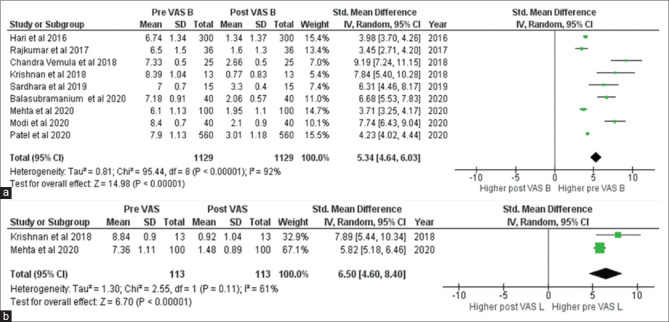
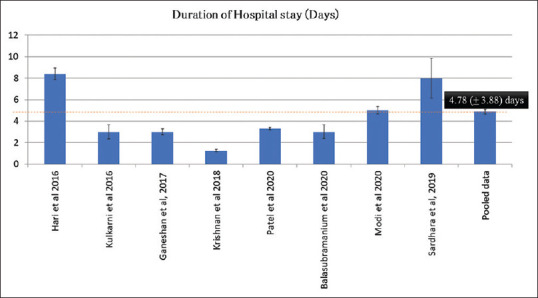
A total of 15 studies comprising a total of 1318 patients were included for analysis. The pooled mean of follow-up duration was 26.64 ± 8.43 months (range 5.7-36.5 months). Degenerative spondylolisthesis of Myerding grade I/II was the most common indication, followed by lytic listhesis, herniated prolapsed disc, and lumbar canal stenosis. The calculated pooled standard mean difference (SMD) suggested a significant decrease in postoperative ODI scores (SMD = 5.53, 95% confidence interval [CI] = 3.77-7.29; < 0.01) and VAS scores (SMD = 6.50, 95% CI = 4.6-8.4; < 0.01). The pooled mean blood loss, duration of postoperative hospital stay, duration of surgery, and fusion rate were 127.75 ± 52.79 mL, 4.78 ± 3.88 days, 178.59 ± 38.69 min, and 97.53% ± 2.69%, respectively. A total of 334 adverse events were recorded in 1318 patients, giving a complication rate of 25.34%.
Minimally invasive transforaminal lumbar interbody fusion (TLIF) is the most common minimally invasive technique employed for lumbar interbody fusion in India, while oblique lumbar interbody fusion is in the initial stages. The surgical and outcome-related factors improved significantly after MIS LIF in the Indian population.
几十年来,在印度,腰椎退行性疾病的治疗趋势向微创脊柱(MIS)手术的全球转变已变得十分显著。我们旨在评估印度人群中用于腰椎椎间融合的MIS技术的现状及其手术效果。
按照系统评价和Meta分析的首选报告项目(PRISMA)指南进行系统评价,截至2020年11月,使用PubMed和谷歌学术进行检索。使用Review Manager 5.4软件分析主要结局(视觉模拟量表[VAS]和奥斯威斯功能障碍指数[ODI]评分;术中失血量;手术时间;住院时间和融合率)和次要结局(伤口相关并发症和硬脊膜撕裂/脑脊液[CSF]漏)。
共纳入15项研究,总计1318例患者进行分析。随访时间的合并平均值为26.64±8.43个月(范围5.7 - 36.5个月)。迈尔丁I/II级退行性脊椎滑脱是最常见的适应证,其次是溶骨性脊椎滑脱、椎间盘突出症和腰椎管狭窄。计算得出的合并标准平均差(SMD)表明术后ODI评分显著降低(SMD = 5.53,95%置信区间[CI] = 3.77 - 7.29;P < 0.01)和VAS评分显著降低(SMD = 6.50,95% CI = 4.6 - 8.4;P < 0.01)。术中平均失血量、术后住院时间、手术时间和融合率分别为127.75±52.79 mL、4.78±3.88天、178.59±38.69分钟和97.53%±2.69%。1318例患者中共记录到334例不良事件,并发症发生率为25.34%。
微创经椎间孔腰椎椎间融合术(TLIF)是印度用于腰椎椎间融合最常用的微创技术,而斜外侧腰椎椎间融合术尚处于起步阶段。在印度人群中,MIS腰椎椎间融合术后手术及与结局相关的因素有显著改善。