Wang Yi-Xin, Arvizu Mariel, Rich-Edwards Janet W, Manson JoAnn E, Wang Liang, Missmer Stacey A, Chavarro Jorge E
Department of Nutrition, Harvard T.H. Chan School of Public Health, Boston, MA, USA.
Department of Environmental Health, Harvard T.H. Chan School of Public Health, Boston, MA, USA.
EClinicalMedicine. 2022 Oct 13;54:101693. doi: 10.1016/j.eclinm.2022.101693. eCollection 2022 Dec.
Breastfeeding has been associated with a reduced maternal long-term risk of chronic diseases, but its association with mortality is poorly known.
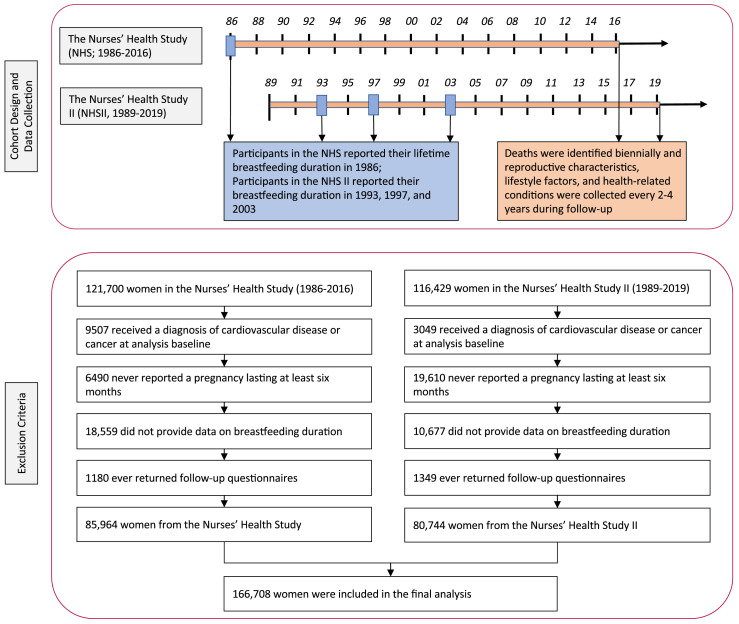
We included 166,708 female United States (US) nurses from the Nurses' Health Study (1986-2016) and the Nurses' Health Study II (1989-2019) who experienced at least one pregnancy lasting at least six months across their reproductive lifespan. Hazard ratios and 95% confidence intervals (CI) for mortality according to lifetime breastfeeding duration were estimated with time-dependent Cox proportional hazards regression models.
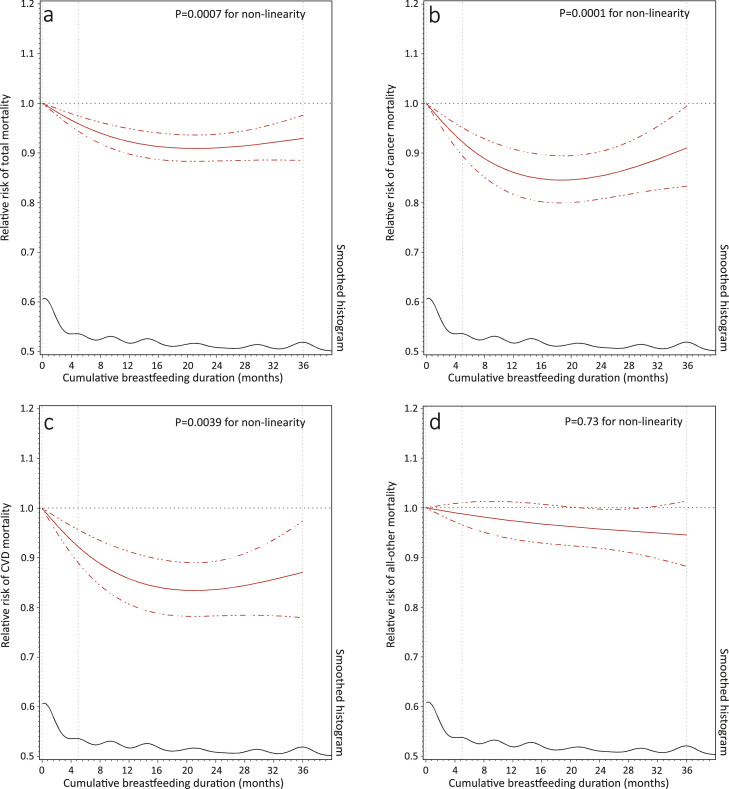
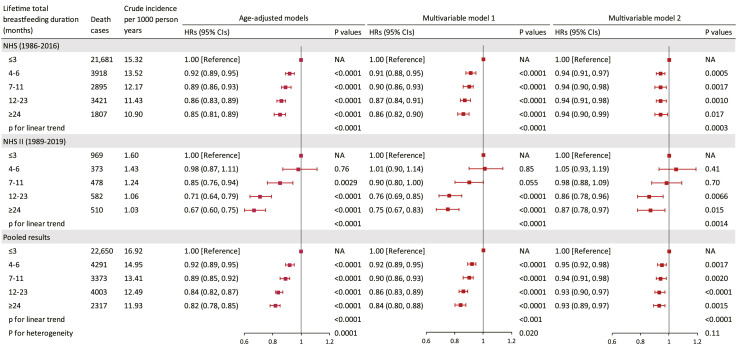
During 4,705,160 person-years of follow-up, 36,634 deaths were documented in both cohorts, including 9880 from cancer and 7709 from cardiovascular disease (CVD). Lifetime total breastfeeding duration was associated with a lower subsequent risk of all-cause mortality in a non-linear manner (p-value for non-linearity=0.0007). The pooled multivariable-adjusted hazard ratios of all-cause mortality were 0.95 (95% CI: 0.92 to 0.98), 0.94 (95% CI: 0.91 to 0.98), 0.93 (95% CI: 0.90 to 0.97), and 0.93 (95% CI: 0.89 to 0.97), respectively, for women reporting lifetime total breastfeeding duration of 4-6, 7-11, 12-23, and ≥24 months, compared to women who breastfed for ≤3 months over their reproductive lifespan. Cause-specific analysis showed a similar pattern of non-linear inverse associations between lifetime total breastfeeding duration and CVD and cancer mortality (both p-values for non-linearity <0.01). There was no evidence of interactions between breastfeeding duration and pre-pregnancy lifestyle factors on mortality risk.
Parous women with longer lifetime breastfeeding duration had a modestly lower risk of mortality.
The National Institutes of Health grants.
母乳喂养与降低母亲患慢性病的长期风险有关,但其与死亡率的关联尚不清楚。
我们纳入了来自护士健康研究(1986 - 2016年)和护士健康研究II(1989 - 2019年)的166,708名美国女性护士,她们在整个生殖寿命期间经历了至少一次持续至少六个月的怀孕。使用时间依赖性Cox比例风险回归模型估计根据终身母乳喂养持续时间的死亡率风险比和95%置信区间(CI)。
在4,705,160人年的随访期间,两个队列中共记录了36,634例死亡,包括9880例癌症死亡和7709例心血管疾病(CVD)死亡。终身总母乳喂养持续时间与随后较低的全因死亡率风险呈非线性相关(非线性p值 = 0.0007)。与在生殖寿命期间母乳喂养≤3个月的女性相比,报告终身总母乳喂养持续时间为4 - 6个月、7 - 11个月、12 - 23个月和≥24个月的女性,全因死亡率的合并多变量调整风险比分别为0.95(95% CI:0.92至0.98)、0.94(95% CI:0.91至0.98)、0.93(95% CI:0.90至0.97)和0.93(95% CI:0.89至0.97)。特定病因分析显示,终身总母乳喂养持续时间与CVD和癌症死亡率之间存在类似的非线性反向关联模式(两者非线性p值均<0.01)。没有证据表明母乳喂养持续时间与孕前生活方式因素之间在死亡风险上存在相互作用。
终身母乳喂养持续时间较长的经产妇死亡风险略低。
美国国立卫生研究院拨款。