Wang Yi-Xin, Li Yanping, Rich-Edwards Janet W, Florio Andrea A, Shan Zhilei, Wang Siwen, Manson JoAnn E, Mukamal Kenneth J, Rimm Eric B, Chavarro Jorge E
Department of Nutrition, Harvard T.H. Chan School of Public Health, Boston, MA, USA.
Department of Epidemiology, Harvard T.H. Chan School of Public Health, Boston, MA, USA.
EClinicalMedicine. 2022 Jul 18;51:101570. doi: 10.1016/j.eclinm.2022.101570. eCollection 2022 Sep.
Low birth weight has been associated with a greater risk of cardiovascular disease (CVD). However, the interaction between low birth weight and adult lifestyle factors on the risk of CVD remains unclear.
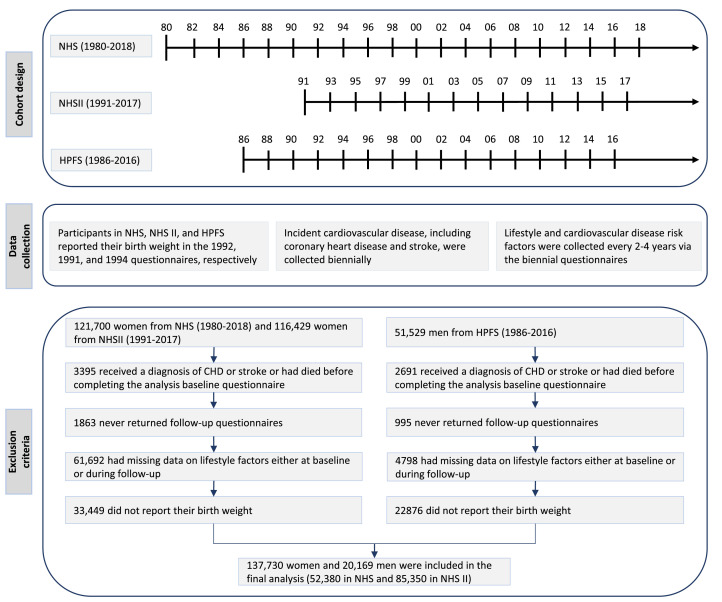
We included 20,169 men from the Health Professionals Follow-up Study (HPFS, 1986-2016), 52,380 women from the Nurses' Health Study (NHS, 1980-2018), and 85,350 women from the Nurses' Health Study II (NHS II, 1991-2017) in the USA who reported birth weight and updated data on adult body weight, smoking status, physical activity, and diet every 2-4 years. Incident cases of CVD, defined as a combined endpoint of fatal and nonfatal coronary heart disease (CHD) and stroke, were self-reported and confirmed by physicians through reviewing medical records.
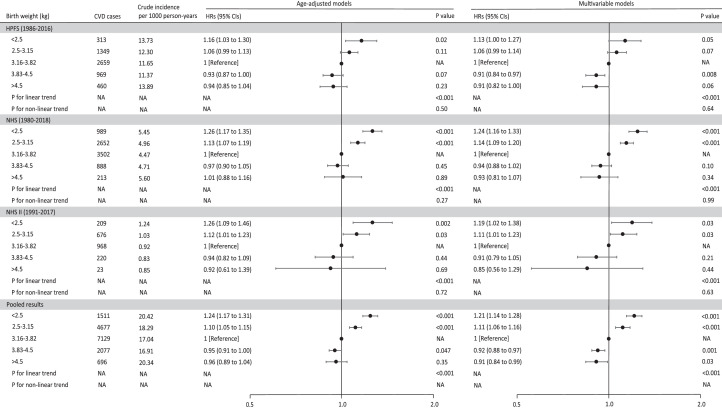
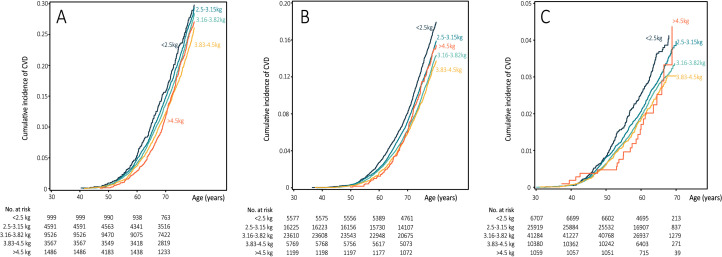
During 4,370,051 person-years of follow-up, 16,244 incident CVD cases were documented, including 12,126 CHD and 4118 stroke cases. Cox proportional hazards regression models revealed an increased risk of CHD during adulthood across categories of decreasing birth weight in all cohorts (all for linear trend <0.001). Additionally, we found an additive interaction between decreasing birth weight and unhealthy lifestyles on the risk of CHD among women, with a pooled relative excess risk due to interaction of 0.06 (95% CI: 0.04-0.08). The attributable proportions of the joint effect were 23.0% (95% CI: 11.0-36.0%) for decreasing birth weight alone, 67.0% (95% CI: 58.0-75.0%) for unhealthy lifestyle alone, and 11.0% (95% CI: 5.0-17.0%) for their additive interaction. Lower birth weight was associated with a greater stroke risk only among women, which was independent of later-life lifestyle factors.
Lower birth weight may interact synergistically with unhealthy lifestyle factors in adulthood to further increase the risk of CHD among women.
The National Institutes of Health grants.
低出生体重与心血管疾病(CVD)风险增加有关。然而,低出生体重与成人生活方式因素对心血管疾病风险的相互作用仍不明确。
我们纳入了来自美国健康专业人员随访研究(HPFS,1986 - 2016年)的20169名男性、护士健康研究(NHS,1980 - 2018年)的52380名女性以及护士健康研究II(NHS II,1991 - 2017年)的85350名女性,这些人报告了出生体重,并每2 - 4年更新一次成人体重、吸烟状况、身体活动和饮食数据。心血管疾病的发病病例定义为致命和非致命冠心病(CHD)及中风的综合终点,由本人自报并经医生查阅病历确认。
在4370051人年的随访期间,记录了16244例心血管疾病发病病例,包括12126例冠心病和4118例中风病例。Cox比例风险回归模型显示,在所有队列中,出生体重降低的类别与成年期冠心病风险增加相关(所有线性趋势P<0.001)。此外,我们发现出生体重降低与不健康生活方式之间在女性冠心病风险上存在相加交互作用,交互作用导致的合并相对超额风险为0.06(95%CI:0.04 - 0.08)。单独出生体重降低的联合效应归因比例为23.0%(95%CI:11.0 - 36.0%),单独不健康生活方式的归因比例为67.0%(95%CI:58.0 - 75.0%),其相加交互作用的归因比例为11.0%(95%CI:5.0 - 17.0%)。仅在女性中,较低的出生体重与更高的中风风险相关,且独立于晚年生活方式因素。
较低的出生体重可能与成年期不健康生活方式因素协同作用,进一步增加女性患冠心病的风险。
美国国立卫生研究院资助。