Al Houri Hasan Nabil, Jomaa Sami, Jabra Massa, Alhouri Ahmad Nabil, Latifeh Youssef
Internal Medicine Department, Damascus University, Damascus, Syria.
Faculty of Medicine, Syrian Private University, Damascus, Syria.
Ann Med Surg (Lond). 2022 Sep 15;82:104671. doi: 10.1016/j.amsu.2022.104671. eCollection 2022 Oct.
Takotsubo cardiomyopathy is a transient type of acute heart failure with distinct wall motion abnormalities and unclear pathophysiology. This review focuses on the proposed pathophysiological mechanisms that could be involved in the occurrence takotsubo cardiomyopathy.
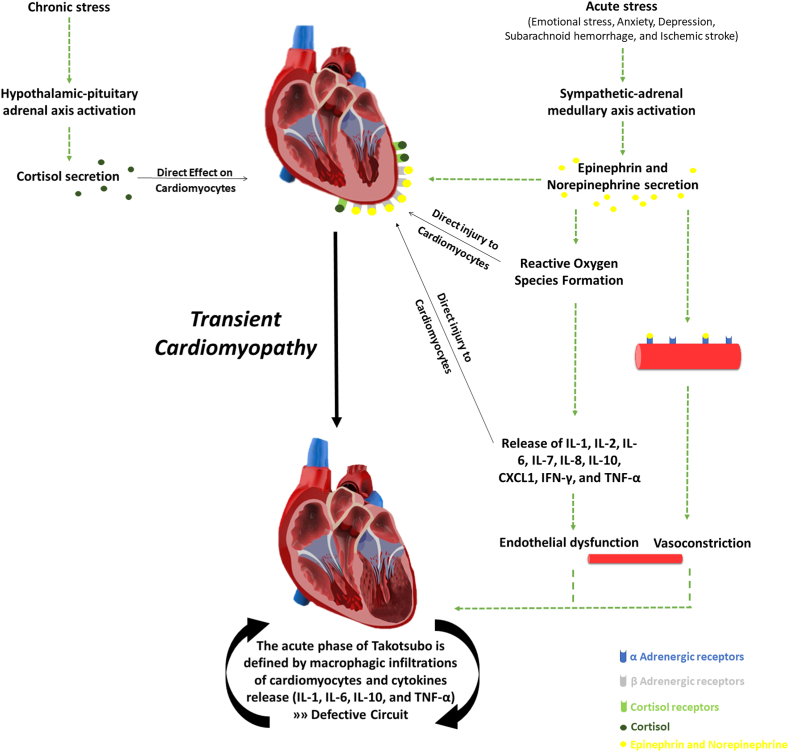
Acute stress and subsequent excessive activation of the sympathetic nervous system are major factors in the pathophysiology of takotsubo cardiomyopathy. The high levels of catecholamine work in a triggering manner, generate reactive oxygen species, release inflammatory cytokines, and induce endothelial injury. The incidence of Takotsubo cardiomyopathy has increased following COVID-19 infection and vaccination, which suggests that neurohormonal and psychological factors (i.e., fear and anxiety of infection or vaccination) may have an additional role in the pathophysiology. In addition, inflammatory state, cytokine storm, augmented sympathetic activity, and endothelial dysfunction during the acute phase of COVID-19 infection may participate in Takotsubo cardiomyopathy. Chronic stress is also linked to this complex mechanism by accelerating cripple of endocrinal hypothalamic-pituitary-adrenal axis activity, which influences the cortisol effect on releasing catecholamine, which is directly related to the pathogenesis of takotsubo cardiomyopathy.
The excessive activation of the sympathetic nervous system and subsequent high levels of catecholamines could initiate the process. The catecholamines, in turn, generate reactive oxygen species and release inflammatory cytokines (i.e., IL-1, IL-2, IL-6, IL-7, IL-8, CXCL1, TNF-α, and IFN-γ), which causes endothelial injury.
应激性心肌病是一种急性心力衰竭的短暂类型,具有明显的室壁运动异常且病理生理学尚不明确。本综述聚焦于可能与应激性心肌病发生相关的病理生理机制。
急性应激及随后交感神经系统的过度激活是应激性心肌病病理生理学的主要因素。高水平的儿茶酚胺起触发作用,产生活性氧,释放炎性细胞因子,并诱导内皮损伤。COVID-19感染和疫苗接种后应激性心肌病的发病率有所增加,这表明神经激素和心理因素(即对感染或疫苗接种的恐惧和焦虑)可能在病理生理学中起额外作用。此外,COVID-19感染急性期的炎症状态、细胞因子风暴、交感神经活动增强和内皮功能障碍可能参与应激性心肌病的发生。慢性应激也通过加速内分泌下丘脑-垂体-肾上腺轴活动的受损与这一复杂机制相关联,这会影响皮质醇对儿茶酚胺释放的作用,而儿茶酚胺释放与应激性心肌病的发病机制直接相关。
交感神经系统的过度激活及随后高水平的儿茶酚胺可启动这一过程。儿茶酚胺进而产生活性氧并释放炎性细胞因子(即白细胞介素-1、白细胞介素-2、白细胞介素-6、白细胞介素-7、白细胞介素-8、CXC趋化因子配体1、肿瘤坏死因子-α和干扰素-γ),从而导致内皮损伤。