Papadoulas Spyros I, Kouri Natasa, Tsimpoukis Andreas, Kitrou Panagiotis, Papasotiriou Marios, Nikolakopoulos Konstantinos M, Verras Georgios-Ioannis, Panagiotopoulos Ioannis, Mulita Francesk, Moulakakis Konstantinos G
Vascular Surgery Department, Patras University Hospital, Patras, Greece.
Interventional Radiology Department, Patras University Hospital, Patras, Greece.
Kardiochir Torakochirurgia Pol. 2022 Sep;19(3):141-145. doi: 10.5114/kitp.2022.119762. Epub 2022 Oct 8.
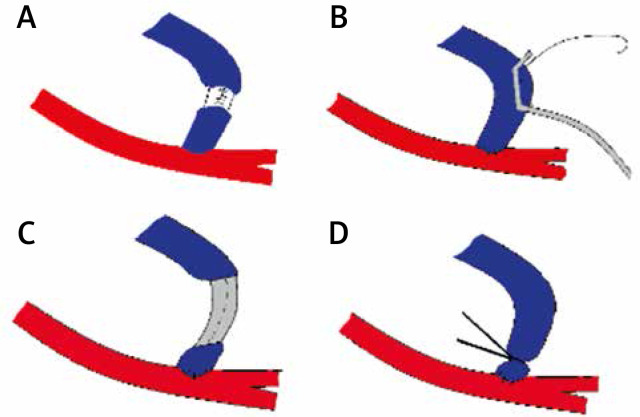
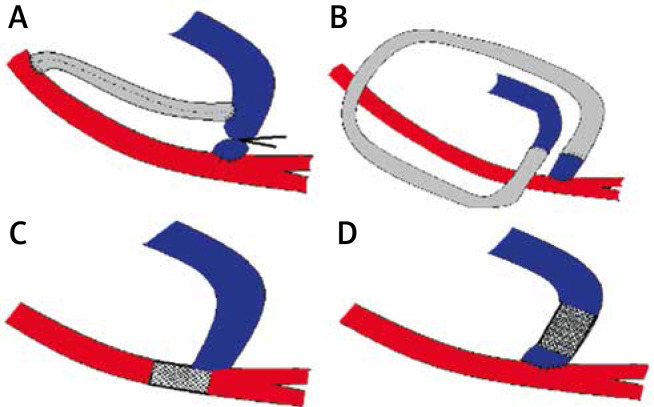
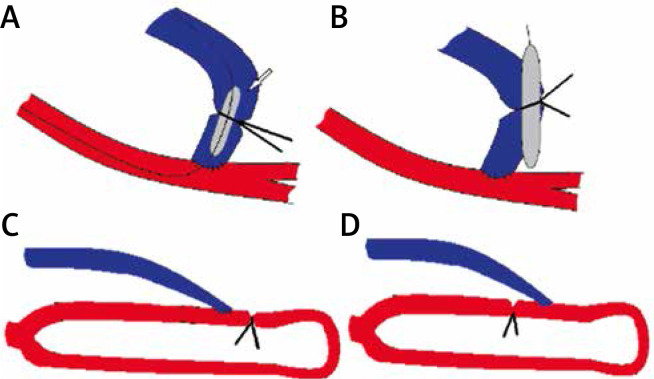
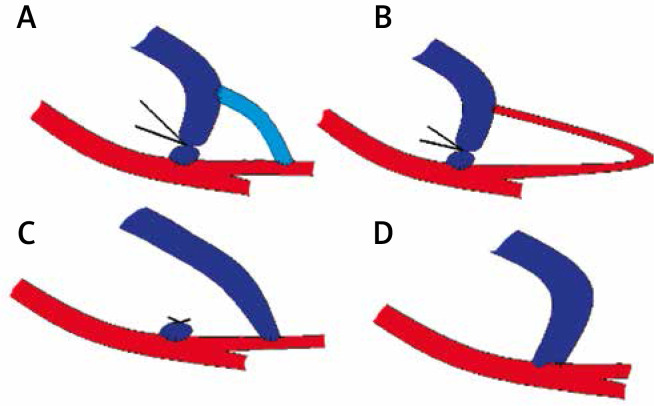
Vascular access-induced limb ischemia is a known complication of arteriovenous fistulas and grafts. Many techniques have been adopted to prevent steal in high-risk patients and to treat steal in cases of moderate ischemia not controlled with conservative management. A major factor guiding treatment is access flow volume. Management is different when ischemia is combined with the excessive flow in contrast to the combination with normal flow. We describe the most popular techniques encountered in the English literature as a part of a stepwise approach to treating dialysis access steal syndrome. In absence of ischemia, when cardiac issues emerge due to extreme access flow volumes, some of these techniques are also used to decrease flow and protect the heart. Patient's history, focused clinical examination, color duplex ultrasound examination, pulse oximetry and an angiogram are essential tools to approach this entity.
血管通路引起的肢体缺血是动静脉内瘘和移植物已知的并发症。已经采用了许多技术来预防高危患者的盗血现象,并治疗经保守治疗仍无法控制的中度缺血病例中的盗血现象。指导治疗的一个主要因素是通路血流量。与正常血流量合并相比,当缺血与血流量过多合并时,管理方式有所不同。作为治疗透析通路盗血综合征逐步方法的一部分,我们描述了英文文献中最常用的技术。在没有缺血的情况下,当由于通路血流量过大而出现心脏问题时,这些技术中的一些也用于减少血流量并保护心脏。患者病史、重点临床检查、彩色双功超声检查、脉搏血氧饱和度测定和血管造影是处理这一病症的重要工具。