
基于任务的共同激活模式可可靠地预测发育过程中静息状态规范网络的参与。
Task-based co-activation patterns reliably predict resting state canonical network engagement during development.
机构信息
Department of Psychiatry, Yale School of Medicine, New Haven, CT 06511, USA.
Department of Psychiatry, Yale School of Medicine, New Haven, CT 06511, USA; Child Study Center, Yale School of Medicine, New Haven, CT 06519, USA.
出版信息
Dev Cogn Neurosci. 2022 Dec;58:101160. doi: 10.1016/j.dcn.2022.101160. Epub 2022 Oct 8.
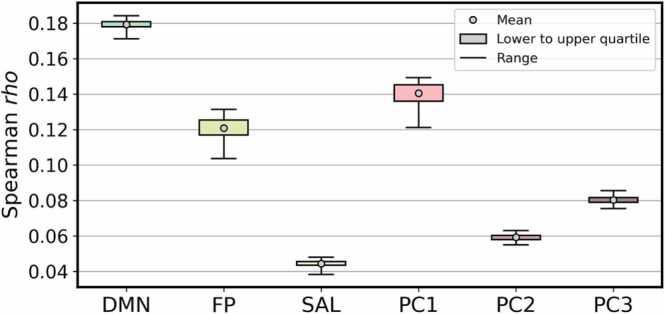
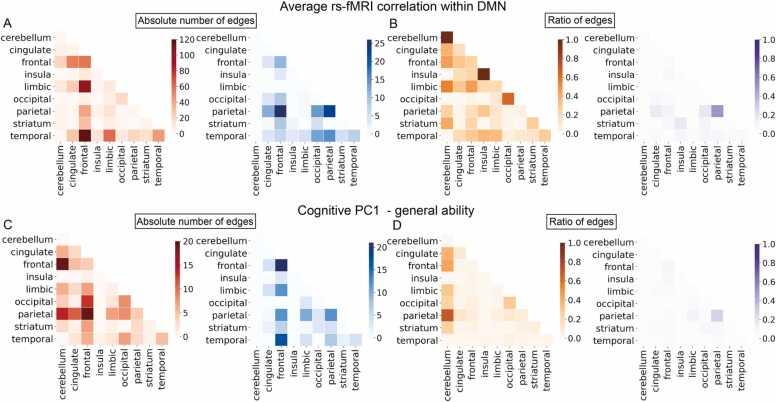
Neurodevelopmental research has traditionally focused on development of individual structures, yet multiple lines of evidence indicate parallel development of large-scale systems, including canonical neural networks (i.e., default mode, frontoparietal). However, the relationship between region- vs. network-level development remains poorly understood. The current study tests the ability of a recently developed multi-task coactivation matrix approach to predict canonical resting state network engagement at baseline and at two-year follow-up in a large and cohort of young adolescents. Pre-processed tabulated neuroimaging data were obtained from the Adolescent Brain and Cognitive Development (ABCD) study, assessing youth at baseline (N = 6073, age = 10.0 ± 0.6 years, 3056 female) and at two-year follow-up (N = 3539, age = 11.9 ± 0.6 years, 1726 female). Individual multi-task co-activation matrices were constructed from the beta weights of task contrasts from the stop signal task, the monetary incentive delay task, and emotional N-back task. Activation-based predictive modeling, a cross-validated machine learning approach, was adopted to predict resting-state canonical network engagement from multi-task co-activation matrices at baseline. Note that the tabulated data used different parcellations of the task fMRI data ("ASEG" and Desikan) and the resting-state fMRI data (Gordon). Despite this, the model successfully predicted connectivity within the default mode network (DMN, rho = 0.179 ± 0.002, p < 0.001) across participants and identified a subset of co-activations within parietal and occipital macroscale brain regions as key contributors to model performance, suggesting an underlying common brain functional architecture across cognitive domains. Notably, predictive features for resting-state connectivity within the DMN identified at baseline also predicted DMN connectivity at two-year follow-up (rho = 0.258). These results indicate that multi-task co-activation matrices are functionally meaningful and can be used to predict resting-state connectivity. Interestingly, given that predictive features within the co-activation matrices identified at baseline can be extended to predictions at a future time point, our results suggest that task-based neural features and models are valid predictors of resting state network level connectivity across the course of development. Future work is encouraged to verify these findings with more consistent parcellations between task-based and resting-state fMRI, and with longer developmental trajectories.
神经发育研究传统上侧重于个体结构的发展,但有多种证据表明大规模系统的平行发展,包括规范的神经网络(即默认模式、额顶叶)。然而,区域与网络水平发展之间的关系仍知之甚少。本研究测试了一种新开发的多任务共同激活矩阵方法的能力,该方法可以预测大量年轻青少年在基线和两年随访时的规范静息状态网络参与度。从青少年大脑与认知发展(ABCD)研究中获取预处理表格神经影像学数据,评估基线时的年轻人(N=6073,年龄=10.0±0.6 岁,3056 名女性)和两年随访时的年轻人(N=3539,年龄=11.9±0.6 岁,1726 名女性)。个体多任务共同激活矩阵是从停止信号任务、货币奖励延迟任务和情绪 N 回任务的任务对比的 beta 权重构建的。采用基于激活的预测建模,即交叉验证机器学习方法,从基线的多任务共同激活矩阵预测静息状态规范网络参与度。请注意,表格数据使用了任务 fMRI 数据(“ASEG”和 Desikan)和静息状态 fMRI 数据(Gordon)的不同分割。尽管如此,该模型还是成功地预测了默认模式网络(DMN)内的连接性(rho=0.179±0.002,p<0.001),并确定了顶叶和枕叶宏观脑区共同激活的子集是模型性能的关键贡献者,这表明认知领域存在潜在的共同脑功能架构。值得注意的是,基线时确定的用于 DMN 静息状态连接性的预测特征也预测了两年随访时 DMN 的连接性(rho=0.258)。这些结果表明,多任务共同激活矩阵具有功能意义,可以用于预测静息状态连接性。有趣的是,由于基线时共同激活矩阵中的预测特征可以扩展到未来时间点的预测,因此我们的结果表明,基于任务的神经特征和模型是发展过程中静息状态网络水平连接度的有效预测因子。鼓励进一步研究使用基于任务的 fMRI 和静息状态 fMRI 之间更一致的分割以及更长的发展轨迹来验证这些发现。



 Zotero 插件