Department of Biological and Medical Psychology, University of Bergen, Bergen, Norway.
School of Health Sciences, Kristiania University College, Bergen, Norway.
Sci Rep. 2022 Apr 15;12(1):6303. doi: 10.1038/s41598-022-10289-7.
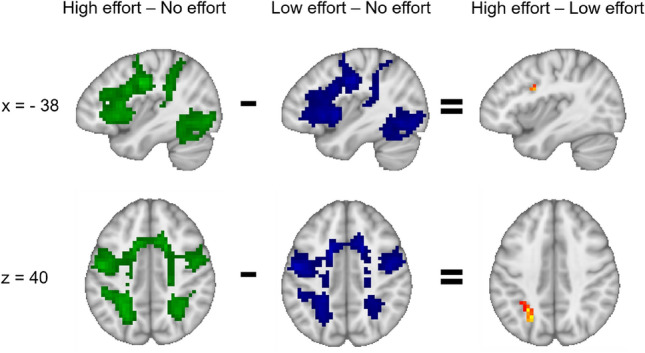
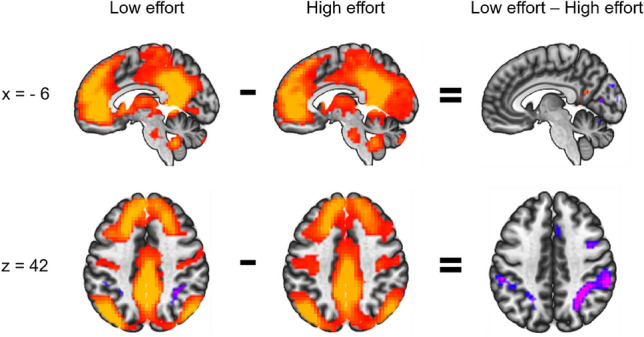
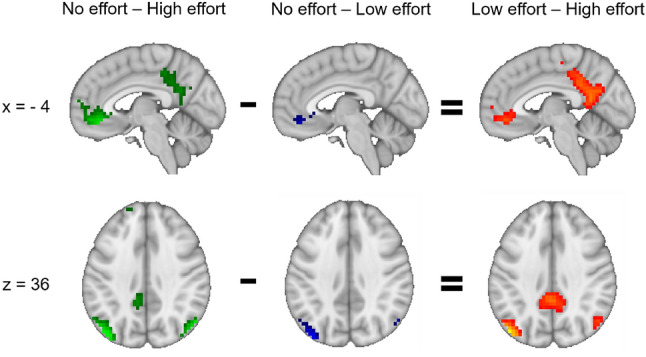
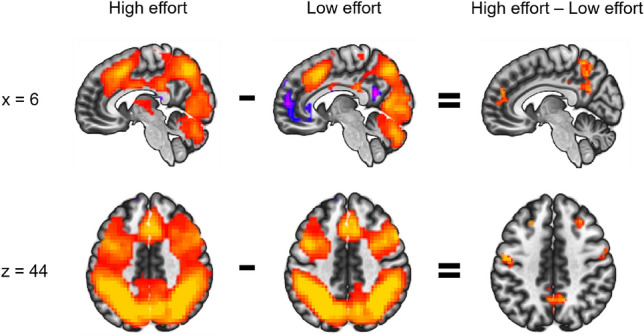
Everyday cognitive functioning is characterized by constant alternations between different modes of information processing, driven by constant fluctuations in environmental demands. At the neural level, this is realized through corresponding dynamic shifts in functional activation and network connectivity. A distinction is often made between resting and task processing and between task-negative and task-positive functional networks. The Default Mode Network (DMN) is classically considered as a resting state (i.e. task-negative) network, upregulated in the absence of cognitive demands. In contrast, task-positive networks have been labelled the Extrinsic Mode Network (EMN). We investigated changes in brain activation and functional network connectivity in an experimental situation of repeated alterations between levels of cognitive effort, following a block-design. Using fMRI and a classic Stroop paradigm, participants switched back and forth between periods of no effort (resting), low effort (word reading, i.e. automatic processing based on learned internal representations and rules) and high effort (color naming, i.e. cognitively controlled perceptual processing of specific features of external stimuli). Results showed an expected EMN-activation for task versus resting contrasts, and DMN-activation for rest versus task contrasts. The DMN was in addition more strongly activated during periods of low effort contrasted with high effort, suggesting a gradual up- and down-regulation of the DMN network, depending on the level of demand and the type of processing required. The often reported "anti-correlation" between DMN and EMN was strongest during periods of low effort, indicating intermittent contributions of both networks. Taken together, these results challenge the traditional view of the DMN as solely a task-negative network. Instead, both the EMN and DMN may contribute to low-effort cognitive processing. In contrast, periods of resting and high effort are dominated by the DMN and EMN, respectively.
日常认知功能的特点是信息处理的不同模式不断交替,这是由环境需求的不断波动驱动的。在神经水平上,这是通过功能激活和网络连接的相应动态变化来实现的。通常区分静息和任务处理以及任务负和任务正功能网络。默认模式网络(DMN)通常被认为是一种静息状态(即任务负)网络,在没有认知需求时上调。相比之下,任务正网络被标记为外在模式网络(EMN)。我们在重复改变认知努力水平的实验情况下,使用 fMRI 和经典 Stroop 范式,研究了大脑激活和功能网络连接的变化。参与者在无努力(静息)、低努力(单词阅读,即基于内部习得的表示和规则的自动处理)和高努力(颜色命名,即对外界刺激特定特征的认知控制感知处理)之间来回切换。结果显示,与静息相比,任务与任务对比显示出预期的 EMN 激活,而与任务相比,静息与任务对比显示出 DMN 激活。DMN 还在低努力期比高努力期更强烈地激活,这表明 DMN 网络的逐渐上调和下调,取决于需求水平和所需的处理类型。经常报告的 DMN 和 EMN 之间的“反相关”在低努力期间最强,表明这两个网络间歇性地参与。总的来说,这些结果挑战了 DMN 仅作为任务负网络的传统观点。相反,EMN 和 DMN 都可能有助于低努力认知处理。相比之下,静息期和高努力期分别由 DMN 和 EMN 主导。