MDHS, University of Melbourne, Parkville, Victoria, Australia.
Florey Department of Neuroscience and Mental Health, University of Melbourne, Parkville, Victoria, Australia.
Int J Neuropsychopharmacol. 2023 Mar 22;26(3):155-188. doi: 10.1093/ijnp/pyac074.
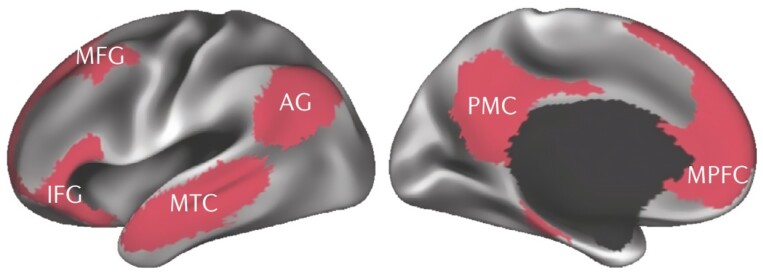
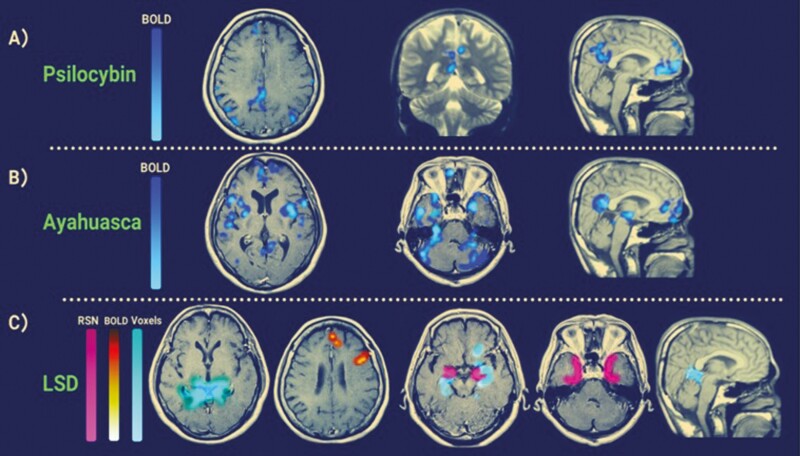
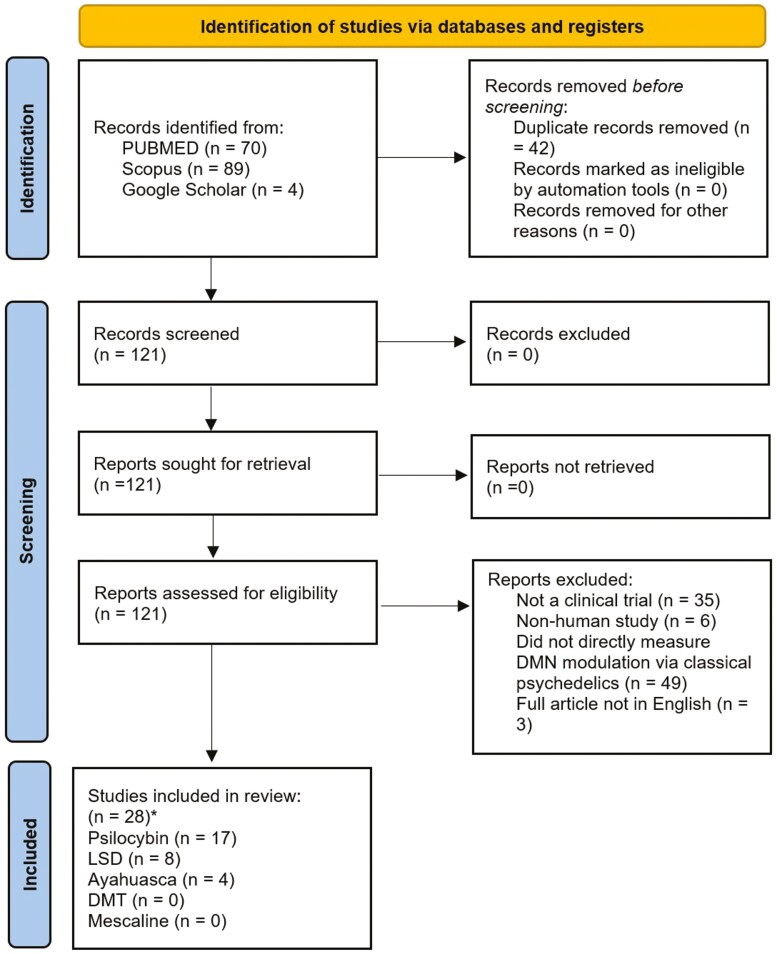
Psychedelics are a unique class of drug that commonly produce vivid hallucinations as well as profound psychological and mystical experiences. A grouping of interconnected brain regions characterized by increased temporal coherence at rest have been termed the Default Mode Network (DMN). The DMN has been the focus of numerous studies assessing its role in self-referencing, mind wandering, and autobiographical memories. Altered connectivity in the DMN has been associated with a range of neuropsychiatric conditions such as depression, anxiety, post-traumatic stress disorder, attention deficit hyperactive disorder, schizophrenia, and obsessive-compulsive disorder. To date, several studies have investigated how psychedelics modulate this network, but no comprehensive review, to our knowledge, has critically evaluated how major classical psychedelic agents-lysergic acid diethylamide, psilocybin, and ayahuasca-modulate the DMN. Here we present a systematic review of the knowledge base. Across psychedelics there is consistent acute disruption in resting state connectivity within the DMN and increased functional connectivity between canonical resting-state networks. Various models have been proposed to explain the cognitive mechanisms of psychedelics, and in one model DMN modulation is a central axiom. Although the DMN is consistently implicated in psychedelic studies, it is unclear how central the DMN is to the therapeutic potential of classical psychedelic agents. This article aims to provide the field with a comprehensive overview that can propel future research in such a way as to elucidate the neurocognitive mechanisms of psychedelics.
迷幻剂是一类独特的药物,通常会产生生动的幻觉以及深刻的心理和神秘体验。一组相互关联的大脑区域,其在静息状态下的时间相干性增加,被称为默认模式网络(DMN)。DMN 一直是许多研究的焦点,这些研究评估了它在自我参照、思维漫游和自传体记忆中的作用。DMN 连接的改变与一系列神经精神疾病有关,如抑郁症、焦虑症、创伤后应激障碍、注意缺陷多动障碍、精神分裂症和强迫症。迄今为止,已有几项研究调查了迷幻剂如何调节该网络,但据我们所知,没有全面的综述批判性地评估了主要经典迷幻剂(麦角酸二乙酰胺、裸盖菇素和死藤水)如何调节 DMN。在这里,我们对知识库进行了系统的回顾。在各种迷幻剂中,DMN 内的静息状态连接在急性中断一致,以及与典型静息状态网络之间的功能连接增加。已经提出了各种模型来解释迷幻剂的认知机制,在一个模型中,DMN 调节是一个中心公理。尽管 DMN 在迷幻研究中一直被牵连,但尚不清楚 DMN 对经典迷幻剂的治疗潜力有多重要。本文旨在为该领域提供一个全面的概述,可以推动未来的研究,以阐明迷幻剂的神经认知机制。