Vékony Teodóra, Pleche Claire, Pesthy Orsolya, Janacsek Karolina, Nemeth Dezso
Lyon Neuroscience Research Center (CRNL), INSERM U1028, CNRS UMR5292, Université Claude Bernard Lyon 1, Lyon, France.
Département d'Études Cognitives, École Normale Supérieure, Université PSL, 75005, Paris, France.
NPJ Sci Learn. 2022 Oct 22;7(1):27. doi: 10.1038/s41539-022-00144-9.
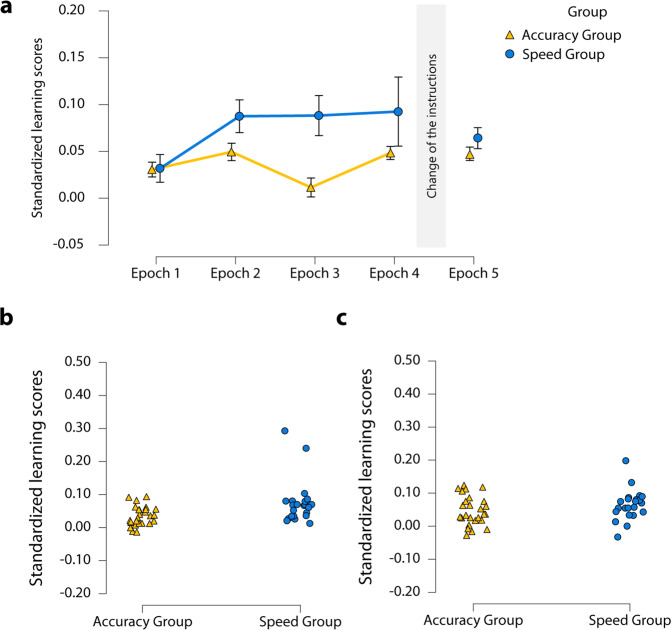
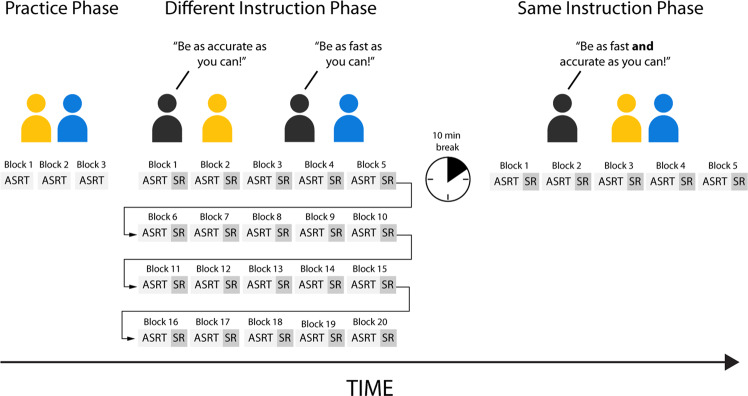
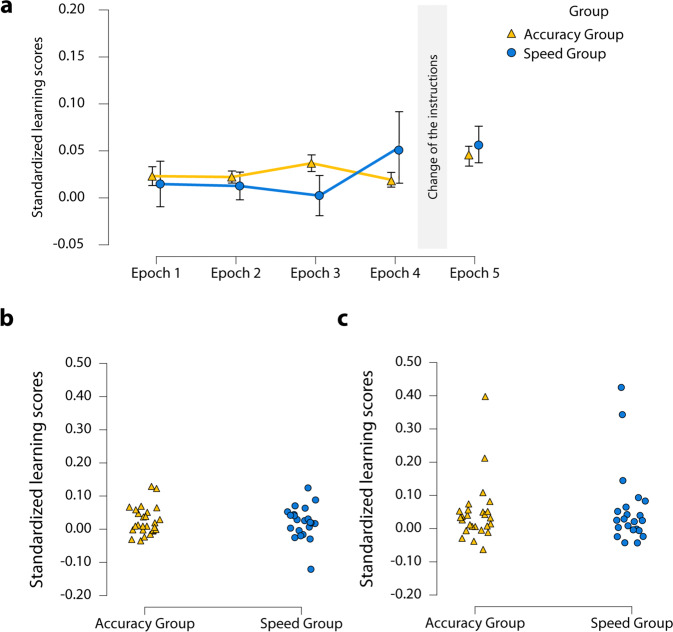
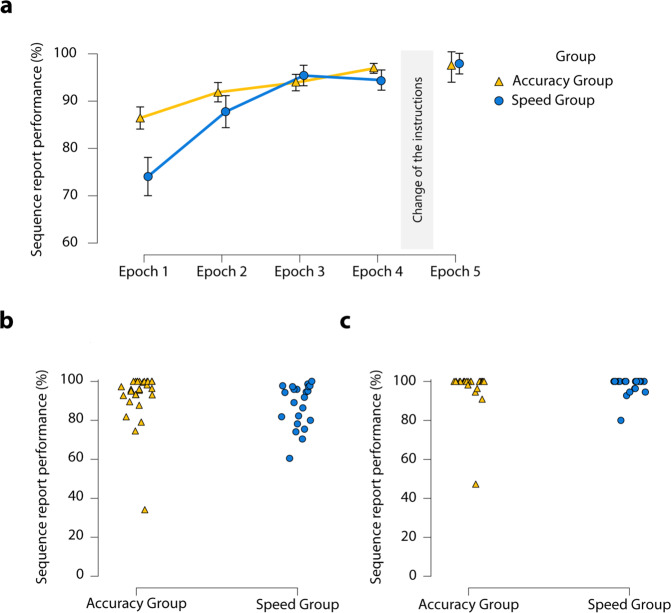
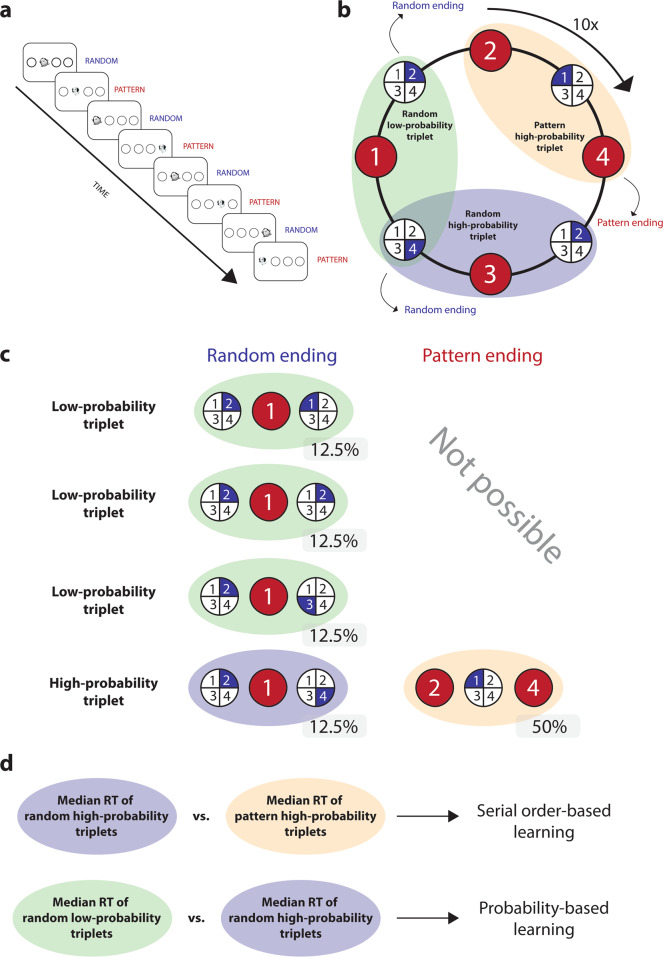
Procedural learning is key to optimal skill learning and is essential for functioning in everyday life. The findings of previous studies are contradictory regarding whether procedural learning can be modified by prioritizing speed or accuracy during learning. The conflicting results may be due to the fact that procedural learning is a multifaceted cognitive function. The purpose of our study is to determine whether and how speed and accuracy instructions affect two aspects of procedural learning: the learning of probability-based and serial-order-based regularities. Two groups of healthy individuals were instructed to practice on a cued probabilistic sequence learning task: one group focused on being fast and the other on being accurate during the learning phase. The speed instruction resulted in enhanced expression of probability-based but not serial-order-based knowledge. After a retention period, we instructed the participants to focus on speed and accuracy equally, and we tested their acquired knowledge. The acquired knowledge was comparable between groups in both types of learning. These findings suggest that different aspects of procedural learning can be affected differently by instructions. However, only momentary performance might be boosted by speed instruction; the acquired knowledge remains intact. In addition, as the accuracy instruction resulted in accuracy near ceiling level, the results illustrate that response errors are not needed for humans to learn in the procedural domain and draw attention to the fact that different instructions can separate competence from performance.
程序性学习是最佳技能学习的关键,对日常生活的运作至关重要。关于在学习过程中优先考虑速度或准确性是否能改变程序性学习,以往研究的结果相互矛盾。这些相互矛盾的结果可能是由于程序性学习是一种多方面的认知功能。我们研究的目的是确定速度和准确性指令是否以及如何影响程序性学习的两个方面:基于概率和基于序列顺序的规律的学习。两组健康个体被指导在一个提示概率序列学习任务上进行练习:一组在学习阶段专注于速度,另一组专注于准确性。速度指令导致基于概率的知识表达增强,但基于序列顺序的知识表达未增强。在一段保留期后,我们指导参与者同等地关注速度和准确性,并测试他们所学的知识。在两种类型的学习中,两组之间所学的知识相当。这些发现表明,程序性学习的不同方面可能受到指令的不同影响。然而,速度指令可能只会提高瞬间表现;所学的知识保持不变。此外,由于准确性指令导致准确性接近上限水平,结果表明在程序性领域人类学习不需要反应错误,并提请注意不同指令可以将能力与表现区分开来这一事实。