
信念与社会互动:对身体表达及个人叙事的影响
Believing and social interactions: effects on bodily expressions and personal narratives.
作者信息
Seitz Rüdiger J, Angel Hans-Ferdinand, Paloutzian Raymond F, Taves Ann
机构信息
Department of Neurology, Centre of Neurology and Neuropsychiatry, LVR-Klinikum Düsseldorf, Medical Faculty, Heinrich-Heine-University Düsseldorf, Düsseldorf, Germany.
Institute of Catechetic and Pedagogic of Religion, Karl Franzens University Graz, Graz, Austria.
出版信息
Front Behav Neurosci. 2022 Oct 6;16:894219. doi: 10.3389/fnbeh.2022.894219. eCollection 2022.
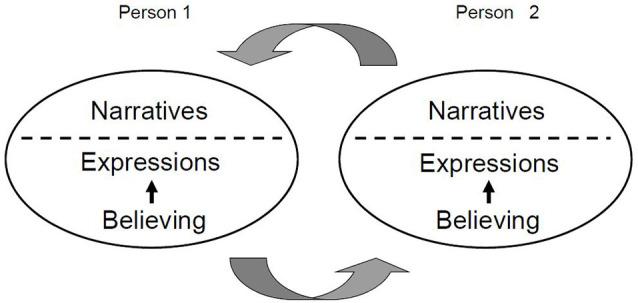
The processes of believing integrate external perceptual information from the environment with internal emotional states and prior experience to generate probabilistic neural representations of events, i.e., beliefs. As these neural representations manifest mostly below the level of a person's conscious awareness, they may inadvertently affect the spontaneous person's bodily expressions and prospective behavior. By yet to be understood mechanisms people can become aware of these representations and reflect upon them. Typically, people can communicate the content of their beliefs as personal statements and can summarize the narratives of others to themselves or to other people. Here, we describe that social interactions may benefit from the consistency between a person's bodily expressions and verbal statements because the person appears authentic and ultimately trustworthy. The transmission of narratives can thus lay the groundwork for social cooperation within and between groups and, ultimately, between communities and nations. Conversely, a discrepancy between bodily expressions and narratives may cause distrust in the addressee(s) and eventually may destroy social bonds.
信念形成的过程将来自环境的外部感知信息与内部情绪状态及先前经验整合起来,以生成事件的概率性神经表征,即信念。由于这些神经表征大多在人的意识觉知水平之下显现,它们可能会不经意地影响人的自发身体表达和预期行为。通过尚未被理解的机制,人们能够意识到这些表征并对其进行反思。通常,人们可以将自己信念的内容作为个人陈述进行交流,也能够向自己或他人总结他人的叙述。在此,我们描述社会互动可能会受益于一个人的身体表达和言语陈述之间的一致性,因为此人看起来真实且最终值得信赖。叙事的传播因此可以为群体内部和群体之间、最终为社区和国家之间的社会合作奠定基础。相反,身体表达和叙事之间的差异可能会导致收件人产生不信任,最终可能破坏社会纽带。

 Zotero 插件