Seaver Autism Center for Research and Treatment, Icahn School of Medicine at Mount Sinai, New York, NY, USA.
Department of Psychiatry, Icahn School of Medicine at Mount Sinai, New York, NY, USA.
HGG Adv. 2022 Sep 26;4(1):100145. doi: 10.1016/j.xhgg.2022.100145. eCollection 2023 Jan 12.
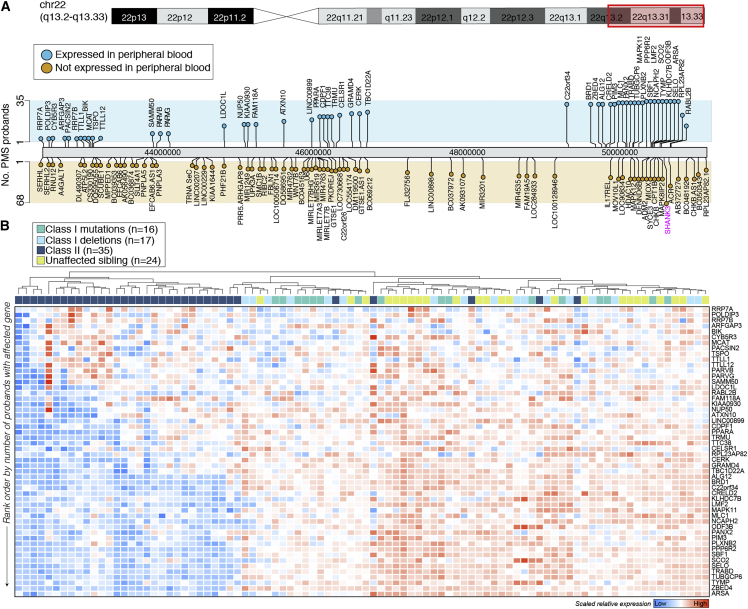
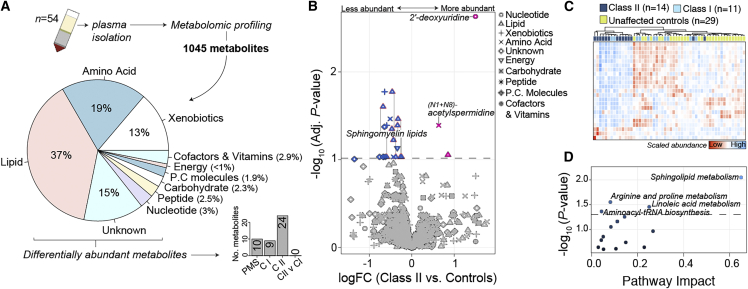
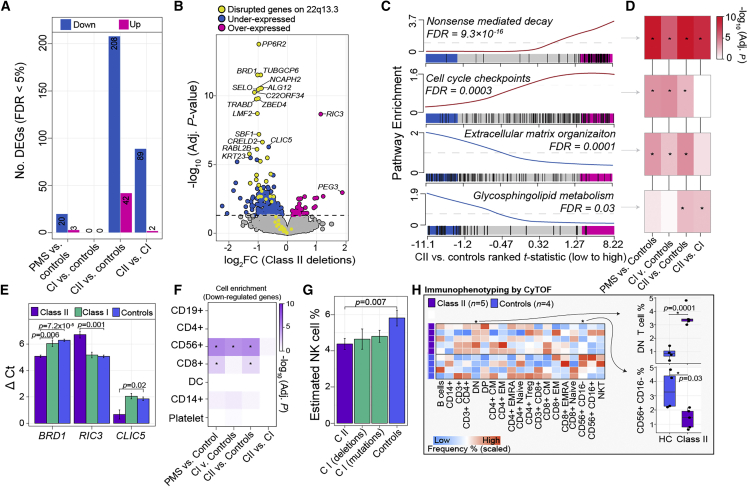
Phelan-McDermid syndrome (PMS) is a rare neurodevelopmental disorder caused at least in part by haploinsufficiency of the SHANK3 gene, due to sequence variants in SHANK3 or subtelomeric 22q13.3 deletions. Phenotypic differences have been reported between PMS participants carrying small "class I" mutations and large "class II" mutations; however, the molecular perturbations underlying these divergent phenotypes remain obscure. Using peripheral blood transcriptome and serum metabolome profiling, we examined the molecular perturbations in the peripheral circulation associated with a full spectrum of PMS genotypes spanning class I (n = 37) and class II mutations (n = 39). Transcriptomic data revealed 52 genes with blood expression profiles that tightly scale with 22q.13.3 deletion size. Furthermore, we uncover 208 underexpressed genes in PMS participants with class II mutations, which were unchanged in class I mutations. These genes were not linked to 22q13.3 and were strongly enriched for glycosphingolipid metabolism, NCAM1 interactions, and cytotoxic natural killer (NK) immune cell signatures. predictions estimated a reduction in CD56+ CD16- NK cell proportions in class II mutations, which was validated by mass cytometry time of flight. Global metabolomics profiling identified 24 metabolites that were significantly altered in PMS participants with class II mutations and confirmed a general reduction in sphingolipid metabolism. Collectively, these results provide new evidence linking PMS participants carrying class II mutations with decreased expression of cytotoxic cell signatures, reduced relative proportions of NK cells, and lower sphingolipid metabolism. These findings highlight alternative avenues for therapeutic development and offer new mechanistic insights supporting genotype-to-phenotype associations in PMS.
佩兰-麦克德米德综合征(PMS)是一种罕见的神经发育障碍,至少部分是由于 SHANK3 基因的单倍不足引起的,这是由于 SHANK3 或亚端粒 22q13.3 缺失中的序列变异。已经报道了携带小“类 I”突变和大“类 II”突变的 PMS 参与者之间的表型差异;然而,这些不同表型背后的分子扰动仍然不清楚。使用外周血转录组和血清代谢组谱分析,我们研究了与跨越 I 类(n=37)和 II 类突变(n=39)的全谱 PMS 基因型相关的外周循环中与分子扰动相关的外周血转录组和血清代谢组谱。转录组数据显示了 52 个具有与 22q.13.3 缺失大小紧密相关的血液表达谱的基因。此外,我们在携带 II 类突变的 PMS 参与者中发现了 208 个下调基因,这些基因在 I 类突变中没有改变。这些基因与 22q13.3 无关,强烈富集于糖脂代谢、NCAM1 相互作用和细胞毒性自然杀伤(NK)免疫细胞特征。预测估计 II 类突变中 CD56+CD16-NK 细胞比例降低,通过飞行时间质谱细胞术验证。全局代谢组学谱分析确定了 24 种代谢物在携带 II 类突变的 PMS 参与者中发生了显著改变,并证实了鞘脂代谢普遍降低。总的来说,这些结果提供了新的证据,将携带 II 类突变的 PMS 参与者与细胞毒性细胞特征表达降低、NK 细胞相对比例降低和鞘脂代谢降低联系起来。这些发现强调了为 PMS 治疗开发提供新的途径,并提供了支持 PMS 基因型到表型关联的新的机制见解。