Department of Experimental Oncology, European Institute of Oncology IRCCS, Milan, Italy.
Division of Cancer Prevention and Genetics, European Institute of Oncology IRCCS, Milan, Italy.
Neoplasia. 2022 Dec;34:100842. doi: 10.1016/j.neo.2022.100842. Epub 2022 Oct 22.
Several studies suggest a role of gut microbiota in colorectal cancer (CRC) initiation and progression. Vitamin D (vitD) blood levels are also inversely correlated with CRC risk and prognosis. However, these factors' interplay remains unknown.
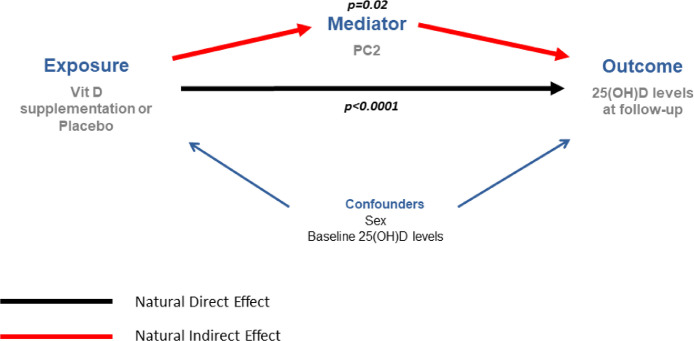
74 CRC patients after standard treatment were randomized to 1-year 2000 IU/day vitD or placebo. Baseline and post-treatment fecal microbiota for shotgun metagenomics sequencing was collected. Coda-lasso and Principal Component Analysis were used to select and summarize treatment-associated taxa and pathways. Associations between vitD and taxa/pathways were investigated with logistic regression. Mediation analysis was performed to study if treatment-associated taxa mediated the effect of supplementation on 25(OH)D levels. Cox proportional-hazards model was used for disease-free survival (DFS).
60 patients were analyzed. Change in alpha diversity (Shannon: p = 0.77; Simpson: p = 0.63) and post-treatment beta diversity (p = 0.70) were comparable between arms. Post-treatment abundances of 63 taxa and 32 pathways differed between arms. The 63 taxa also mediated the effect of supplementation on 25(OH)D (p = 0.02). There were sex differences in vitD levels, microbiota and pathways. Pathways of essential amino acids' biosynthesis were more abundant in supplemented women. Fusobacterium nucleatum presence at baseline was associated with worse DFS (p = 0.02). Those achieving vitD sufficiency (25(OH)D≥30 ng/ml) had lower post-treatment abundances (p = 0.05). Women were more likely to have F. nucleatum post-treatment (p = 0.02).
VitD supplementation may contribute shaping the gut microbiota and the microbiota may partially mediate the effect of supplementation on 25(OH)D. The observed sex-specific differences highlight the necessity of including sex/gender as a variable in microbiome studies.
多项研究表明,肠道微生物群在结直肠癌(CRC)的发生和发展中起作用。维生素 D(vitD)的血液水平也与 CRC 风险和预后呈负相关。然而,这些因素的相互作用尚不清楚。
74 例接受标准治疗的 CRC 患者随机分为 1 年 2000IU/天 vitD 或安慰剂治疗组。收集基线和治疗后粪便微生物组进行 shotgun 宏基因组测序。使用 Coda-lasso 和主成分分析(PCA)选择和总结与治疗相关的分类群和途径。使用逻辑回归分析 vitD 与分类群/途径之间的关系。进行中介分析以研究补充 vitD 是否通过治疗相关的分类群影响 25(OH)D 水平。使用 Cox 比例风险模型进行无病生存(DFS)分析。
共分析了 60 例患者。两组间的 alpha 多样性(Shannon:p=0.77;Simpson:p=0.63)和治疗后 beta 多样性(p=0.70)的变化无差异。治疗后两组间 63 个分类群和 32 个途径的丰度存在差异。63 个分类群也介导了补充 vitD 对 25(OH)D 的影响(p=0.02)。vitD 水平、微生物群和途径存在性别差异。补充 vitD 的女性中必需氨基酸生物合成途径的丰度更高。基线时存在具核梭杆菌(Fusobacterium nucleatum)与较差的 DFS 相关(p=0.02)。达到 vitD 充足状态(25(OH)D≥30ng/ml)的患者治疗后丰度较低(p=0.05)。女性更有可能在治疗后存在具核梭杆菌(p=0.02)。
vitD 补充可能有助于塑造肠道微生物群,而微生物群可能部分介导补充 vitD 对 25(OH)D 的影响。观察到的性别特异性差异突出表明,在微生物组研究中必须将性别作为一个变量纳入。