Suppakitjanusant Pichatorn, Wang Yanling, Sivapiromrat Alisa K, Hu Chengcheng, Binongo Jose, Hunt William R, Weinstein Samuel, Jathal Ishaan, Alvarez Jessica A, Chassaing Benoit, Ziegler Thomas R, Gewirtz Andrew T, Tangpricha Vin
Division of Endocrinology, Metabolism and Lipids, Department of Medicine, Emory University School of Medicine, Atlanta, GA, USA.
Faculty of Medicine Ramathibodi Hospital, Mahidol University, Bangkok, Thailand.
J Clin Transl Endocrinol. 2024 Jul 24;37:100362. doi: 10.1016/j.jcte.2024.100362. eCollection 2024 Sep.
Cystic fibrosis (CF) is a multi-organ disease caused by mutations in the cystic fibrosis transmembrane conductance regulator (CFTR). Individuals with CF often have gastrointestinal (GI) dysbiosis due to chronic inflammation and antibiotic use. Previous studies suggested a role for vitamin D in reversing the GI dysbiosis found in CF.
To explore the potential role of a combination of high-dose oral cholecalciferol (vitamin D) and fermentable dietary fiber, inulin, to impact bacterial composition, richness, and diversity of intestinal and airway microbiota in adults with CF.
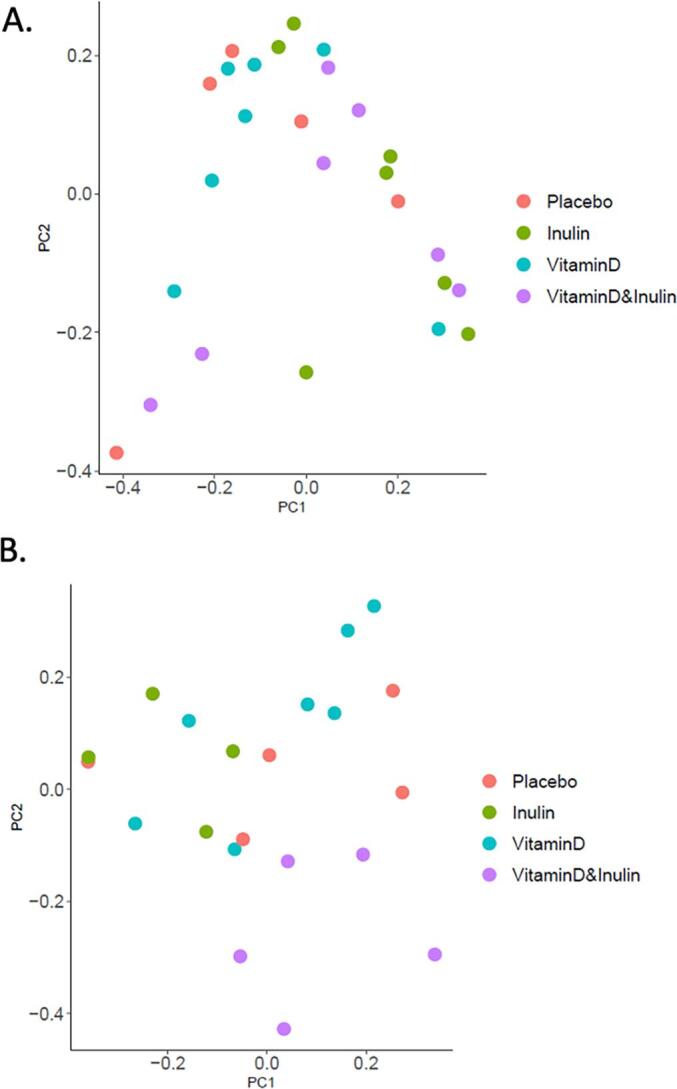
This was a 2 × 2 factorial, double-blinded, placebo-controlled, randomized, pilot clinical trial in which adults with CF received oral cholecalciferol (vitamin D) (50,000 IU/week) and/or inulin (12 g/day) for 12 weeks. Thus, there were 4 study groups (n = 10 subjects per group); 1) placebo 2) vitamin D 3) inulin 4) vitamin D plus inulin. Stool and sputum samples were collected at baseline (just before) and after the intervention and were analysed using 16S ribosomal RNA gene sequencing for gut and airway microbiota composition. Statistical analyses assessed alpha and beta diversity to evaluate microbial community changes.
Of a total of 254 screened participants, 40 eligible participants were randomized to one of the 4 treatment arms. Participants receiving vitamin D plus inulin exhibited greater changes in microbiome indexes in both intestinal and airway relative to those in the other study groups. Specific taxonomic changes supported the potential beneficial influence of this combination to mitigate both intestinal and airway dysbiosis in adults with CF.
This pilot study established that the combination of oral vitamin D and the prebiotic inulin was well tolerated over 12 weeks in adults with CF and altered gut and airway bacterial communities. Future research appear warranted to define clinical outcomes and the role of microbiota changes therein with this approach.
囊性纤维化(CF)是一种由囊性纤维化跨膜传导调节因子(CFTR)突变引起的多器官疾病。由于慢性炎症和抗生素的使用,CF患者常出现胃肠道(GI)生态失调。先前的研究表明维生素D在逆转CF患者的胃肠道生态失调中发挥作用。
探讨高剂量口服胆钙化醇(维生素D)与可发酵膳食纤维菊粉联合使用对成年CF患者肠道和气道微生物群的细菌组成、丰富度和多样性的潜在影响。
这是一项2×2析因、双盲、安慰剂对照、随机的试点临床试验,成年CF患者接受口服胆钙化醇(维生素D)(50,000 IU/周)和/或菊粉(12 g/天),持续12周。因此,有4个研究组(每组n = 10名受试者);1)安慰剂 2)维生素D 3)菊粉 4)维生素D加菊粉。在基线(干预前)和干预后收集粪便和痰液样本,并使用16S核糖体RNA基因测序分析肠道和气道微生物群组成。统计分析评估α和β多样性以评估微生物群落变化。
在总共254名筛查参与者中,40名符合条件的参与者被随机分配到4个治疗组之一。相对于其他研究组,接受维生素D加菊粉的参与者在肠道和气道中的微生物组指数变化更大。特定的分类学变化支持了这种联合用药对减轻成年CF患者肠道和气道生态失调的潜在有益影响。
这项试点研究表明,口服维生素D和益生元菊粉的联合用药在成年CF患者中12周内耐受性良好,并改变了肠道和气道细菌群落。未来的研究似乎有必要确定临床结果以及这种方法中微生物群变化在其中的作用。