Department of Epidemiology and Biostatistics, School of Public Health, Imperial College London, London, UK.
Department of Nutrition, Bjørknes University College, Oslo, Norway.
Int J Cancer. 2023 Feb 15;152(4):616-634. doi: 10.1002/ijc.34321. Epub 2022 Oct 24.
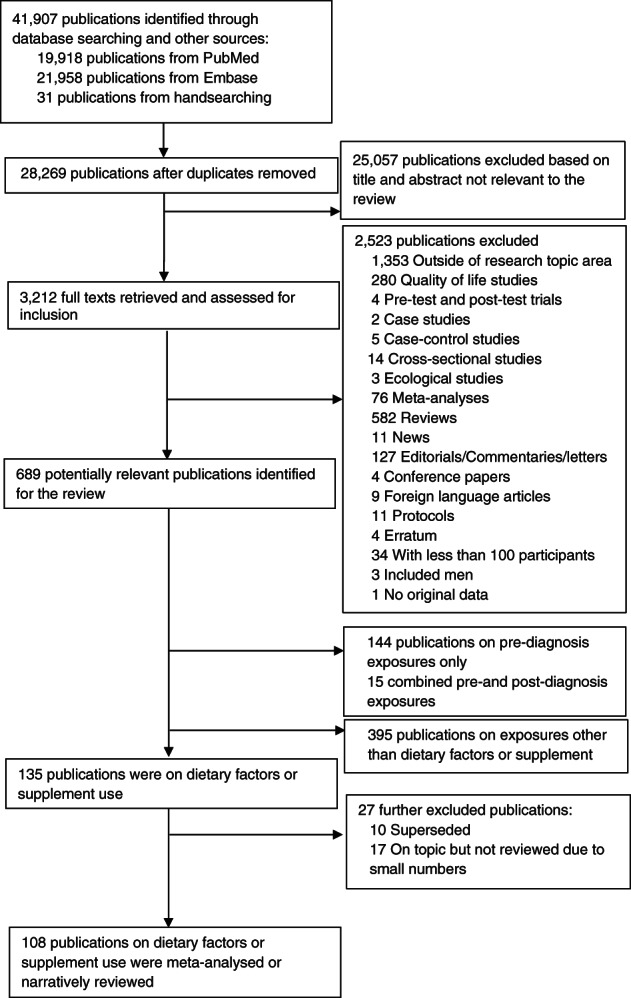
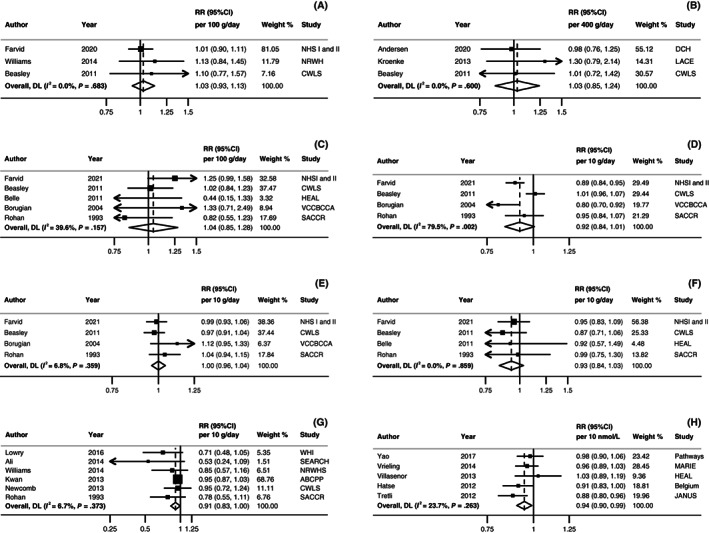
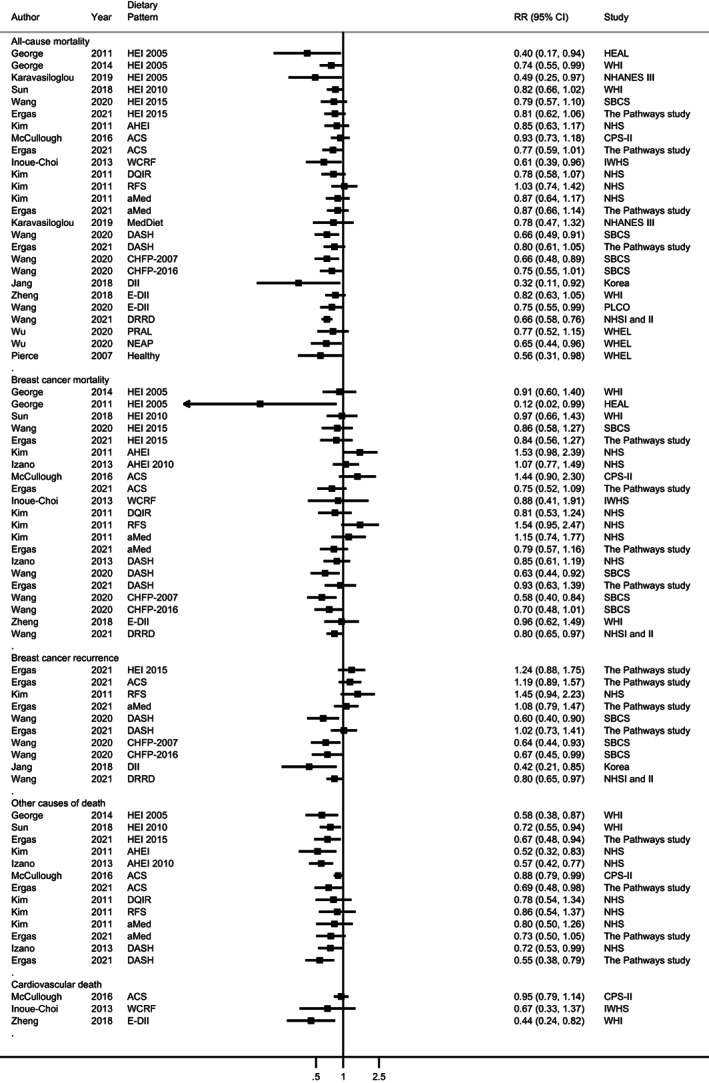
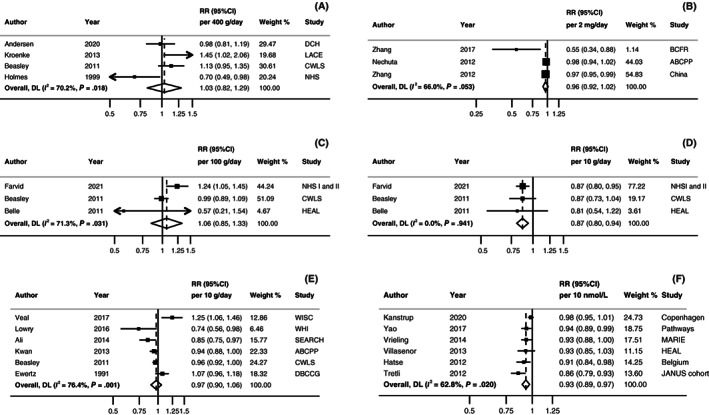
Little is known about how diet might influence breast cancer prognosis. The current systematic reviews and meta-analyses summarise the evidence on postdiagnosis dietary factors and breast cancer outcomes from randomised controlled trials and longitudinal observational studies. PubMed and Embase were searched through 31st October 2021. Random-effects linear dose-response meta-analysis was conducted when at least three studies with sufficient information were available. The quality of the evidence was evaluated by an independent Expert Panel. We identified 108 publications. No meta-analysis was conducted for dietary patterns, vegetables, wholegrains, fish, meat, and supplements due to few studies, often with insufficient data. Meta-analysis was only possible for all-cause mortality with dairy, isoflavone, carbohydrate, dietary fibre, alcohol intake and serum 25-hydroxyvitamin D (25(OH)D), and for breast cancer-specific mortality with fruit, dairy, carbohydrate, protein, dietary fat, fibre, alcohol intake and serum 25(OH)D. The results, with few exceptions, were generally null. There was limited-suggestive evidence that predefined dietary patterns may reduce the risk of all-cause and other causes of death; that isoflavone intake reduces the risk of all-cause mortality (relative risk (RR) per 2 mg/day: 0.96, 95% confidence interval (CI): 0.92-1.02), breast cancer-specific mortality (RR for high vs low: 0.83, 95% CI: 0.64-1.07), and recurrence (RR for high vs low: 0.75, 95% CI: 0.61-0.92); that dietary fibre intake decreases all-cause mortality (RR per 10 g/day: 0.87, 95% CI: 0.80-0.94); and that serum 25(OH)D is inversely associated with all-cause and breast cancer-specific mortality (RR per 10 nmol/L: 0.93, 95% CI: 0.89-0.97 and 0.94, 95% CI: 0.90-0.99, respectively). The remaining associations were graded as limited-no conclusion.
关于饮食如何影响乳腺癌预后,人们知之甚少。目前的系统评价和荟萃分析总结了来自随机对照试验和纵向观察研究的诊断后饮食因素与乳腺癌结局的证据。通过 PubMed 和 Embase 检索至 2021 年 10 月 31 日。当至少有 3 项具有足够信息的研究可用时,进行了随机效应线性剂量反应荟萃分析。证据质量由独立的专家小组进行评估。我们确定了 108 篇出版物。由于研究较少且数据通常不足,因此无法对饮食模式、蔬菜、全谷物、鱼、肉和补充剂进行荟萃分析。仅对全因死亡率进行了乳制品、异黄酮、碳水化合物、膳食纤维、酒精摄入量和血清 25-羟维生素 D(25(OH)D)的荟萃分析,对乳腺癌特异性死亡率进行了水果、乳制品、碳水化合物、蛋白质、膳食脂肪、纤维、酒精摄入量和血清 25-羟维生素 D 的荟萃分析。除了少数例外,结果通常都是无效的。有有限的提示性证据表明,预先确定的饮食模式可能降低全因死亡和其他原因死亡的风险;异黄酮摄入降低全因死亡率(每 2 毫克/天的相对风险(RR):0.96,95%置信区间(CI):0.92-1.02),乳腺癌特异性死亡率(高 vs 低的 RR:0.83,95%CI:0.64-1.07)和复发(高 vs 低的 RR:0.75,95%CI:0.61-0.92);膳食纤维摄入量降低全因死亡率(每天 10 克 RR:0.87,95%CI:0.80-0.94);血清 25(OH)D 与全因和乳腺癌特异性死亡率呈负相关(每 10 纳摩尔/升的 RR:0.93,95%CI:0.89-0.97 和 0.94,95%CI:0.90-0.99,分别)。其余关联被评为有限-无结论。