Department of Genetics and Animal Breeding, Poznan University of Life Sciences, Wolynska 33, 60-637, Poznan, Poland.
Department of Preclinical Sciences and Infectious Diseases, Poznan University of Life Sciences, Poznan, Poland.
Sci Rep. 2022 Oct 24;12(1):17807. doi: 10.1038/s41598-022-21718-y.
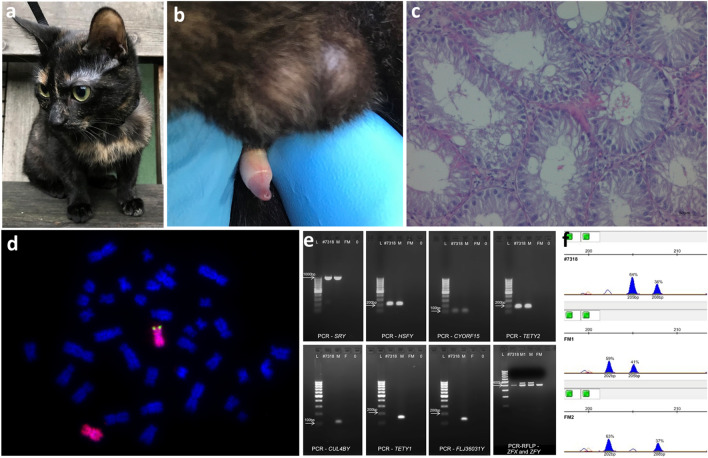
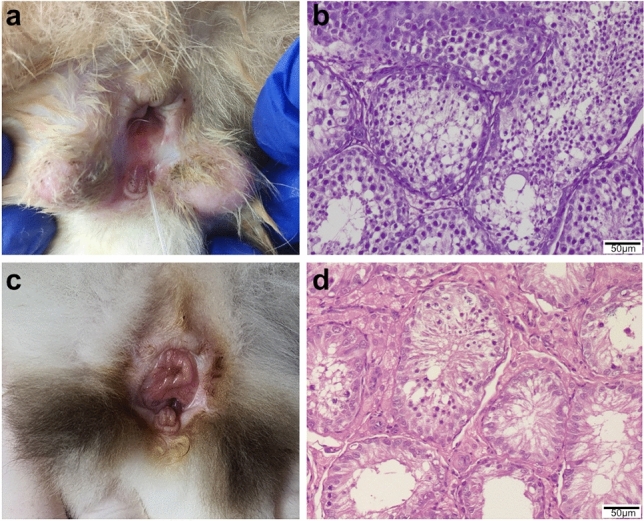
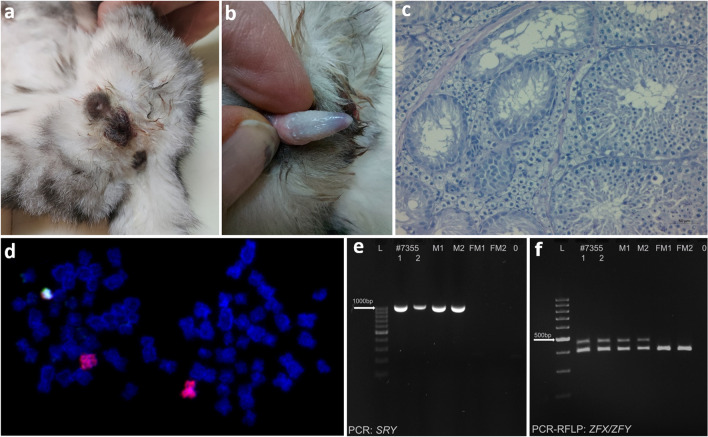
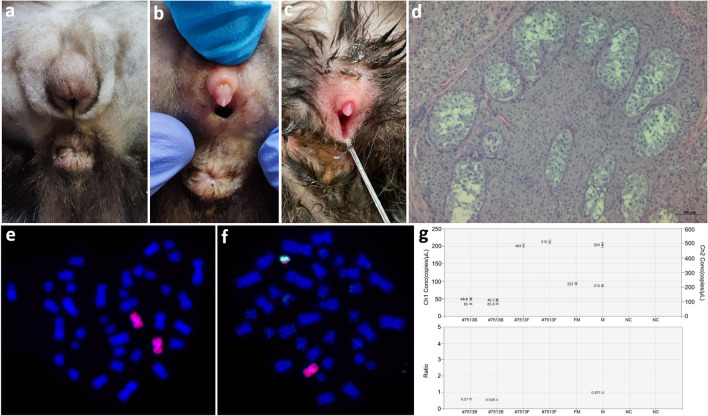
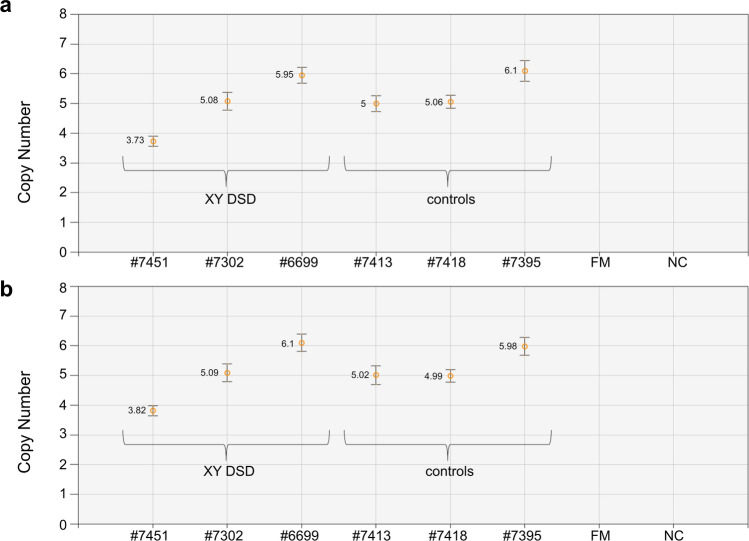
The genetic background of feline disorders of sex development (DSDs) is poorly understood. We performed comprehensive cytogenetic, molecular, and histological studies of 17 cats with abnormal external genitalia, unusual behavior, or tricolor coats (atypical in males). The DSD phenotype of three cats was associated with sex chromosome abnormalities: X/Y translocation (38,XX), 37,X/38,XY mosaicism, and XX/XY leukocyte chimerism. The remaining 14 affected cats were classified as XY DSD (SRY-positive). In this group and 38 normal males, we analyzed a priori selected candidate genes (SRY, TAC3, CYP11B1 and LHCGR). Only a previously reported nonpathogenic variant was found in SRY. Moreover, SRY gene copy number was determined, and three variants were observed: 6, 5 (modal), and 4 copies in a single DSD case. The known variants in TAC3 and CYP11B1, responsible for testicular hypoplasia, persistent primary dentition or congenital adrenal hyperplasia, were not found in the study group. Nine novel polymorphisms were identified in the LHCGR gene, one of which, a potentially regulatory indel variant in 5'UTR, was significantly associated (p = 0.0467) with XY DSD. Our report confirmed that abnormalities of sex chromosomes are important causes of feline DSDs. We also showed that the indel variant of LHCGR can be considered a promising marker associated with XY DSD phenotype.
猫科动物性别发育障碍(DSD)的遗传背景知之甚少。我们对 17 只具有异常外部生殖器、异常行为或三色被毛(雄性异常)的猫进行了全面的细胞遗传学、分子和组织学研究。三只有 DSD 表型的猫与性染色体异常有关:X/Y 易位(38,XX)、37,X/38,XY 嵌合体和 XX/XY 白细胞嵌合体。其余 14 只受影响的猫被归类为 XY DSD(SRY 阳性)。在这组和 38 只正常雄性中,我们分析了预先选择的候选基因(SRY、TAC3、CYP11B1 和 LHCGR)。仅在 SRY 中发现了一个先前报道的非致病性变异。此外,还确定了 SRY 基因拷贝数,观察到三种变体:单个 DSD 病例中的 6、5(模态)和 4 个拷贝。在研究组中未发现导致睾丸发育不全、持续乳牙或先天性肾上腺增生的 TAC3 和 CYP11B1 中的已知变异。在 LHCGR 基因中发现了 9 个新的多态性,其中一个 5'UTR 中的潜在调节缺失变异与 XY DSD 显著相关(p=0.0467)。我们的报告证实,性染色体异常是猫科动物 DSD 的重要原因。我们还表明,LHCGR 的插入缺失变体可以被认为是与 XY DSD 表型相关的有前途的标记。