Department of Pathobiology, Ontario Veterinary College, University of Guelph, Guelph, Ontario, N1G 2W1, Canada.
J Feline Med Surg. 2022 Mar;24(3):257-265. doi: 10.1177/1098612X221079711.
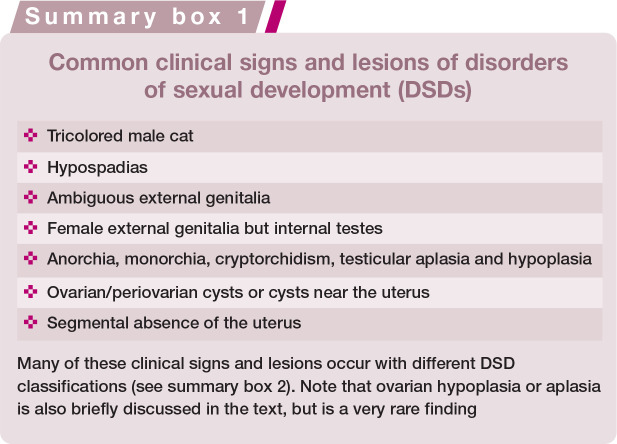
Any congenital or developmental abnormality of any part of the male or female reproductive tract is a 'disorder of sexual development' (DSD). The tricolored male cat phenotype, cryptorchidism, gonadal hypoplasia and incidental abnormalities such as cystic remnants or embryonic ducts are well-known feline DSDs.
Full characterization of DSDs requires sex chromosome determination and identification of genes related to development of the gonads, internal tubular genitalia and external genitalia. Fortunately, affected cats are seen sporadically and the clinical effects are usually minimal.
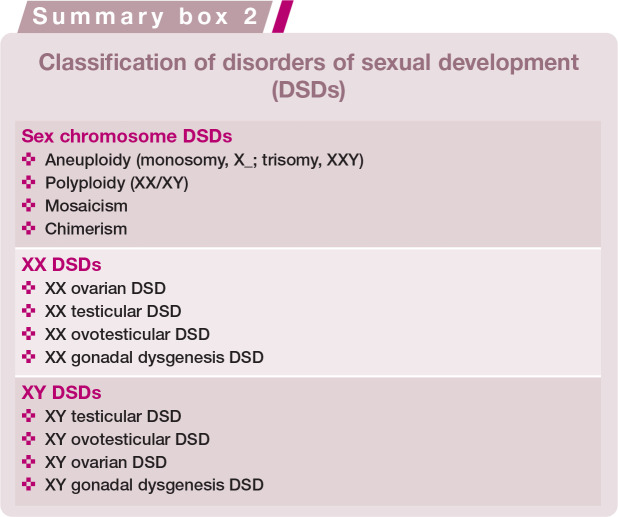
The classification nomenclature has changed. In place of intersex, hermaphrodite, pseudohermaphrodite and sex reversal, the newer standard classification, based on sex chromosomes, designates sex chromosome DSD when there is an abnormality in the sex chromosomes, and XX (female) and XY (male) DSDs where there is not. Identification of the gonadal type (testes, ovaries, ovotestes or gonadal dysgenesis) and documentation of the internal and external genital components completes the classification.
The original basis of the DSD classification was a consensus reached in humans. It was quickly accepted in veterinary pathology, courtesy of its logic and ease of application, and it has subsequently begun to appear in peer-reviewed papers and clinical reviews. This article reviewing the various disorders in cats is based on application of the classification and draws on the feline peer-reviewed literature encompassing chromosome analysis and definition of reproductive abnormalities, syndromes and diseases.
男性或女性生殖管道任何部分的先天性或发育性异常都是“性发育障碍”(DSD)。三色公猫表型、隐睾、性腺发育不良以及偶然出现的异常,如囊性残余物或胚胎导管,都是众所周知的猫科 DSD。
全面描述 DSD 需要确定性染色体并鉴定与性腺、内部管状生殖器官和外部生殖器发育相关的基因。幸运的是,受影响的猫是零星出现的,临床影响通常很小。
分类命名法已经改变。取代两性畸形、雌雄同体、假两性畸形和性别反转,基于性染色体的新标准分类,当性染色体异常时指定性染色体 DSD,而当性染色体正常时指定 XX(女性)和 XY(男性)DSD。鉴定性腺类型(睾丸、卵巢、卵睾或性腺发育不良)和记录内部和外部生殖器成分完成分类。
DSD 分类的最初基础是在人类中达成的共识。由于其逻辑和易于应用,它很快在兽医病理学中得到了认可,并且随后开始出现在同行评审的论文和临床评论中。这篇综述猫科动物各种疾病的文章基于该分类的应用,并借鉴了涵盖染色体分析和生殖异常、综合征和疾病定义的猫科同行评审文献。