Ojha Pooja, Malhotra Varun
All India Institute of Medical Sciences, Jodhpur, Rajasthan, India.
Era's Lucknow Medical College, Lucknow, Uttar Pradesh, India.
Neurol Res Int. 2022 Oct 15;2022:8219254. doi: 10.1155/2022/8219254. eCollection 2022.
Chronic migraine, being a debilitating headache disorder, needs assessment of the risk factors implicated in its occurrence. We investigated the potential role of obesity as a risk for chronic migraine in premenopausal females with episodic migraine.
In this analytical study, body fat% was compared between episodic and chronic migraine patient groups. The standard criteria of the international classification of headache disorder were used for the diagnosis. Demographic data, clinical details of migraine, and anthropometric measurements were collected using structured questions and standardized techniques. Pearson's correlation () was estimated to assess the concordance between body fat% and migraine frequency. High body fat%'s implication on chronic migraine which was adjusted for body mass index (BMI), and the use of oral contraceptives was determined using logistic regression analysis.
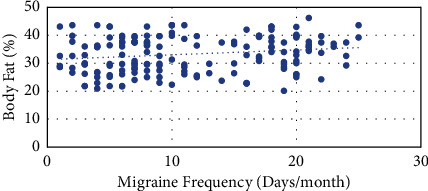
A total of 168 premenopausal female migraineurs, with a mean (Standard deviation) age of 33.0 (±9.0) years, were enrolled in the study. BMI and high body fat% were significantly associated with chronic migraine ( < 0.05). There was a weak positive, but significant, correlation between body fat% and migraine frequency ( = 0.185, < 0.017). The presence of high body fat was found to increase the risk of chronic migraine by 2.8 times (confidence interval 1.4-5.6; < 0.003).
The amount of fat mass in the body relates to the clinical characteristics of migraine. There is an increased risk of developing chronic migraine in patients having high body fat. Weight control measures can be targeted for the prevention of migraine worsening.
慢性偏头痛是一种使人衰弱的头痛疾病,需要对其发病相关的危险因素进行评估。我们调查了肥胖作为发作性偏头痛的绝经前女性患慢性偏头痛风险因素的潜在作用。
在这项分析性研究中,比较了发作性和慢性偏头痛患者组的体脂百分比。采用国际头痛疾病分类的标准标准进行诊断。使用结构化问题和标准化技术收集人口统计学数据、偏头痛的临床细节和人体测量数据。估计皮尔逊相关性()以评估体脂百分比与偏头痛频率之间的一致性。使用逻辑回归分析确定经体重指数(BMI)和口服避孕药调整后的高体脂百分比对慢性偏头痛的影响。
共有168名绝经前女性偏头痛患者纳入研究,平均(标准差)年龄为33.0(±9.0)岁。BMI和高体脂百分比与慢性偏头痛显著相关(<0.05)。体脂百分比与偏头痛频率之间存在微弱的正相关,但具有显著性(=0.185,<0.017)。发现高体脂会使慢性偏头痛的风险增加2.8倍(置信区间1.4 - 5.6;<0.003)。
体内脂肪量与偏头痛的临床特征有关。高体脂患者患慢性偏头痛的风险增加。可以针对体重控制措施来预防偏头痛恶化。