Skrabic Roko, Kumric Marko, Vrdoljak Josip, Rusic Doris, Skrabic Ivna, Vilovic Marino, Martinovic Dinko, Duplancic Vid, Ticinovic Kurir Tina, Bozic Josko
Department of Nephrology, University Hospital of Split, 21000 Split, Croatia.
Department of Pathophsiology, University of Split School of Medicine, 21000 Split, Croatia.
Biomedicines. 2022 Oct 1;10(10):2458. doi: 10.3390/biomedicines10102458.
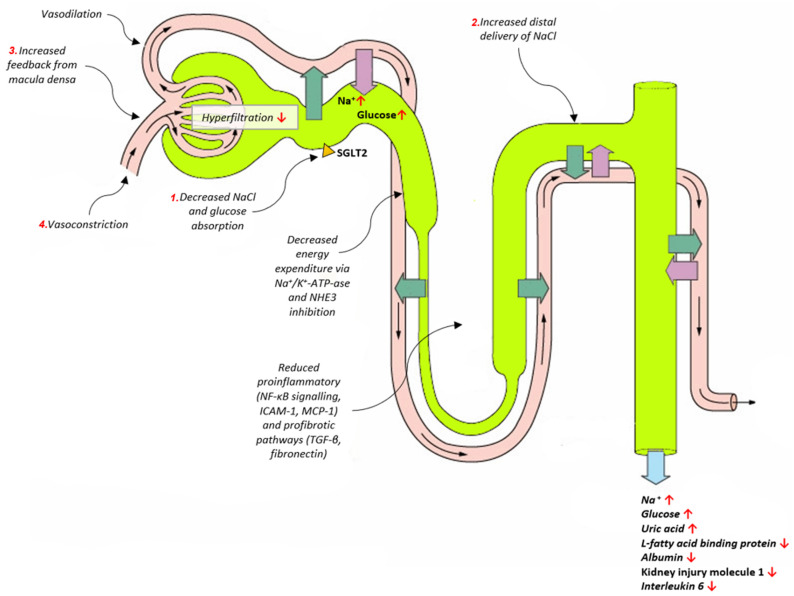
In recent years, sodium-glucose co-transporter 2 inhibitors (SGLT2i) have demonstrated beneficial renoprotective effects, which culminated in the recent approval of their use for patients with chronic kidney disease (CKD), following a similar path to one they had already crossed due to their cardioprotective effects, meaning that SGLT2i represent a cornerstone of heart failure therapy. In the present review, we aimed to discuss the pathophysiological mechanisms operating in CKD that are targeted with SGLT2i, either directly or indirectly. Furthermore, we presented clinical evidence of SGLT2i in CKD with respect to the presence of diabetes mellitus. Despite initial safety concerns with regard to euglycemic diabetic ketoacidosis and transient decline in glomerular filtration rate, the accumulating clinical data are reassuring. In summary, although SGLT2i provide clinicians with an exciting new treatment option for patients with CKD, further research is needed to determine which subgroups of patients with CKD will benefit the most, and which the least, from this therapeutical option.
近年来,钠-葡萄糖协同转运蛋白2抑制剂(SGLT2i)已显示出有益的肾脏保护作用,这最终促成了它们最近被批准用于慢性肾脏病(CKD)患者,其过程与它们因心脏保护作用而走过的类似路径相同,这意味着SGLT2i是心力衰竭治疗的基石。在本综述中,我们旨在讨论在CKD中起作用的、直接或间接成为SGLT2i作用靶点的病理生理机制。此外,我们还介绍了SGLT2i在合并糖尿病的CKD患者中的临床证据。尽管最初对正常血糖性糖尿病酮症酸中毒和肾小球滤过率短暂下降存在安全担忧,但不断积累的临床数据令人安心。总之,虽然SGLT2i为CKD患者提供了一个令人兴奋的新治疗选择,但仍需要进一步研究以确定哪些CKD患者亚组将从这种治疗选择中获益最大,哪些获益最小。