Institute of Cosmetic Regulatory Science and College of Chemistry and Materials Engineering, Beijing Technology and Business University, Beijing 100048, China.
College of Chemistry and Materials Engineering, Beijing Technology and Business University, Beijing 100029, China.
Biosensors (Basel). 2022 Sep 20;12(10):779. doi: 10.3390/bios12100779.
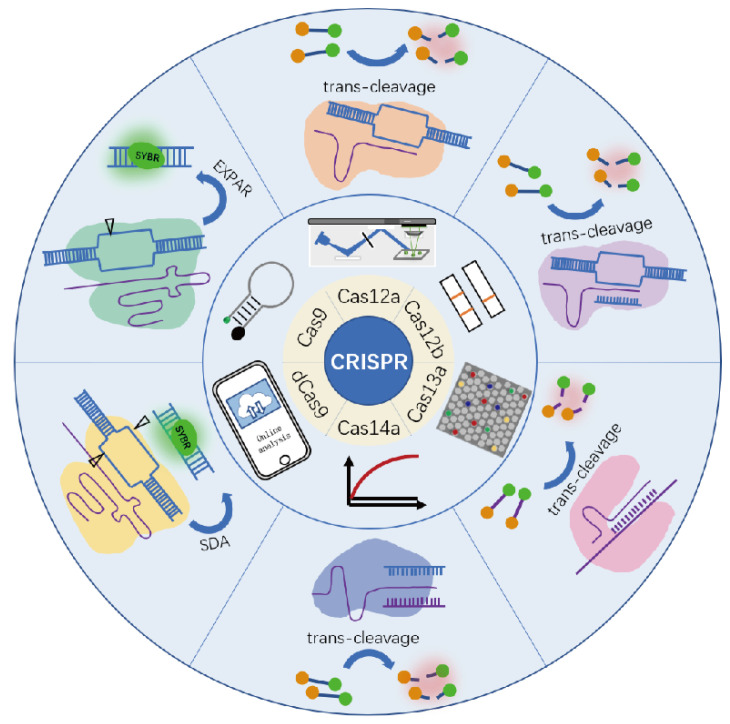
The CRISPR/Cas system is now being used extensively in nucleic acid detection applications, particularly after the trans-cleavage activity of several Cas effectors was found. A CRISPR/Cas system combined with multiple signal-readout techniques has been developed for various molecular diagnostics applications. Fluorescence is now a widely utilized dominant read-out technique in CRISPR biosensors. An in-depth understanding of various fluorescence readout types and variables affecting the fluorescence signals can facilitate better experimental designs to effectively improve the analytical performance. There are the following two commonly used types of CRISPR/Cas detection modes: the first is based on binding activity, such as Cas9 and dCas9; the second is based on cleavage activity, such as Cas12a, Cas12b, Cas13, and Cas14. In this review, fluorescence signal-readout strategies from the last 5 years based on the binding activity and cleavage activity of the CRISPR/Cas system with fundamentals and examples are fully discussed. A detailed comparison of the available fluorescent reporter sequences and design principles is summarized. Current challenges and further applications of CRISPR-based detection methods will be discussed according to the most recent developments.
CRISPR/Cas 系统现在被广泛应用于核酸检测应用中,特别是在发现几种 Cas 效应蛋白的转切割活性之后。CRISPR/Cas 系统与多种信号读取技术相结合,已经应用于各种分子诊断应用。荧光现在是 CRISPR 生物传感器中广泛使用的主要读出技术。深入了解各种荧光读出类型和影响荧光信号的变量,可以有助于更好的实验设计,从而有效地提高分析性能。目前有两种常用的 CRISPR/Cas 检测模式:第一种是基于结合活性的,例如 Cas9 和 dCas9;第二种是基于切割活性的,例如 Cas12a、Cas12b、Cas13 和 Cas14。在这篇综述中,充分讨论了基于 CRISPR/Cas 系统的结合活性和切割活性的荧光信号读出策略,包括基本原理和实例。总结了可用荧光报告序列和设计原则的详细比较。根据最新的发展情况,讨论了基于 CRISPR 的检测方法的当前挑战和进一步的应用。