Numbi Muya Gloria Marceline, Mutiaka Bienvenu Kambashi, Bindelle Jérôme, Francis Frédéric, Caparros Megido Rudy
Functional and Evolutionary Entomology, Gembloux Agro-Bio Tech, University of Liege, Passage des Déportés 2, 5030 Gembloux, Belgium.
Department of Zootechnics, University of Kinshasa, Kimwenza Road No. 01, Commune of Lemba, Kinshasa 012, Democratic Republic of the Congo.
Insects. 2022 Sep 29;13(10):886. doi: 10.3390/insects13100886.
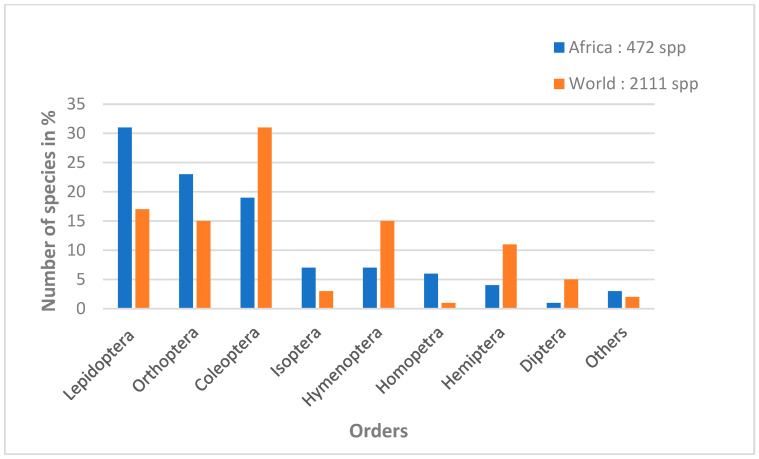
There are 472 edible insect species in sub-Saharan Africa, of which 31% are Lepidoptera. Wild harvesting is still the main source of supply for these prized species to this day, with some harvesting techniques negatively impacting the environment. The successful production of edible caterpillars requires the appropriate and efficient implementation of husbandry techniques and practices. In this review, we present current literature on edible caterpillars. We provide a general overview of their life history, nutritional composition, and availability associated with specific host plants, with emphasis on semi-domestication and rearing practices that should replace wild harvest. Based on the assimilated information, a proposal of potential species for farming is provided, with details on key characteristics of development cycles to promote the establishment and development of sustainable farms of edible caterpillars at small and large scales. Such advances would contribute toward reducing anthropological pressure related to the exploitation of these food resources, as well as the environmental footprint of this widespread practice.
撒哈拉以南非洲有472种可食用昆虫,其中31% 是鳞翅目昆虫。时至今日,野生采集仍是这些珍贵昆虫物种的主要供应来源,一些采集技术对环境产生了负面影响。成功生产可食用毛虫需要适当且高效地实施饲养技术和实践。在这篇综述中,我们展示了关于可食用毛虫的现有文献。我们概述了它们的生活史、营养成分以及与特定寄主植物相关的可得性,重点介绍了应取代野生采集的半驯化和饲养实践。基于所吸收的信息,提供了一份养殖潜在物种的提议,并详细说明了发育周期的关键特征,以促进小规模和大规模可食用毛虫可持续养殖场的建立和发展。这些进展将有助于减轻与这些食物资源开发相关的人为压力,以及这种广泛做法对环境的影响。