
非洲孕产妇死亡率:区域趋势(2000-2017 年)。
Maternal Mortality in Africa: Regional Trends (2000-2017).
机构信息
School of Health Sciences, Catholic University of Central Africa, Yaoundé 1110, Cameroon.
Epidemiology and Public Health Program, Department of Surgery, Medical and Social Sciences, University of Alcala de Henares, 28801 Madrid, Spain.
出版信息
Int J Environ Res Public Health. 2022 Oct 12;19(20):13146. doi: 10.3390/ijerph192013146.
BACKGROUND
United Nations Sustainable Development Goals state that by 2030, the global maternal mortality rate (MMR) should be lower than 70 per 100,000 live births. MMR is still one of Africa's leading causes of death among women. The leading causes of maternal mortality in Africa are hemorrhage and eclampsia. This research aims to study regional trends in maternal mortality (MM) in Africa.
METHODS
We extracted data for maternal mortality rates per 100,000 births from the United Nations Children's Fund (UNICEF) databank from 2000 to 2017, 2017 being the last date available. Joinpoint regression was used to study the trends and estimate the annual percent change (APC).
RESULTS
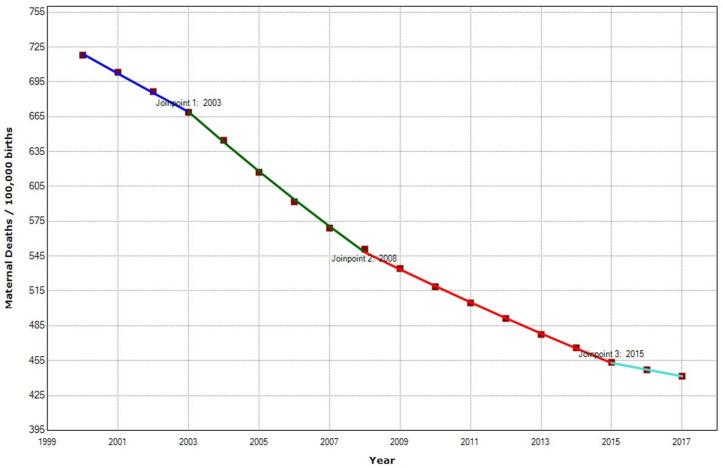
Maternal mortality has decreased in Africa over the study period by an average APC of -3.0% (95% CI -2.9; -3,2%). All regions showed significant downward trends, with the greatest decreases in the South. Only the North African region is close to the United Nations' sustainable development goals for Maternal mortality. The remaining Sub-Saharan African regions are still far from achieving the goals.
CONCLUSIONS
Maternal mortality has decreased in Africa, especially in the South African region. The only region close to the United Nations' target is the North African region. The remaining Sub-Saharan African regions are still far from achieving the goals. The West African region needs more extraordinary efforts to achieve the goals of the United Nations. Policies should ensure that all pregnant women have antenatal visits and give birth in a health facility staffed by specialized personnel.
背景
联合国可持续发展目标指出,到 2030 年,全球孕产妇死亡率(MMR)应低于每 10 万活产儿 70 例。孕产妇死亡率仍然是非洲女性死亡的主要原因之一。非洲孕产妇死亡的主要原因是出血和子痫。本研究旨在研究非洲孕产妇死亡率(MM)的区域趋势。
方法
我们从联合国儿童基金会(UNICEF)数据库中提取了 2000 年至 2017 年每 10 万例活产儿的孕产妇死亡率数据,2017 年是可获得的最后一年。使用 Joinpoint 回归分析来研究趋势并估计年平均变化百分比(APC)。
结果
在研究期间,非洲的孕产妇死亡率呈平均下降趋势,APC 为-3.0%(95%CI -2.9;-3.2%)。所有地区均呈显著下降趋势,南部地区降幅最大。只有北非地区接近联合国孕产妇死亡率可持续发展目标。其余撒哈拉以南非洲地区仍远未实现这些目标。
结论
非洲的孕产妇死亡率有所下降,特别是在南非地区。只有北非地区接近联合国的目标。其余撒哈拉以南非洲地区仍远未实现这些目标。西非地区需要更加努力才能实现联合国的目标。政策应确保所有孕妇都能进行产前检查,并在有专业人员配备的卫生机构分娩。




 Zotero 插件