
中国女性初婚的量子与节奏。
On the Quantum and Tempo of Women First Marriages in China.
机构信息
Institute for Population and Development Studies, School of Public Policy and Administration, Xi'an Jiaotong University, Xi'an 710049, China.
INRS-Urbanization Culture Society Research Centre, Montreal, QC H2X 1E3, Canada.
出版信息
Int J Environ Res Public Health. 2022 Oct 15;19(20):13312. doi: 10.3390/ijerph192013312.
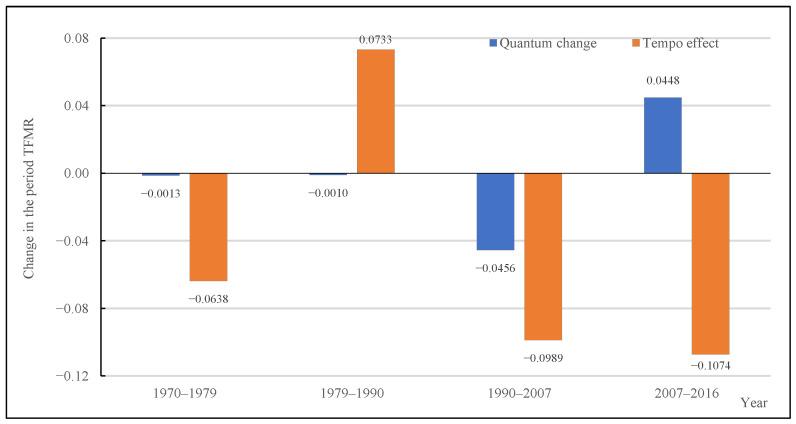
The total first marriage rate (TFMR) of Chinese women shows a downward trend in fluctuations from 1970 to 2016, but it is affected by the tempo distortion caused by changes in the mean age at first marriage. Thus, we compare the total first marriage rate (TFMR) and tempo-adjusted period proportion ever married (PPEM*) to estimate the extent to which the TFMR is affected by tempo effects. We also decompose the women's TFMR change into its quantum and tempo components from 1970 to 2016 to analyze how much of the changes in TFMR are due to the quantum changes and how much of it is caused by tempo effects. The results show that the tempo effects have had a persistent influence on the period TFMR of Chinese women from 1970 to 2016. The recent decline in the TFMR in Chinese women is mainly due to the first marriage delay, not signaling a retreat from universal marriage.
中国女性的初婚总率(TFMR)在 1970 年至 2016 年期间呈波动下降趋势,但受到初婚平均年龄变化引起的时距扭曲的影响。因此,我们比较了初婚总率(TFMR)和时距调整的有偶比例(PPEM*),以估计 TFMR 受时距效应影响的程度。我们还将女性的 TFMR 变化从 1970 年到 2016 年分解为其数量和时距组成部分,以分析 TFMR 的变化中有多少是由于数量变化引起的,有多少是由于时距效应引起的。结果表明,从 1970 年到 2016 年,时距效应一直对中国女性的时期 TFMR 产生持续影响。中国女性 TFMR 的近期下降主要是由于初婚延迟,而不是普遍婚姻的倒退。


 Zotero 插件