Leal Rita, Pardinhas Clara, Martinho António, Sá Helena Oliveira, Figueiredo Arnaldo, Alves Rui
Nephrology Department, Centro Hospitalar e Universitário de Coimbra, 3000-548 Coimbra, Portugal.
Faculty of Medicine, University of Coimbra, 3004-531 Coimbra, Portugal.
J Clin Med. 2022 Oct 17;11(20):6108. doi: 10.3390/jcm11206108.
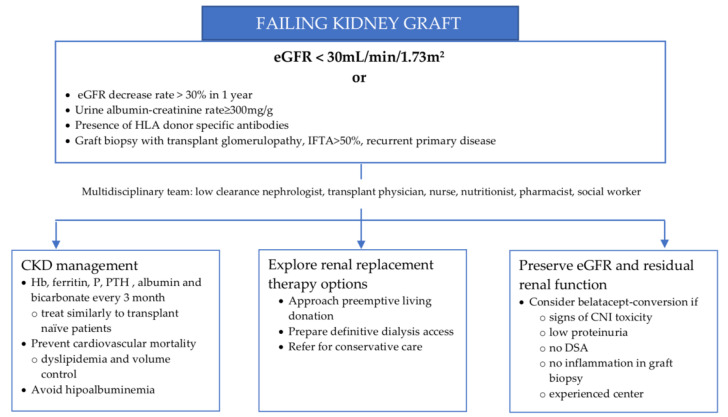
Patients with a failed kidney allograft have steadily increase in recent years and returning to dialysis after graft loss is one of the most difficult transitions for chronic kidney disease patients and their assistant physicians. The management of these patients is complex and encompasses the treatment of chronic kidney disease complications, dialysis restart and access planning, immunosuppression withdrawal, graft nephrectomy, and evaluation for a potential retransplant. In recent years, several groups have focused on the management of the patient with a failing renal graft and expert recommendations are arising. A review of Pubmed, ScienceDirect and the Cochrane Library was performed focusing on the specific care of these patients, from the management of low clearance complications to concerns with a subsequent kidney transplant. Conclusion: There is a growing interest in the failing renal graft and new approaches to improve these patients' outcomes are being defined including specific multidisciplinary programs, individualized immunosuppression withdrawal schemes, and strategies to prevent HLA sensitization and increase retransplant rates.
近年来,肾移植失败患者的数量持续增加,移植肾失功后重新开始透析是慢性肾病患者及其辅助医生面临的最困难的转变之一。这些患者的管理很复杂,包括慢性肾病并发症的治疗、透析重新开始及通路规划、免疫抑制的撤减、移植肾切除术以及潜在再次移植的评估。近年来,多个团队专注于移植肾功能衰竭患者的管理,专家建议也不断涌现。我们检索了PubMed、ScienceDirect和Cochrane图书馆,重点关注这些患者的特殊护理,从低清除率并发症的管理到后续肾移植的相关问题。结论:对于移植肾功能衰竭的关注度日益增加,正在确定改善这些患者预后的新方法,包括特定的多学科项目、个性化免疫抑制撤减方案以及预防HLA致敏和提高再次移植率的策略。