
用于高温质子交换膜燃料电池应用的基于咔唑聚苯并咪唑(PBI-O-PhT)的膜,由聚聚苯并咪唑电纺纳米纤维毡增强。
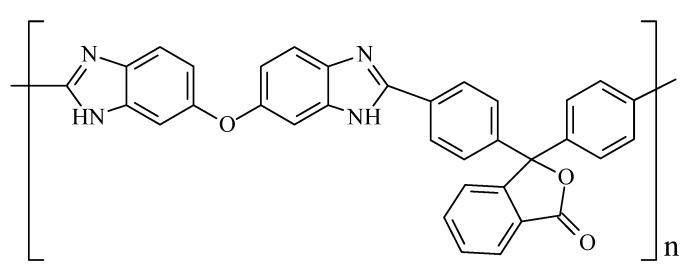
Cardo Polybenzimidazole (PBI-O-PhT) Based Membrane Reinforced with -polybenzimidazole Electrospun Nanofiber Mat for HT-PEM Fuel Cell Applications.
作者信息
Ponomarev Igor I, Skupov Kirill M, Modestov Alexander D, Lysova Anna A, Ponomarev Ivan I, Vtyurina Elizaveta S
机构信息
A.N. Nesmeyanov Institute of Organoelement Compounds of Russian Academy of Sciences, Vavilova St., 28, bld. 1, 119334 Moscow, Russia.
A.N. Frumkin Institute of Physical Chemistry and Electrochemistry of Russian Academy of Sciences, Leninsky Av., 31, bld. 4., 119071 Moscow, Russia.
出版信息
Membranes (Basel). 2022 Sep 29;12(10):956. doi: 10.3390/membranes12100956.
The further development of high temperature polymer electrolyte membrane (HT-PEM) fuel cells largely depends on the improvement of all components of the membrane-electrode assembly (MEA), especially membranes and electrodes. To improve the membrane characteristics, the cardo-polybenzimidazole (PBI-O-PhT)-based polymer electrolyte complex doped with phosphoric acid is reinforced using an electrospun -PBI mat. As a result, the PBI-O-PhT/es--PBI · nHPO reinforced membrane is obtained with hydrogen crossover values (0.2 mA cm atm), one order of magnitude lower than the one of the initial PBI-O-PhT membrane (3 mA cm atm) during HT-PEM fuel cell operation with CeltecP1000 electrodes at 180 °C. Just as importantly, the reinforced membrane resistance was very close to the original one (65-75 mΩ cm compared to ~60 mΩ cm). A stress test that consisted of 20 start-stops, which included cooling to the room temperature and heating back to 180 °C, was applied to the MEAs with the reinforced membrane. More stable operation for the HT-PEM fuel cell was shown when the CeltecP1000 cathode (based on carbon black) was replaced with the carbon nanofiber cathode (based on the pyrolyzed polyacrylonitrile electrospun nanofiber mat). The obtained data confirm the enhanced characteristics of the PBI-O-PhT/es--PBI · nHPO reinforced membrane.
高温聚合物电解质膜(HT-PEM)燃料电池的进一步发展在很大程度上取决于膜电极组件(MEA)所有组件的改进,尤其是膜和电极。为了改善膜的特性,使用静电纺丝的聚对苯二甲酰对苯二胺(es-PBI)毡对掺杂磷酸的基于咔唑-聚苯并咪唑(PBI-O-PhT)的聚合物电解质复合物进行增强。结果,获得了PBI-O-PhT/es-PBI·nHPO增强膜,在180℃下使用CeltecP1000电极的HT-PEM燃料电池运行期间,其氢渗透值(0.2 mA cm atm)比初始PBI-O-PhT膜(3 mA cm atm)低一个数量级。同样重要的是,增强膜的电阻与原始膜非常接近(65 - 75 mΩ cm,而原始膜约为60 mΩ cm)。对带有增强膜的MEA进行了由20次启动-停止组成的应力测试,包括冷却至室温并加热回180℃。当将基于炭黑的CeltecP1000阴极替换为基于热解聚丙烯腈静电纺丝纳米纤维毡的碳纳米纤维阴极时,HT-PEM燃料电池显示出更稳定的运行。所获得的数据证实了PBI-O-PhT/es-PBI·nHPO增强膜的增强特性。



 Zotero 插件