Frix Anne-Noelle, Heaney Liam G, Dahlén Barbro, Mihaltan Florin, Sergejeva Svetlana, Popović-Grle Sanja, Sedlak Vratislav, Lehtimäki Lauri, Bourdin Arnaud, Korn Stephanie, Zervas Eleftherios, Csoma Zsuzsanna, Lúðvíksdóttir Dora, Butler Marcus, Canonica Giorgio Walter, Grisle Ineta, Bieksiene Kristina, Ten Brinke Anneke, Kuna Piotr, Chaves Loureiro Claudia, Nenasheva Natalia M, Lazic Zorica, Škrgat Sabina, Ramos-Barbon David, Leuppi Joerg, Gemicioglu Bilun, Bossios Apostolos, Porsbjerg Celeste M, Bel Elisabeth H, Djukanovic Ratko, Louis Renaud
Department of Respiratory Medicine, University Hospital of Liège, Liège, Belgium.
Centre for Experimental Medicine, School of Medicine, Dentistry and Biomedical Sciences, Queen's University Belfast, Belfast, UK.
ERJ Open Res. 2022 Oct 24;8(4). doi: 10.1183/23120541.00273-2022. eCollection 2022 Oct.
Treatment with biologics for severe asthma is informed by international and national guidelines and defined by national regulating bodies, but how these drugs are used in real-life is unknown.
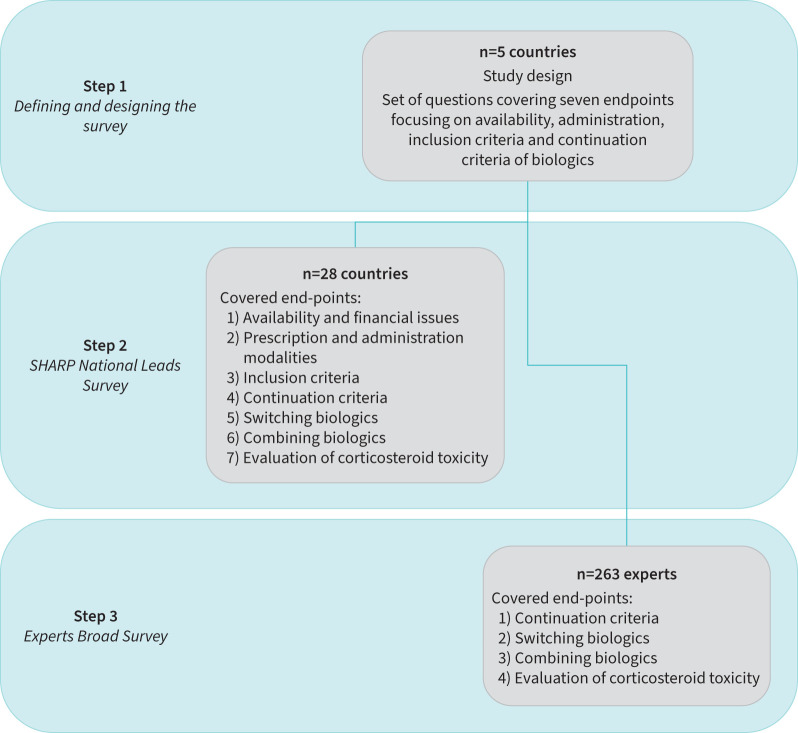
The European Respiratory Society (ERS) SHARP Clinical Research Collaboration conducted a three-step survey collecting information on asthma biologics use in Europe. Five geographically distant countries defined the survey questions, focusing on seven end-points: biologics availability and financial issues, prescription and administration modalities, inclusion criteria, continuation criteria, switching biologics, combining biologics and evaluation of corticosteroid toxicity. The survey was then sent to SHARP National Leads of 28 European countries. Finally, selected questions were submitted to a broad group of 263 asthma experts identified by national societies.
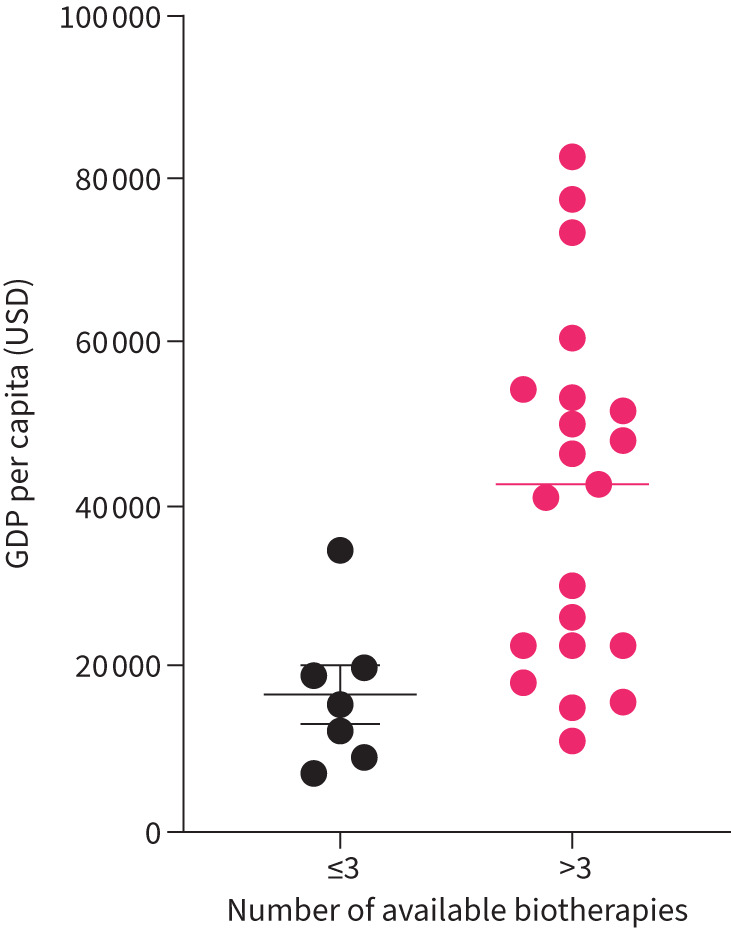
Availability of biologics varied between countries, with 17 out of 28 countries having all five existing biologics. Authorised prescribers (pulmonologists and other specialists) also differed. In-hospital administration was the preferred deliverance modality. While exacerbation rate was used as an inclusion criterion in all countries, forced expiratory volume in 1 s was used in 46%. Blood eosinophils were an inclusion criterion in all countries for interleukin-5 (IL-5)-targeted and IL-4/IL-13-targeted biologics, with varying thresholds. There were no formally established criteria for continuing biologics. Reduction in exacerbations represented the most important benchmark, followed by improvement in asthma control and quality of life. Only 73% (191 out of 263) of surveyed clinicians assessed their patients for corticosteroid-induced toxicity.
Our study reveals important heterogeneity in the use of asthma biologics across Europe. To what extent this impacts on clinical outcomes relevant to patients and healthcare services needs further investigation.
重度哮喘生物制剂的治疗依据国际和国家指南,并由国家监管机构界定,但这些药物在现实生活中的使用情况尚不清楚。
欧洲呼吸学会(ERS)SHARP临床研究协作组开展了一项三步调查,收集欧洲哮喘生物制剂使用情况的信息。五个地理位置相隔较远的国家确定了调查问题,重点关注七个终点:生物制剂的可及性和财务问题、处方和给药方式、纳入标准、继续治疗标准、更换生物制剂、联合使用生物制剂以及皮质类固醇毒性评估。然后将该调查发送给28个欧洲国家的SHARP国家负责人。最后,将选定的问题提交给由各国学会确定的263名哮喘专家组成的广泛群体。
各国生物制剂的可及性存在差异,28个国家中有17个国家拥有全部五种现有生物制剂。授权开处方者(肺科医生和其他专科医生)也有所不同。院内给药是首选的给药方式。虽然所有国家都将加重率用作纳入标准,但46%的国家将1秒用力呼气量用作纳入标准。血液嗜酸性粒细胞是所有国家针对白细胞介素-5(IL-5)和白细胞介素-4/白细胞介素-13的生物制剂的纳入标准,阈值各不相同。没有正式确立的继续使用生物制剂的标准。加重次数减少是最重要的基准,其次是哮喘控制和生活质量的改善。在接受调查的临床医生中,只有7