Francis Heather M, Stevenson Richard J, Tan Lorraine S Y, Ehrenfeld Lauren, Byeon Sooin, Attuquayefio Tuki, Gupta Dolly, Lim Chai K
Department of Psychology, Faculty of Medicine, Health and Human Sciences, Macquarie University, North Ryde, NSW, Australia.
Department of Neurology, Royal North Shore Hospital, Sydney, NSW, Australia.
Front Nutr. 2022 Oct 10;9:945538. doi: 10.3389/fnut.2022.945538. eCollection 2022.
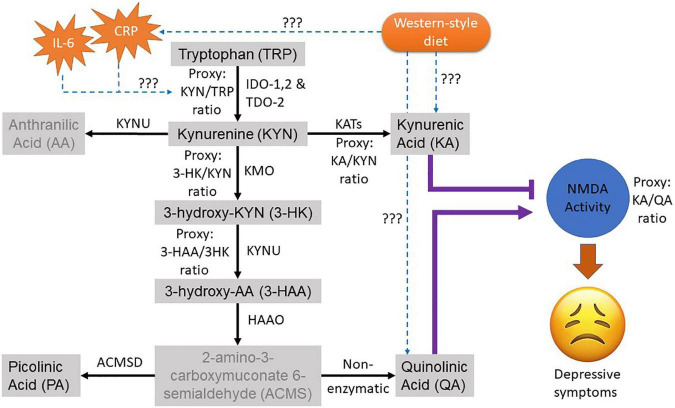
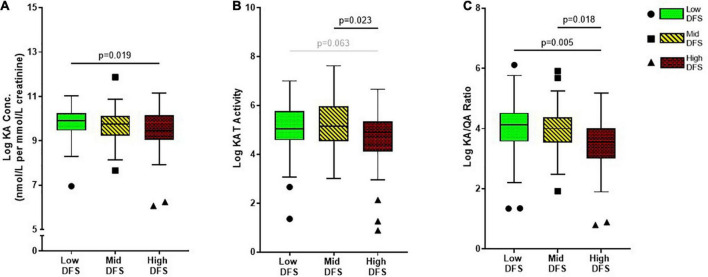
Consumption of a Western-style diet (WS-diet), high in saturated fat and added sugar, is associated with increased depression risk. However, the physiological mechanisms underlying the relationship requires elucidation. Diet can alter tryptophan metabolism along the kynurenine pathway (KP), potentially linking inflammation and depression. This study aimed to examine whether urinary inflammatory markers and KP metabolites differed according to WS-diet consumption and depression severity. Depression symptoms and habitual WS-diet consumption were assessed in 169 healthy adults aged 17-35 recruited from two experimental studies. Targeted metabolomics profiling of seven KP metabolites, ELISA-based assays of interleukin-6 (IL-6) and C-reactive protein (CRP) were performed using urine samples collected from the participants. Parametric tests were performed for group comparison and associations analysis. Multilevel mixed-effect modelling was applied to control for biases. Higher intake of WS-diet was associated with lower levels of neuroprotective kynurenic acid (KA; = -0.17, = 0.0236). There were no differences in IL-6 or CRP across diet groups ( > 0.05). Physical activity had negative associations with most KP metabolites. Mixed-effects regression analysis showed the glutamatergic inhibitor, KA, was the only biomarker to have a significant association with depression symptoms in a model adjusted for demographic and lifestyle variables: a unit increase in KA was associated with 0.21 unit decrease in Depression Anxiety and Stress Scale-21 depression score ( = 0.009). These findings suggest that urinary KA is associated with both habitual WS-diet intake, and levels of depression symptoms, independent of inflammation. Findings support the role of neuroprotection and glutamatergic modulation in depression. We propose that KA may act as endogenous glutamatergic inhibition in regulating depression severity in the absence of inflammation. Further comparison with blood-based markers will assist in validating the utility of non-invasive urine samples for measuring KP metabolites.
摄入富含饱和脂肪和添加糖的西式饮食(WS饮食)与抑郁症风险增加有关。然而,这种关系背后的生理机制尚需阐明。饮食可改变色氨酸沿犬尿氨酸途径(KP)的代谢,这可能将炎症与抑郁症联系起来。本研究旨在探讨尿炎症标志物和KP代谢产物是否因WS饮食摄入和抑郁严重程度而异。从两项实验研究中招募了169名年龄在17 - 35岁的健康成年人,评估他们的抑郁症状和习惯性WS饮食摄入量。使用从参与者收集的尿液样本对七种KP代谢产物进行靶向代谢组学分析,基于酶联免疫吸附测定法检测白细胞介素-6(IL-6)和C反应蛋白(CRP)。进行参数检验以进行组间比较和关联分析。应用多水平混合效应模型来控制偏差。较高的WS饮食摄入量与神经保护性犬尿喹啉酸(KA)水平较低相关(β = -0.17,P = 0.0236)。不同饮食组之间的IL-6或CRP没有差异(P > 0.05)。身体活动与大多数KP代谢产物呈负相关。混合效应回归分析表明,在调整了人口统计学和生活方式变量的模型中,谷氨酸能抑制剂KA是唯一与抑郁症状有显著关联的生物标志物:KA每增加一个单位,抑郁焦虑压力量表-21(DASS-21)抑郁评分就降低0.21个单位(P = 0.009)。这些发现表明,尿KA与习惯性WS饮食摄入量和抑郁症状水平均相关,且独立于炎症。研究结果支持神经保护和谷氨酸能调节在抑郁症中的作用。我们提出,在没有炎症的情况下,KA可能作为内源性谷氨酸能抑制剂来调节抑郁严重程度。与基于血液的标志物进行进一步比较将有助于验证非侵入性尿液样本用于测量KP代谢产物的效用。