Yale School of Medicine, New Haven, Connecticut.
VA Connecticut Healthcare Center, West Haven, Connecticut.
JAMA Netw Open. 2022 Oct 3;5(10):e2238880. doi: 10.1001/jamanetworkopen.2022.38880.
Alcohol genome-wide association studies (GWASs) have generally focused on alcohol consumption and alcohol use disorder (AUD); few have examined habitual drinking behaviors like maximum habitual alcohol intake (MaxAlc).
To identify genetic loci associated with MaxAlc and to elucidate the genetic architecture across alcohol traits.
DESIGN, SETTING, AND PARTICIPANTS: This MaxAlc genetic association study was performed among Million Veteran Program participants enrolled from January 10, 2011, to September 30, 2020. Ancestry-specific GWASs were conducted in participants with European (n = 218 623) and African (n = 29 132) ancestry, then meta-analyzed (N = 247 755). Linkage-disequilibrium score regression was used to estimate single nucleotide variant (SNV)-heritability and genetic correlations (rg) with other alcohol and psychiatric traits. Genomic structural equation modeling (gSEM) was used to evaluate genetic associations between MaxAlc and other alcohol traits. Mendelian randomization was used to examine potential causal relationships between MaxAlc and liver enzyme levels. MTAG (multitrait analysis of GWAS) was used to analyze MaxAlc and problematic alcohol use (PAU) jointly.
Genetic associations.
MaxAlc was defined from the following survey item: "in a typical month, what is/was the largest number of drinks of alcohol you may have had in one day?" with ordinal responses from 0 to 15 or more drinks.
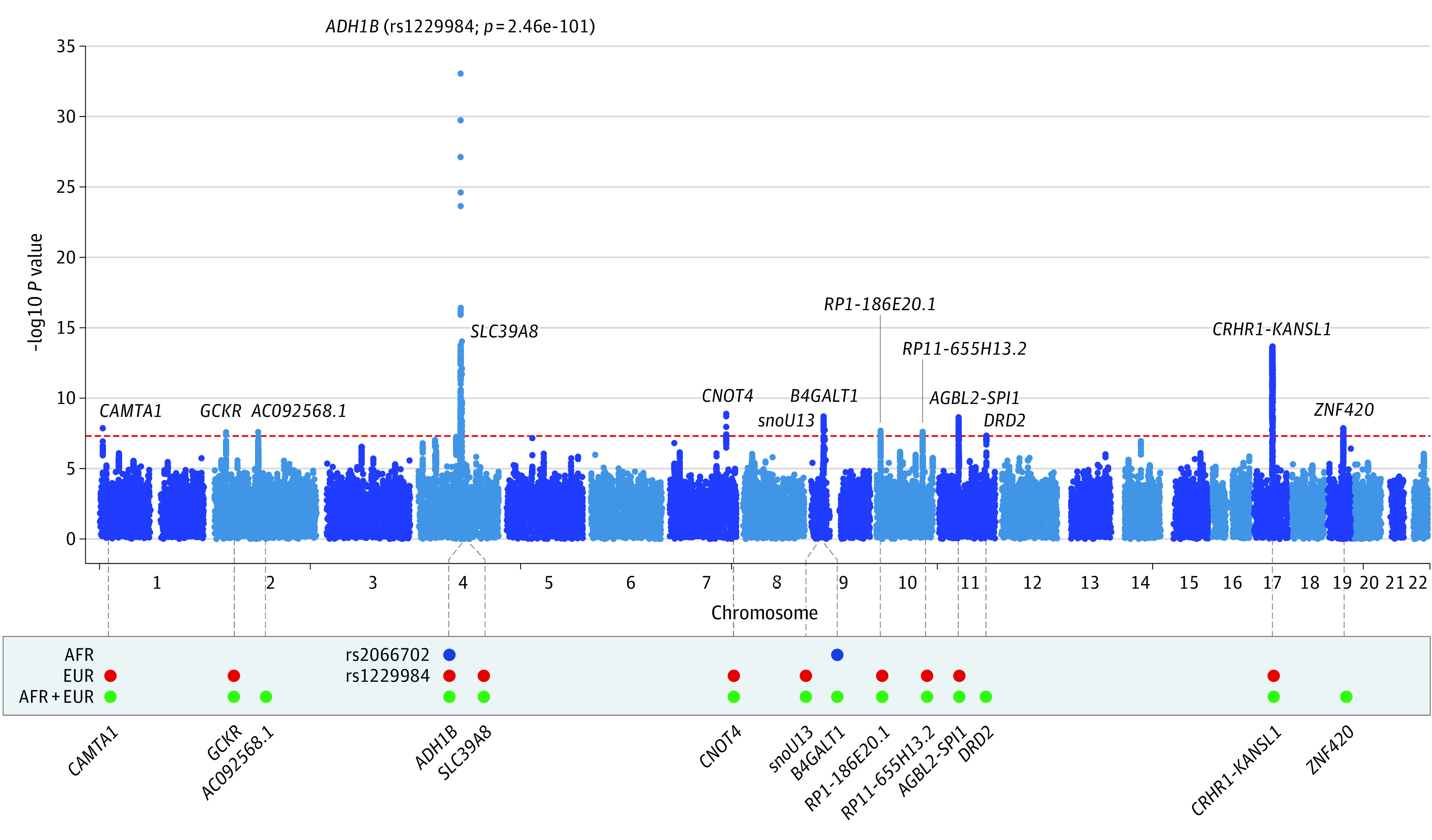
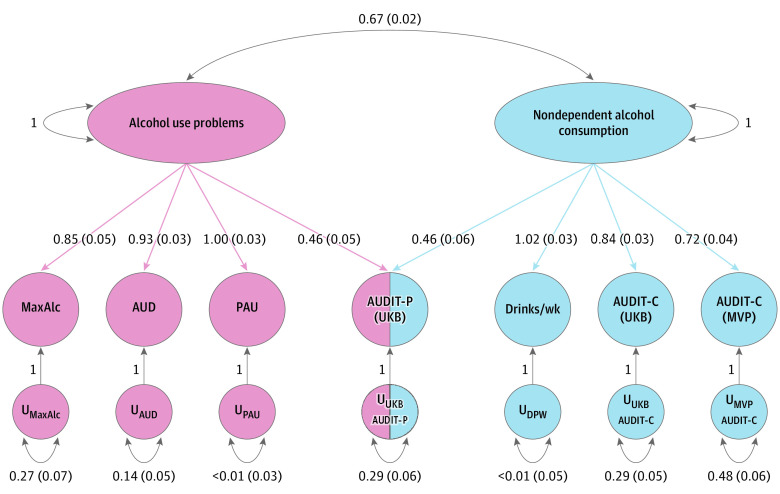
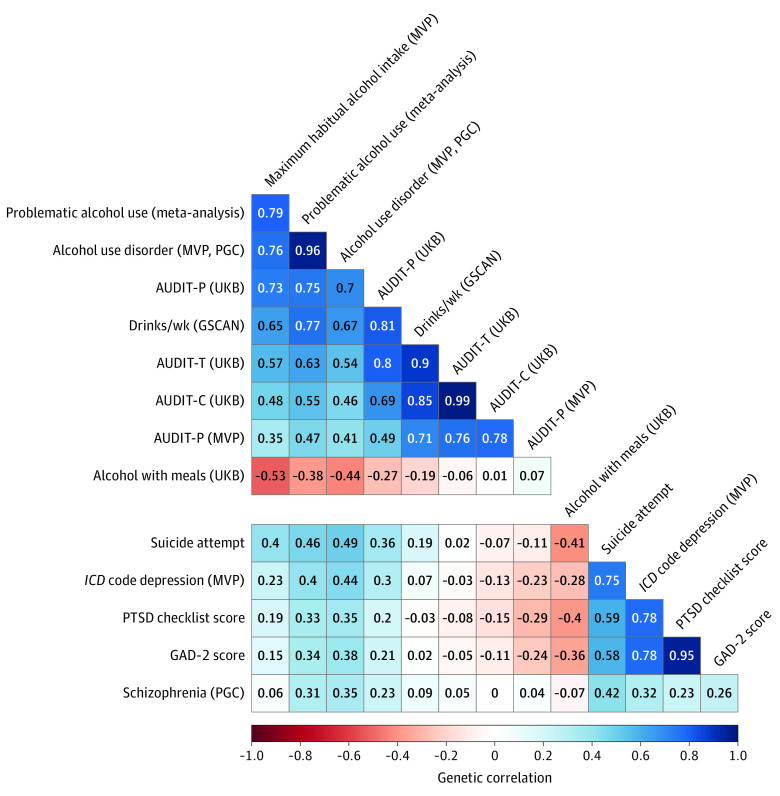
GWASs were conducted on sample sizes of as many as 247 455 US veterans. Participants were 92.68% male and had mean (SD) age of 65.92 (11.70) years. The MaxAlc GWAS resulted in 15 genome-wide significant loci. Top associations in European-ancestry and African-ancestry participants were with known functional variants in the ADH1B gene, namely rs1229984 (P = 3.12 × 10-101) and rs2066702 (P = 6.30 × 10⁻¹⁷), respectively. Novel associations were also found. SNV-heritability was 6.65% (SE, 0.41) in European-ancestry participants and 3.42% (SE, 1.46) in African-ancestry participants. MaxAlc was positively correlated with PAU (rg = 0.79; P = 3.95 × 10-149) and AUD (rg = 0.76; P = 1.26 × 10-127) and had negative rg with the UK Biobank "alcohol usually taken with meals" (rg = -0.53; P = 1.40 × 10-50). For psychiatric traits, MaxAlc had the strongest genetic correlation with suicide attempt (rg = 0.40; P = 3.02 × 10⁻²¹). gSEM supported a 2-factor model with MaxAlc loading on a factor with PAU and AUD and other alcohol consumption measures loading on a separate factor. Mendelian randomization supported an association between MaxAlc and the liver enzyme gamma-glutamyltransferase (β = 0.012; P = 2.66 × 10⁻¹⁰). MaxAlc MTAG resulted in 31 genome-wide significant loci.
The findings suggest that MaxAlc closely aligns genetically with PAU traits. This study improves understanding of the mechanisms associated with normative alcohol consumption vs problematic habitual use and AUD as well as how MaxAlc relates to psychiatric and medical conditions genetically and biologically.
酒精全基因组关联研究(GWAS)通常侧重于酒精摄入量和酒精使用障碍(AUD);很少有研究检查习惯性饮酒行为,如最大习惯性酒精摄入量(MaxAlc)。
确定与 MaxAlc 相关的遗传位点,并阐明 across alcohol traits 的遗传结构。
设计、设置和参与者:这项 MaxAlc 遗传关联研究是在 2011 年 1 月 10 日至 2020 年 9 月 30 日期间参加百万退伍军人计划的参与者中进行的。在具有欧洲(n=218623)和非洲(n=29132)血统的参与者中进行了特定于祖先的 GWAS,然后进行了荟萃分析(N=247755)。连锁不平衡评分回归用于估计单核苷酸变异(SNV)-遗传率和与其他酒精和精神特质的遗传相关性(rg)。基因组结构方程建模(gSEM)用于评估 MaxAlc 与其他酒精特质之间的遗传关联。孟德尔随机化用于检查 MaxAlc 与肝酶水平之间潜在的因果关系。MTAG(GWAS 的多特质分析)用于联合分析 MaxAlc 和有问题的酒精使用(PAU)。
遗传关联。
MaxAlc 是根据以下调查项目定义的:“在一个典型的月份,你可能在一天中喝了多少最大数量的酒精饮料?”答案从 0 到 15 或更多不等。
在多达 247455 名美国退伍军人的样本中进行了 GWAS。参与者中 92.68%为男性,平均(SD)年龄为 65.92(11.70)岁。MaxAlc GWAS 产生了 15 个全基因组显著位点。欧洲血统和非洲血统参与者中的顶级关联是 ADH1B 基因中的已知功能变异,即 rs1229984(P=3.12×10-101)和 rs2066702(P=6.30×10⁻¹⁷)。还发现了新的关联。欧洲血统参与者的 SNV-遗传率为 6.65%(SE,0.41),非洲血统参与者的 SNV-遗传率为 3.42%(SE,1.46)。MaxAlc 与 PAU(rg=0.79;P=3.95×10-149)和 AUD(rg=0.76;P=1.26×10-127)呈正相关,与 UK Biobank“通常与餐食一起摄入的酒精”呈负相关(rg=-0.53;P=1.40×10-50)。对于精神特质,MaxAlc 与自杀企图的遗传相关性最强(rg=0.40;P=3.02×10⁻²¹)。gSEM 支持一个 2 因素模型,MaxAlc 加载在一个因子上,该因子与 PAU 和 AUD 以及其他酒精摄入量测量值加载在另一个因子上。孟德尔随机化支持 MaxAlc 与肝酶γ-谷氨酰转移酶(β=0.012;P=2.66×10⁻¹⁰)之间的关联。MaxAlc MTAG 导致 31 个全基因组显著位点。
研究结果表明,MaxAlc 在遗传上与 PAU 特征密切一致。这项研究提高了对与正常酒精消费与问题习惯性使用和 AUD 相关的遗传机制的理解,以及 MaxAlc 在遗传和生物学上与精神和医疗状况的关系。