Yang Lin, Wang Li, Bao Erhao, Wang Jiahao, Zhu Pingyu
Department of Urology, Affiliated Hospital of North Sichuan Medical College, Nanchong, China.
Department of Urology, The Second Hospital of Lanzhou University, Lanzhou, China.
Front Nutr. 2024 Jul 29;11:1428844. doi: 10.3389/fnut.2024.1428844. eCollection 2024.
Daily dietary habits are closely related to human health, and long-term unhealthy dietary intake, such as excessive consumption of alcohol and pickled foods, may promote the development of cancers. However, comprehensive research on the causal relationship between dietary habits and cancer is lacking. Therefore, this study aimed to reveal the potential causal link between dietary risk factors and the prognosis of cancer-related to genetic susceptibility.
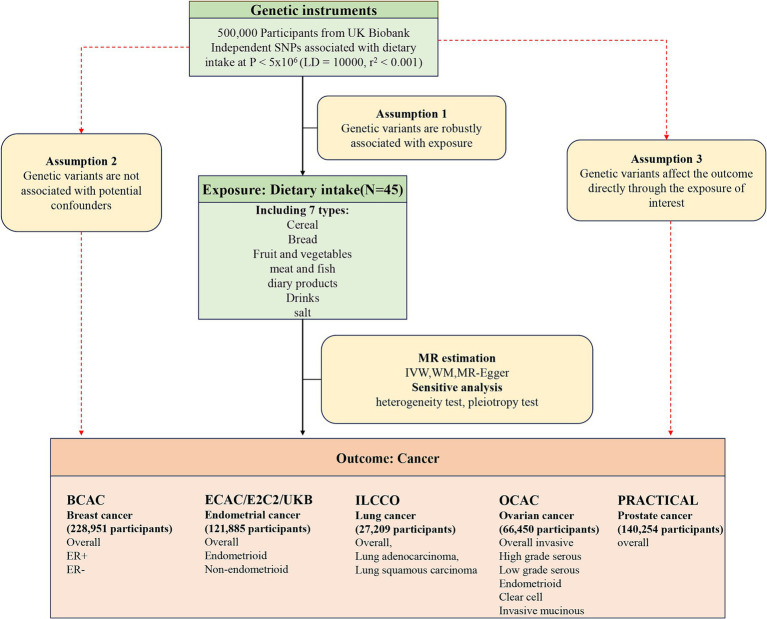
GWAS (Genome-Wide Association Studies) summary data on dietary habits and five common types of cancer and their pathological subtypes were obtained from the UK Biobank and various cancer association consortia. A univariable two-sample Mendelian randomization (UVMR) and FDR correction analysis was conducted to explore the causal relationships between 45 dietary habits and five common types of cancer and their histopathological subtypes. In addition, multivariable Mendelian randomization analysis (MVMR) was performed to adjust for traditional risk factors for dietary habits, and the direct or indirect effects of diet on cancer were evaluated. Finally, the prognostic impact of selected instrumental variables on cancer was analyzed using an online data platform.
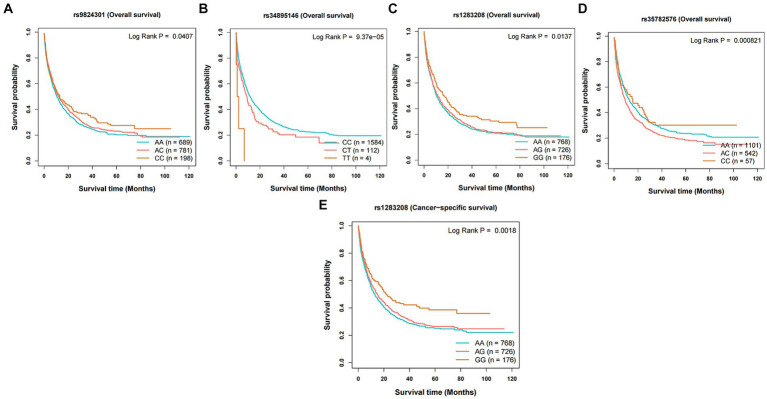
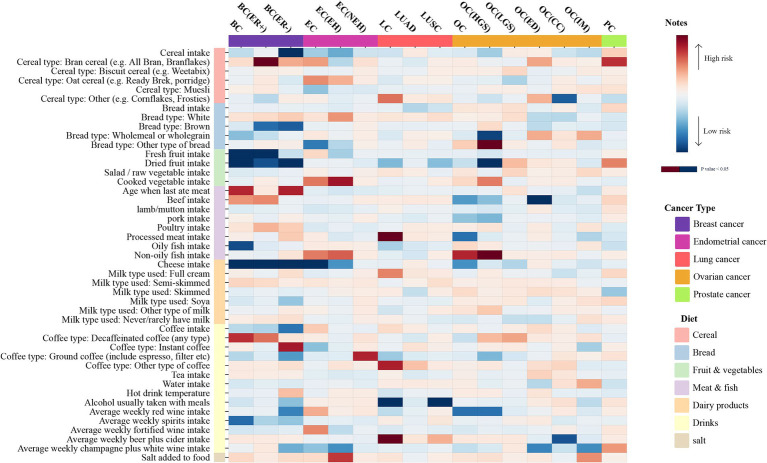
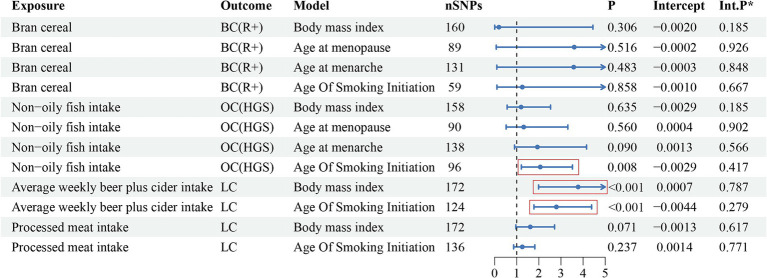
In the UVMR analysis, four dietary habits were identified as risk factors for cancer, while five dietary habits were identified as protective factors. Among the latter, one dietary habit showed a significant association with cancer even after FDR correction, indicating a potential causal relationship. The MVMR analysis revealed that weekly beer and cider intake, may act as an independent risk factor for cancer development. Other causal associations between dietary habits and cancer risk may be mediated by intermediate factors. In the prognostic analysis, the SNPs (Single Nucleotide Polymorphisms) of average weekly beer and cider intake were set as independent risk factors and were found to significantly impact overall survival (OS) and cancer-specific survival (CSS) in lung cancer.
This causal relationship study supports the notion that adjusting daily dietary habits and specific dietary interventions may decrease the risk of cancer.
日常饮食习惯与人类健康密切相关,长期不健康的饮食摄入,如过量饮酒和食用腌制食品,可能会促进癌症的发展。然而,关于饮食习惯与癌症之间因果关系的综合研究尚属缺乏。因此,本研究旨在揭示饮食风险因素与癌症预后之间潜在的因果联系,并探讨基因易感性在其中的作用。
从英国生物银行和各癌症协会联盟获取关于饮食习惯以及五种常见癌症及其病理亚型的全基因组关联研究(GWAS)汇总数据。采用单变量双样本孟德尔随机化(UVMR)和错误发现率(FDR)校正分析,以探究45种饮食习惯与五种常见癌症及其组织病理学亚型之间的因果关系。此外,进行多变量孟德尔随机化分析(MVMR)以校正饮食习惯的传统风险因素,并评估饮食对癌症的直接或间接影响。最后,使用在线数据平台分析所选工具变量对癌症预后的影响。
在UVMR分析中,四种饮食习惯被确定为癌症的危险因素,而五种饮食习惯被确定为保护因素。在后者中,有一种饮食习惯即使在FDR校正后仍与癌症存在显著关联,表明存在潜在的因果关系。MVMR分析显示,每周饮用啤酒和苹果酒可能是癌症发生的独立危险因素。饮食习惯与癌症风险之间的其他因果关联可能由中间因素介导。在预后分析中,将平均每周饮用啤酒和苹果酒的单核苷酸多态性(SNP)设定为独立危险因素,发现其对肺癌的总生存期(OS)和癌症特异性生存期(CSS)有显著影响。
这项因果关系研究支持这样一种观点,即调整日常饮食习惯和进行特定的饮食干预可能会降低癌症风险。