Department of Surgery, Amsterdam University Medical Centers, Location Vrije Universiteit, De Boelelaan 1117, 1081 HV, Amsterdam, The Netherlands.
Global Surgery Amsterdam, Amsterdam, The Netherlands.
Surg Endosc. 2023 Mar;37(3):2085-2094. doi: 10.1007/s00464-022-09726-5. Epub 2022 Oct 27.
Open inguinal hernia repair is the most commonly performed procedure in general surgery in sub-Saharan Africa, but data on its learning curve are lacking. This study evaluated the learning curve characteristics to improve surgical training and enable scaling up hernia surgery in low- and middle-income countries.
Logbook data of associate clinicians enrolled in a surgical training program in Sierra Leone were collected and their first 55 hernia surgeries following the Bassini technique (herniorrhaphies) were analyzed in cohorts of five cases. Studied variables were gradient of decline of operating time, variation in operating time, and length of stay (LOS). Eleven subsequent cohorts of each five herniorrhaphies were investigated.
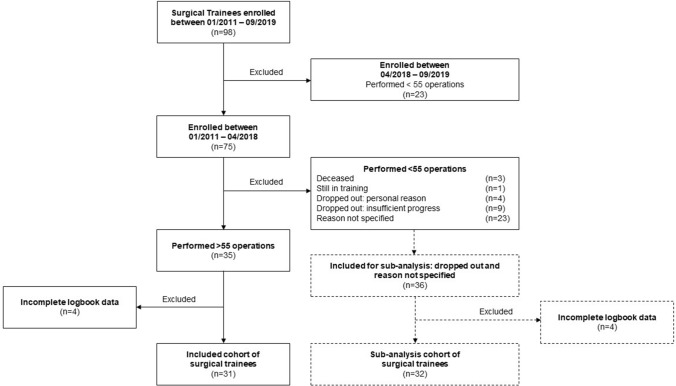
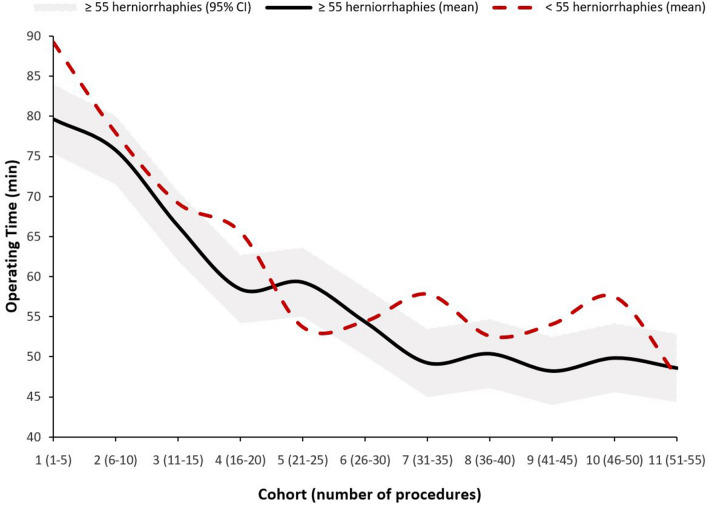
Seventy-five trainees enrolled in the training program between 2011 and 2020 were eligible for inclusion. Thirty-one (41.3%) performed the minimum of 55 herniorrhaphies, and had also complete personal logbook data. Mean operating times dropped from 79.6 (95% CI 75.3-84.0) to 48.6 (95% CI 44.3-52.9) minutes between the first and last cohort, while standard deviation in operating time nearly halved to 15.4 (95% CI 11.7-20.0) minutes, and LOS was shortened by 3 days (8.5 days, 95%CI 6.1-10.8 vs. 5.4 days, 95% 3.1-7.6). Operating times flattened after 31-35 cases which corresponded with 1.5 years of training.
The learning curve of inguinal hernia surgery for associate clinicians flattens after 31-35 procedures. Training programs can be tailored based on this finding. The recorded learning curve may serve as a baseline for future training techniques.
腹股沟疝修补术是撒哈拉以南非洲普通外科最常进行的手术,但缺乏其学习曲线的数据。本研究评估了学习曲线的特征,以改善手术培训,并使疝手术在中低收入国家得以扩大。
收集塞拉利昂外科培训计划中助理临床医生的日志数据,并按巴斯尼技术(疝修补术)对他们的前 55 例疝手术进行了分析,分为每 5 例一组。研究变量包括手术时间下降的梯度、手术时间的变化和住院时间(LOS)。随后对每组 5 例的 11 个后续队列进行了研究。
2011 年至 2020 年期间,共有 75 名培训生参加了培训计划,符合纳入标准。其中 31 名(41.3%)完成了至少 55 例疝修补术,且个人日志数据完整。手术时间从第 1 组到第 11 组从 79.6 分钟(95%CI 75.3-84.0)降至 48.6 分钟(95%CI 44.3-52.9),而手术时间的标准差几乎减半至 15.4 分钟(95%CI 11.7-20.0),住院时间缩短了 3 天(8.5 天,95%CI 6.1-10.8 天 vs. 5.4 天,95%CI 3.1-7.6 天)。手术时间在第 31-35 例时趋于平稳,这相当于 1.5 年的培训。
助理临床医生腹股沟疝手术的学习曲线在完成 31-35 例手术后趋于平稳。培训计划可以根据这一发现进行调整。记录的学习曲线可以作为未来培训技术的基准。