Department of Orthopedic Surgery, Yonsei University College of Medicine, 03722 Seoul, Republic of Korea.
Department of Orthopedic Surgery, Ewha Womans University College of Medicine, 07804 Seoul, Republic of Korea.
Biomed Res Int. 2022 Oct 18;2022:8293524. doi: 10.1155/2022/8293524. eCollection 2022.
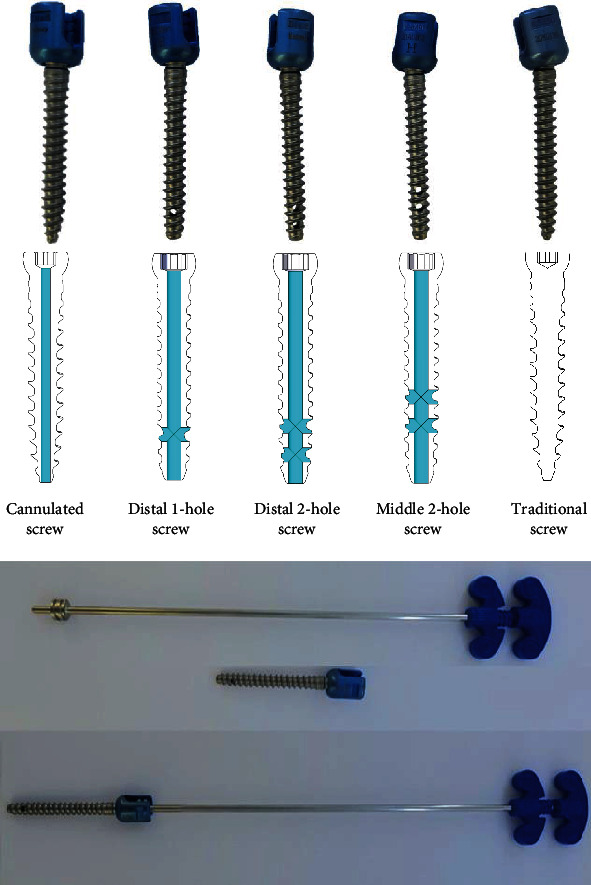
The purpose of this study to explore strategies for reducing cement leakage during cement-augmented pedicle screw fixation, we compared the cement distribution patterns and biomechanical strengths of different types of cement-augmented fenestrated screws and traditional cement-augmented techniques. We compared five screw groups in this study: (1) Cannulated screws (Cann); (2) distal one-hole screws (D1); (3) distal two-hole screws (D2); (4) middle two-hole screws (M2); and (5) traditional screws with a traditional cement injection technique (Trad). The screws were inserted into cancellous bone blocks using a controlled, adequate cement injection pressure (1.6-2.0 kg), and an appropriate cement viscosity. Center to screw tip distance, three-dimensional distribution, and pull-out strength for cement were compared between groups. The average distance between the cement center and the screw tip was highest in the M2 group, suggesting a higher risk of cement leakage into the spinal canal. The Trad group had the highest migration distance in the -axis, also reflecting a higher risk of leakage into the spinal canal. The D1 group had the highest pull-out strength (253 ± 48.82 N and 797 ± 58.31 N) in bone blocks representing different degrees of osteoporosis, and the D2 group had the second highest pull-out strength in the severe osteoporosis model. Overall, D1 screws appeared to be the best option for optimizing biomechanical function and minimizing the risk of cement leakage into the spinal canal in patients with osteoporotic bone undergoing spinal surgery.
本研究旨在探讨减少骨水泥渗漏的策略,比较了不同类型的骨水泥增强型开窗螺钉和传统骨水泥增强技术的骨水泥分布模式和生物力学强度。我们在本研究中比较了 5 组螺钉:(1) 中空螺钉(Cann);(2) 远侧单孔螺钉(D1);(3) 远侧双孔螺钉(D2);(4) 中间双孔螺钉(M2);(5) 采用传统骨水泥注射技术的传统螺钉(Trad)。使用可控的、足够的骨水泥注射压力(1.6-2.0kg)和适当的骨水泥粘性,将螺钉插入松质骨块中。比较了各组之间的螺钉中心到尖端的距离、三维分布和骨水泥拔出强度。M2 组的骨水泥中心到螺钉尖端的平均距离最高,表明骨水泥向椎管渗漏的风险较高。Trad 组在 - 轴上的迁移距离最高,也反映了向椎管渗漏的风险较高。D1 组在不同程度骨质疏松的骨块中具有最高的拔出强度(253±48.82N 和 797±58.31N),D2 组在严重骨质疏松模型中具有第二高的拔出强度。总体而言,对于接受脊柱手术的骨质疏松性骨患者,D1 螺钉似乎是优化生物力学功能和最小化骨水泥向椎管渗漏风险的最佳选择。