Gao Qiannan, Tan Jiang-Shan, Fan Luyun, Wang Xiaoqi, Hua Lu, Cai Jun
Hypertension Center, FuWai Hospital, State Key Laboratory of Cardiovascular Disease, National Center for Cardiovascular Diseases, Peking Union Medical College, Chinese Academy of Medical Sciences, Beijing, China.
Center for Respiratory and Pulmonary Vascular Diseases, Department of Cardiology, National Clinical Research Center of Cardiovascular Diseases, State Key Laboratory of Cardiovascular Disease, Fuwai Hospital, National Center for Cardiovascular Diseases, Chinese Academy of Medical Sciences and Peking Union Medical College, Beijing, China.
Front Cell Dev Biol. 2022 Oct 11;10:1023006. doi: 10.3389/fcell.2022.1023006. eCollection 2022.
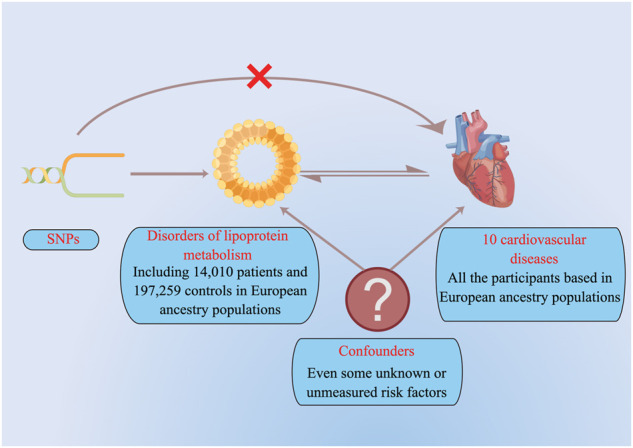
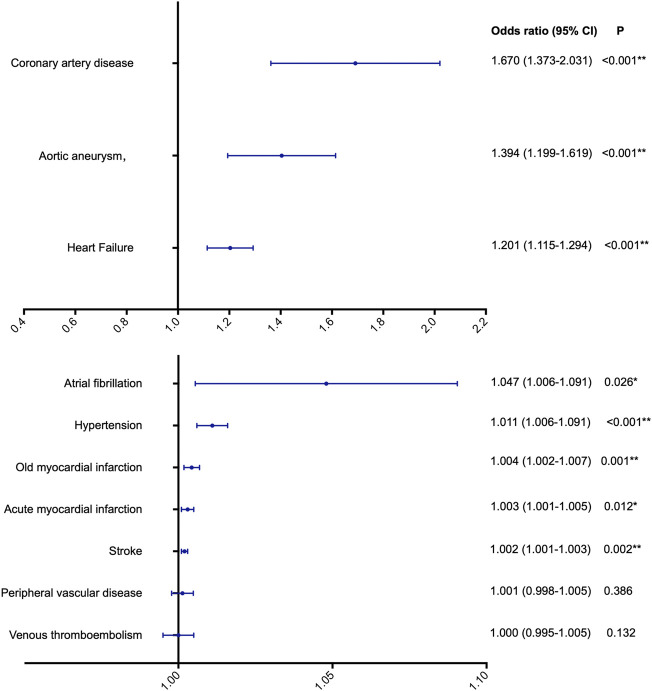
Disorders of lipoprotein metabolism have been linked with an increased risk of cardiovascular diseases (CVDs) but the causal association is unclear. In this study, we investigated the causal association between disorders of lipoprotein metabolism and CVDs using two-sample Mendelian randomization (MR). The exposure was obtained from Finn genome-wide association studies (14,010 cases, 197,259 controls), and the corresponding CVDs were extracted from the largest published genome-wide association studies. A random-effects inverse-variance weighted method was used for the main analyses with a complementary analysis using the weighted median and MR-Egger approaches. Multiple sensitivity analyses were performed to assess horizontal pleiotropy. The MR analysis indicated positive associations of disorders of lipoprotein metabolism with coronary artery disease (odds ratio [OR] 1.670, 95% confidence interval [CI] 1.373-2.031; < 0.001), aortic aneurysm (OR 1.394, 95% CI 1.199-1.619; < 0.001), heart failure (OR 1.20, 95% CI 1.115-1.294; < 0.001), hypertension (OR 1.011, 95% CI 1.006-1.091; < 0.001), old myocardial infarction (OR 1.004, 95% CI 1.002-1.007; = 0.001), and stroke (OR 1.002, 95% CI 1.001-1.003; = 0.002). There is a suggestive causal relationship between disorders of lipoprotein metabolism and atrial fibrillation (OR 1.047, 95% CI 1.006-1.091; = 0.026) and acute myocardial infarction (OR 1.003, 95% CI 1.001-1.005; = 0.012). There was limited evidence of a causal association between disorders of lipoprotein metabolism and peripheral vascular disease and venous thromboembolism. Our findings indicate a significant causal association between disorders of lipoprotein metabolism and many CVDs, including coronary artery disease, aortic aneurysm, heart failure, hypertension, old myocardial infarction, and stroke. These associations may be useful for development of treatment strategies that regulate lipoprotein metabolism in patients with CVD.
脂蛋白代谢紊乱与心血管疾病(CVD)风险增加有关,但因果关系尚不清楚。在本研究中,我们使用两样本孟德尔随机化(MR)方法研究了脂蛋白代谢紊乱与CVD之间的因果关系。暴露数据来自芬兰全基因组关联研究(14010例病例,197259例对照),相应的CVD数据从已发表的最大规模全基因组关联研究中提取。主要分析采用随机效应逆方差加权法,并使用加权中位数和MR-Egger方法进行补充分析。进行了多项敏感性分析以评估水平多效性。MR分析表明,脂蛋白代谢紊乱与冠状动脉疾病(优势比[OR]1.670,95%置信区间[CI]1.373 - 2.031;P < 0.001)、主动脉瘤(OR 1.394,95% CI 1.199 - 1.619;P < 0.001)、心力衰竭(OR 1.20,95% CI 1.115 - 1.294;P < 0.001)、高血压(OR 1.011,95% CI 1.006 - 1.091;P < 0.001)、陈旧性心肌梗死(OR 1.004,95% CI 1.002 - 1.007;P = 0.001)和中风(OR 1.002,95% CI 1.001 - 1.003;P = 0.002)呈正相关。脂蛋白代谢紊乱与心房颤动(OR 1.047,95% CI 1.006 - 1.091;P = 0.026)和急性心肌梗死(OR 1.003,95% CI 1.001 - 1.005;P = 0.012)之间存在提示性因果关系。脂蛋白代谢紊乱与外周血管疾病和静脉血栓栓塞之间存在因果关联的证据有限。我们的研究结果表明,脂蛋白代谢紊乱与许多CVD之间存在显著的因果关系,包括冠状动脉疾病、主动脉瘤、心力衰竭、高血压、陈旧性心肌梗死和中风。这些关联可能有助于制定调节CVD患者脂蛋白代谢的治疗策略。