Wang Jun, Guan Hongwei, Hostrup Morten, Rowlands David S, González-Alonso José, Jensen Jørgen
Department of Exercise Physiology, Beijing Sport University, Beijing, China.
Department of Health Promotion and Physical Education, School of Health Sciences and Human Performance, Ithaca College, Ithaca, NY 14850 USA.
J Sci Sport Exerc. 2021;3(4):321-331. doi: 10.1007/s42978-021-00133-1. Epub 2021 Sep 27.
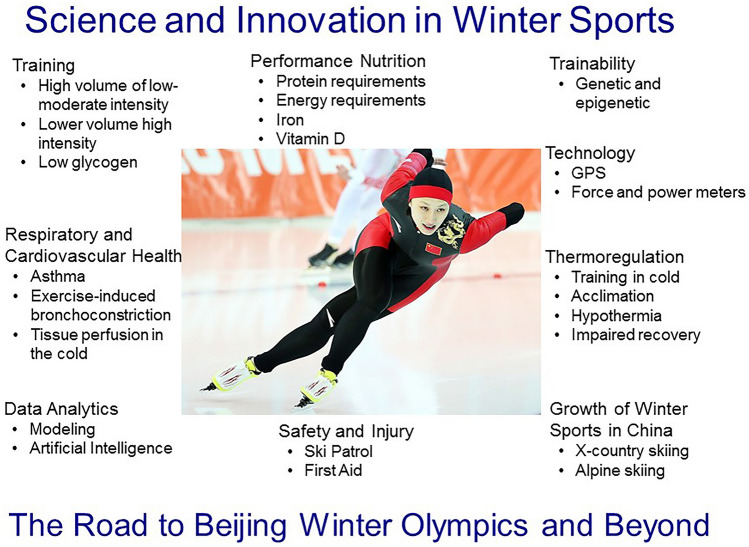
Beijing will host the 2022 Winter Olympics, and China strengthens research on various aspects to allow their athletes to compete successfully in winter sport. Simultaneously, Government-directed initiatives aim to increase public participation in recreational winter sport. These parallel developments allow research to advance knowledge and understanding of the physiological determinants of performance and health related to winter sport. Winter sport athletes often conduct a substantial amount of training with high volumes of low-to-moderate exercise intensity and lower volumes of high-intensity work. Moreover, much of the training occur at low ambient temperatures and winter sport athletes have high risk of developing asthma or asthma-related conditions, such as exercise-induced bronchoconstriction. The high training volumes require optimal nutrition with increased energy and dietary protein requirement to stimulate muscle protein synthesis response in the post-exercise period. Whether higher protein intake is required in the cold should be investigated. Cross-country skiing is performed mostly in Northern hemisphere with a strong cultural heritage and sporting tradition. It is expected that innovative initiatives on recruitment and training during the next few years will target to enhance performance of Chinese athletes in classical endurance-based winter sport. The innovation potential coupled with resourcing and population may be substantial with the potential for China to become a significant winter sport nation. This paper discusses the physiological aspects of endurance training and performance in winter sport highlighting areas where innovation may advance in athletic performance in cold environments. In addition, to ensure sustainable development of snow sport, a quality ski patrol and rescue system is recommended for the safety of increasing mass participation.
北京将举办2022年冬奥会,中国加强了各方面研究,以使本国运动员在冬季运动项目中取得佳绩。与此同时,政府主导的各项举措旨在提高公众对冬季休闲运动的参与度。这些同步发展的情况使得相关研究能够增进对与冬季运动相关的运动表现和健康的生理决定因素的认识和理解。冬季运动项目的运动员经常进行大量训练,其中低至中等运动强度的训练量较大,高强度训练量较小。此外,大部分训练是在低温环境下进行的,冬季运动项目的运动员患哮喘或哮喘相关病症(如运动诱发的支气管收缩)的风险很高。大量的训练需要最佳营养,增加能量和膳食蛋白质需求,以刺激运动后阶段的肌肉蛋白质合成反应。是否在寒冷环境中需要更高的蛋白质摄入量有待研究。越野滑雪主要在北半球进行,有着深厚的文化底蕴和体育传统。预计未来几年在招募和训练方面的创新举措将致力于提高中国运动员在以耐力为基础的传统冬季运动项目中的表现。随着中国有潜力成为一个重要的冬季运动国家,创新潜力加上资源和人口因素可能十分巨大。本文讨论了冬季运动中耐力训练和运动表现的生理方面,突出了在寒冷环境下运动表现方面创新可能取得进展的领域。此外,为确保雪上运动的可持续发展,建议建立高质量的滑雪巡逻和救援系统,以保障越来越多的大众参与者的安全。