Li Rui, Sharma Vaibhav, Thangamani Subasini, Yakimovich Artur
Center for Advanced Systems Understanding (CASUS), Helmholtz-Zentrum Dresden-Rossendorf e. V. (HZDR), Görlitz, Germany.
Bladder Infection and Immunity Group (BIIG), Department of Renal Medicine, Division of Medicine, University College London, Royal Free Hospital Campus, London, United Kingdom.
Front Bioinform. 2022 Jul 5;2:912809. doi: 10.3389/fbinf.2022.912809. eCollection 2022.
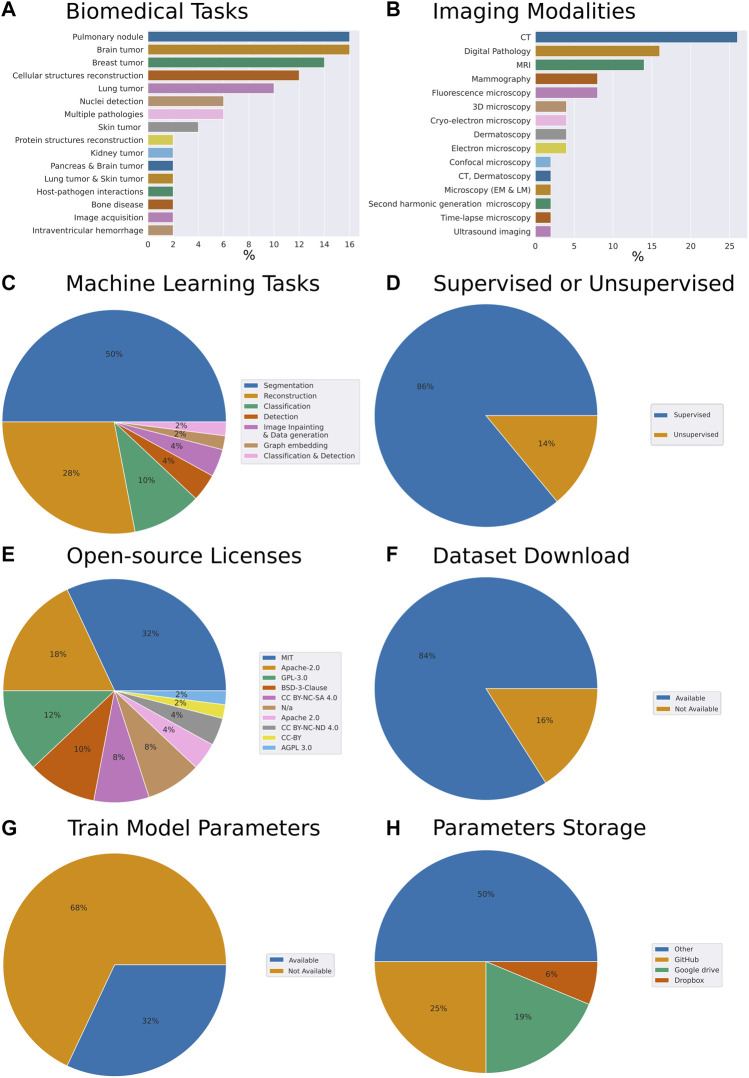
Open-source research software has proven indispensable in modern biomedical image analysis. A multitude of open-source platforms drive image analysis pipelines and help disseminate novel analytical approaches and algorithms. Recent advances in machine learning allow for unprecedented improvement in these approaches. However, these novel algorithms come with new requirements in order to remain open source. To understand how these requirements are met, we have collected 50 biomedical image analysis models and performed a meta-analysis of their respective papers, source code, dataset, and trained model parameters. We concluded that while there are many positive trends in openness, only a fraction of all publications makes all necessary elements available to the research community.
开源研究软件在现代生物医学图像分析中已被证明是不可或缺的。众多开源平台推动图像分析流程,并有助于传播新颖的分析方法和算法。机器学习的最新进展使这些方法得到了前所未有的改进。然而,这些新颖的算法为了保持开源性质带来了新的要求。为了了解这些要求是如何得到满足的,我们收集了50个生物医学图像分析模型,并对它们各自的论文、源代码、数据集和训练模型参数进行了荟萃分析。我们得出的结论是,虽然在开放性方面有许多积极趋势,但所有出版物中只有一小部分向研究界提供了所有必要的要素。