Chen Hao, Jiang Rui, Huang Wentao, Chen Kequan, Zeng Ruijie, Wu Huihuan, Yang Qi, Guo Kehang, Li Jingwei, Wei Rui, Liao Songyan, Tse Hung-Fat, Sha Weihong, Zhuo Zewei
Department of Gastroenterology, Guangdong Provincial People's Hospital, Guangdong Academy of Medical Sciences, Guangzhou, China.
School of Medicine, South China University of Technology, Guangzhou, China.
Front Cardiovasc Med. 2022 Oct 11;9:993142. doi: 10.3389/fcvm.2022.993142. eCollection 2022.
Energy metabolism plays a crucial role in the improvement of heart dysfunction as well as the development of heart failure (HF). The current study is designed to identify energy metabolism-related diagnostic biomarkers for predicting the risk of HF due to myocardial infarction.
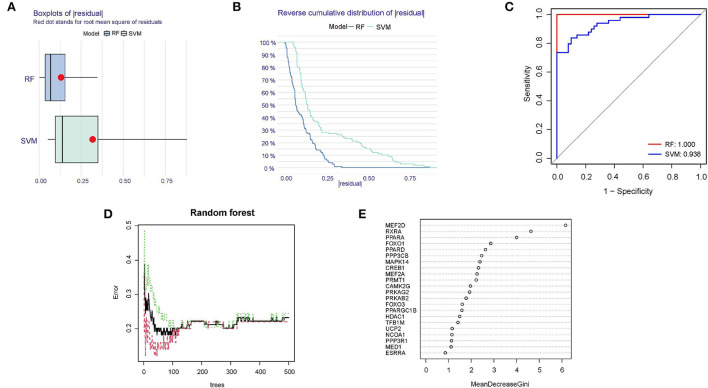
Transcriptome sequencing data of HF patients and non-heart failure (NF) people (GSE66360 and GSE59867) were obtained from gene expression omnibus (GEO) database. Energy metabolism-related differentially expressed genes (DEGs) were screened between HF and NF samples. The subtyping consistency analysis was performed to enable the samples to be grouped. The immune infiltration level among subtypes was assessed by single sample gene set enrichment analysis (ssGSEA). Random forest algorithm (RF) and support vector machine (SVM) were applied to identify diagnostic biomarkers, and the receiver operating characteristic curves (ROC) was plotted to validate the accuracy. Predictive nomogram was constructed and validated based on the result of the RF. Drug screening and gene-miRNA network were analyzed to predict the energy metabolism-related drugs and potential molecular mechanism.
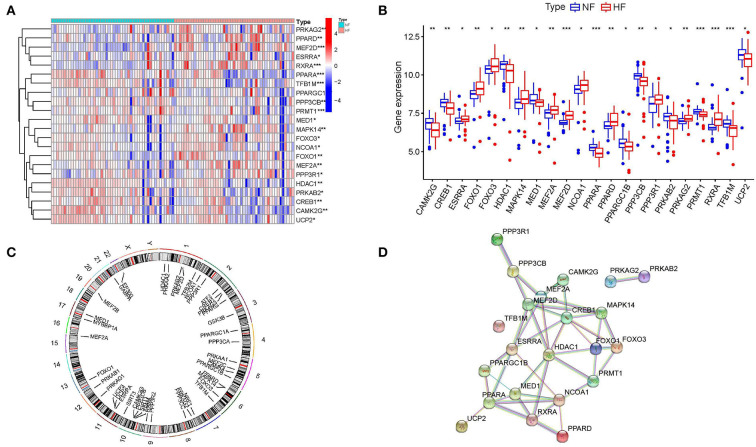
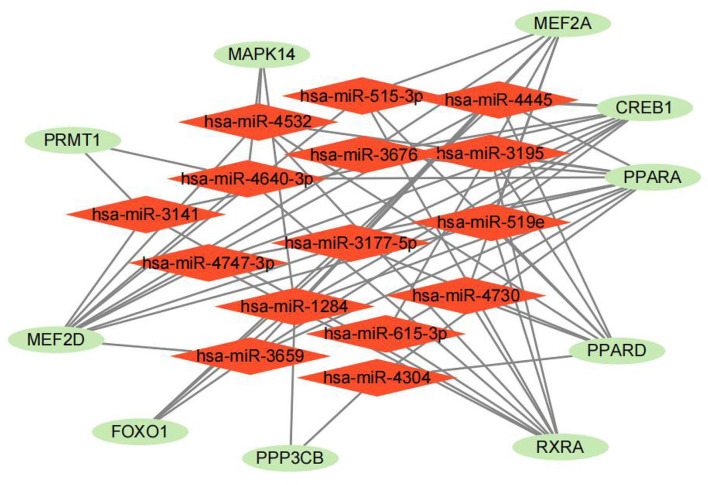
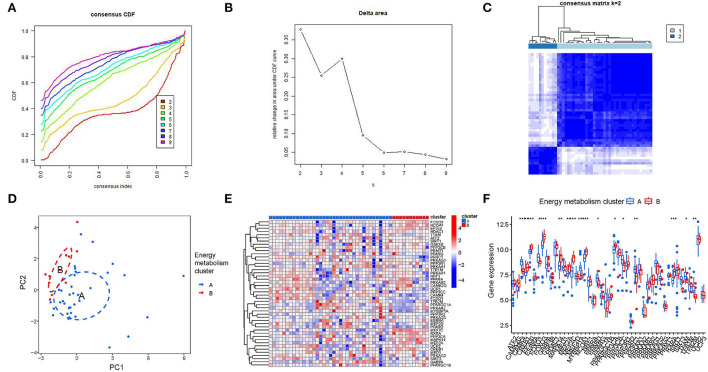
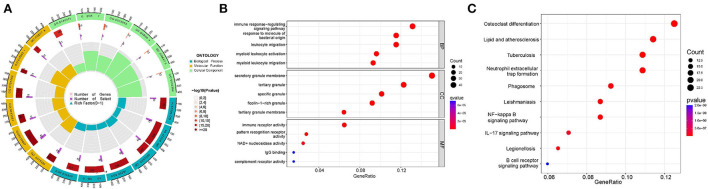
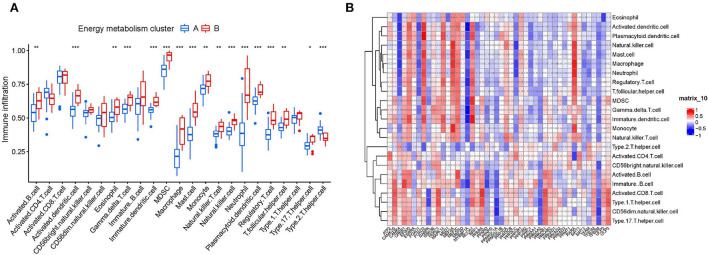
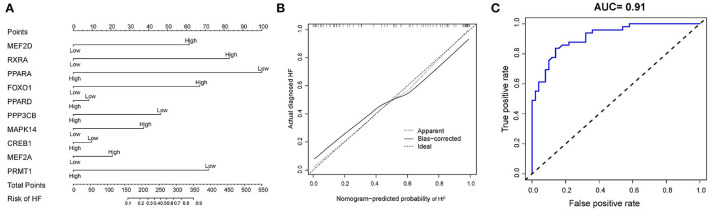
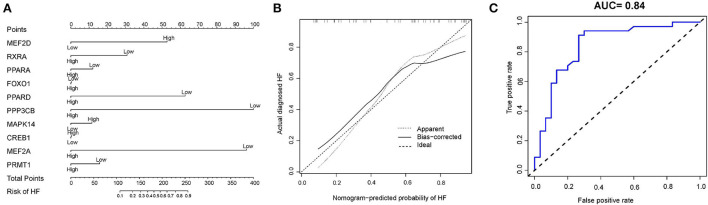
A total of 22 energy metabolism-related DEGs were identified between HF and NF patients. The clustering analysis showed that HF patients could be classified into two subtypes based on the energy metabolism-related genes, and functional analyses demonstrated that the identified DEGs among two clusters were mainly involved in immune response regulating signaling pathway and lipid and atherosclerosis. ssGSEA analysis revealed that there were significant differences in the infiltration levels of immune cells between two subtypes of HF patients. Random-forest and support vector machine algorithm eventually identified ten diagnostic markers (MEF2D, RXRA, PPARA, FOXO1, PPARD, PPP3CB, MAPK14, CREB1, MEF2A, PRMT1) for risk prediction of HF patients, and the proposed nomogram resulted in good predictive performance (GSE66360, AUC = 0.91; GSE59867, AUC = 0.84) and the clinical usefulness in HF patients. More importantly, 10 drugs and 15 miRNA were predicted as drug target and hub miRNA that associated with energy metabolism-related genes, providing further information on clinical HF treatment.
This study identified ten energy metabolism-related diagnostic markers using random forest algorithm, which may help optimize risk stratification and clinical treatment in HF patients.
能量代谢在改善心脏功能障碍以及心力衰竭(HF)的发展过程中起着至关重要的作用。本研究旨在确定与能量代谢相关的诊断生物标志物,以预测心肌梗死所致HF的风险。
从基因表达综合数据库(GEO)获取HF患者和非心力衰竭(NF)人群的转录组测序数据(GSE66360和GSE59867)。在HF和NF样本之间筛选与能量代谢相关的差异表达基因(DEG)。进行亚型一致性分析以使样本能够分组。通过单样本基因集富集分析(ssGSEA)评估各亚型间的免疫浸润水平。应用随机森林算法(RF)和支持向量机(SVM)识别诊断生物标志物,并绘制受试者工作特征曲线(ROC)以验证准确性。基于RF的结果构建并验证预测列线图。进行药物筛选和基因 - miRNA网络分析,以预测与能量代谢相关的药物和潜在分子机制。
在HF和NF患者之间共鉴定出22个与能量代谢相关的DEG。聚类分析表明,HF患者可根据与能量代谢相关的基因分为两个亚型,功能分析表明,两个聚类中鉴定出的DEG主要参与免疫反应调节信号通路以及脂质和动脉粥样硬化。ssGSEA分析显示,HF患者的两个亚型之间免疫细胞浸润水平存在显著差异。随机森林和支持向量机算法最终确定了10个用于HF患者风险预测的诊断标志物(MEF2D、RXRA、PPARA、FOXO1、PPARD、PPP3CB、MAPK14、CREB1、MEF2A、PRMT1),所提出的列线图具有良好的预测性能(GSE66360,AUC = 0.91;GSE59867,AUC = 0.84)以及在HF患者中的临床实用性。更重要的是,预测了10种药物和15种miRNA作为与能量代谢相关基因相关的药物靶点和枢纽miRNA,为HF临床治疗提供了更多信息。
本研究使用随机森林算法鉴定了10个与能量代谢相关的诊断标志物,这可能有助于优化HF患者的风险分层和临床治疗。