Department of Biochemistry, Faculty of Medicine, Khon Kaen University, Khon Kaen, Thailand.
Chronic Kidney Disease Prevention in the Northeast of Thailand (CKDNET) Project, Khon Kaen University, Khon Kaen, Thailand.
Sci Rep. 2022 Oct 28;12(1):18188. doi: 10.1038/s41598-022-22538-w.
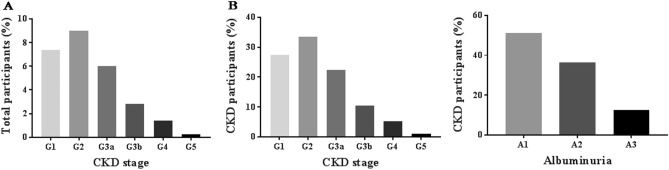
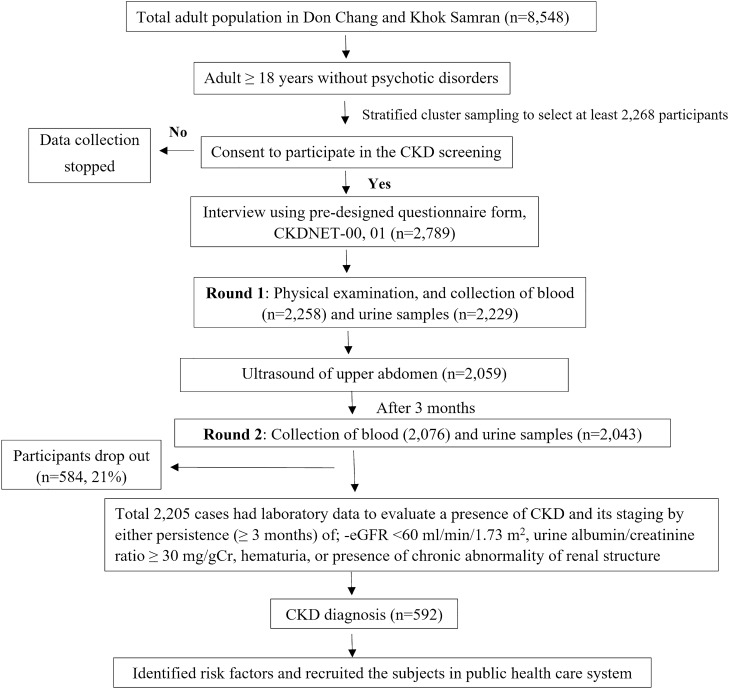
In Thailand, chronic kidney disease (CKD) screening was reported in 2009 with an overall prevalence of 17.5% and the highest at 22.2% in the northeastern region. This study aimed to find out CKD prevalence of the Kidney Disease Improving Global Outcomes criteria and their related risk factors in the rural community. A population-based study was conducted in the rural sub-districts of northeastern Thailand. Data of socio-demographic status, lifestyle, underlying diseases, blood pressure, and body mass index were recorded. Blood and urine analysis was conducted along with ultrasonography of kidneys. Specimen collection and analyses were repeated after 3 months, and the factors associated with CKD were studied by logistic regression analysis. A total of 2205 participants with a mean age of 57.8 ± 11.7 years and female predominance (66.7%) completed the study. The prevalence of CKD was 26.8%, i.e., stages 1 (7.3%); stage 2 (9.0%); stage 3a (6.0%); stage 3b (2.8%); stage 4 (1.4%); and stage 5 (0.3%). Hypertension, diabetes mellitus, and renal stones were the major underlying diseases. Only 3.5% of the participants were aware of having CKD. An increase in age, male, unemployment, current smoking, diabetes, hypertension, underweight, anemia, hyperuricemia, and leukocytosis were significantly associated factors with the disease. The study revealed that CKD has developed as a significant public health problem in rural northeastern Thailand and one out of every four people has CKD. Therefore, early interventions are essential for the proper management and prevention of CKD.
在泰国,2009 年报告了慢性肾脏病(CKD)的筛查情况,总体患病率为 17.5%,东北地区的患病率最高,为 22.2%。本研究旨在了解符合肾脏病改善全球结局(KDIGO)标准的 CKD 患病率及其在农村社区的相关危险因素。在泰国东北部的农村地区进行了一项基于人群的研究。记录了社会人口统计学状况、生活方式、潜在疾病、血压和体重指数等数据。进行了血液和尿液分析以及肾脏超声检查。在 3 个月后重复采集样本并进行分析,并通过逻辑回归分析研究与 CKD 相关的因素。共有 2205 名平均年龄为 57.8±11.7 岁且女性占主导地位(66.7%)的参与者完成了研究。CKD 的患病率为 26.8%,即 1 期(7.3%);2 期(9.0%);3a 期(6.0%);3b 期(2.8%);4 期(1.4%);和 5 期(0.3%)。高血压、糖尿病和肾结石是主要的潜在疾病。只有 3.5%的参与者知道自己患有 CKD。年龄增长、男性、失业、当前吸烟、糖尿病、高血压、体重不足、贫血、高尿酸血症和白细胞增多与该疾病有显著关联。研究表明,CKD 已成为泰国东北部农村地区的一个重大公共卫生问题,每四个人中就有一个患有 CKD。因此,早期干预对于 CKD 的适当管理和预防至关重要。