Hochschule Fresenius, University of Applied Sciences, Munich, Germany.
Department of Psychiatry and Psychotherapy, LMU University Hospital Munich, Munich, Germany.
Eur Arch Psychiatry Clin Neurosci. 2023 Aug;273(5):1023-1028. doi: 10.1007/s00406-022-01503-8. Epub 2022 Oct 29.
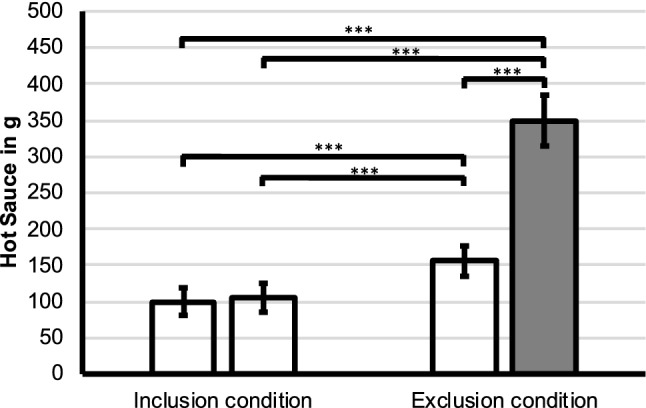
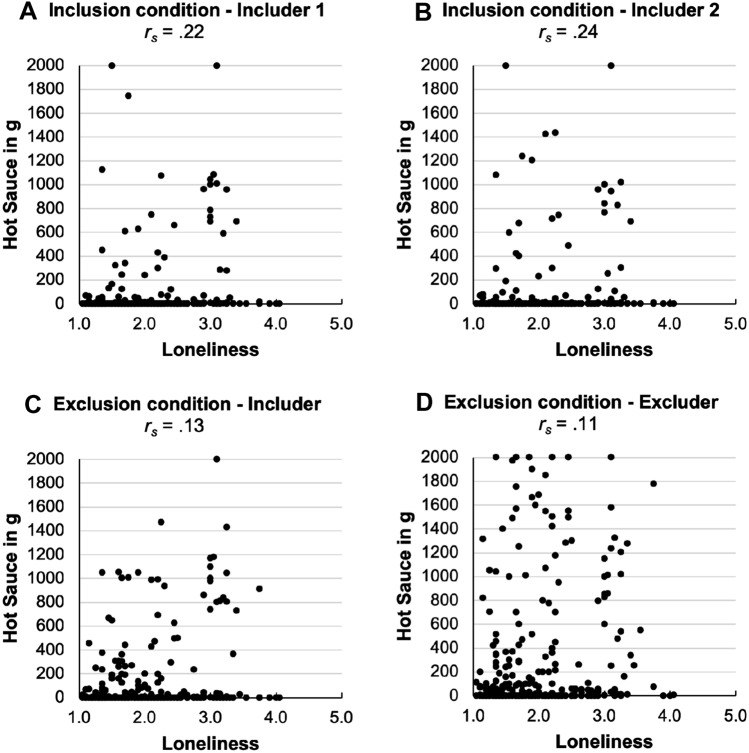
Both social exclusion and loneliness are aversive experiences that can lead to hostile behavioral reactions, including aggressive behavior. This study aimed to assess whether a social exclusion scenario in the subject's imagination elicits aggressive reactions towards an excluding person as measured with the hot sauce paradigm. Furthermore, we studied the effect of loneliness on such reactions. In total, 251 subjects (67.7% female; mean age 27.3 ± 9.3 years) participated in this study which was based on an online survey. After trait loneliness was assessed with the UCLA Loneliness scale at baseline, two imaginary scenarios were presented in randomized order, i.e., an exclusion condition (with one of two working colleagues excluding the participant from a social activity) and an inclusion condition (without exclusion). Following each scenario, participants had the task to allocate the amount of hot sauce to each colleague that they find appropriate. Participants distributed significantly more hot sauce to the excluder than to the includers. The amount of hot sauce was significantly correlated with loneliness for all includer interactions (i.e., after the inclusion as well as the exclusion scenario), but not for the interaction with the excluder. Our results support the hypothesis that social exclusion elicits aggressive behavior. Interestingly, the experience of loneliness seems to be associated with an increase in aggressive behavioral tendencies or a lack of their inhibition. The cognitive and/or emotional processes underlying the interplay between social exclusion, loneliness and aggression should be a focus of future research.
社会排斥和孤独都是令人厌恶的体验,可能导致敌对的行为反应,包括攻击行为。本研究旨在评估在个体的想象中是否会出现社会排斥情景,从而引发对排斥者的攻击反应,这可以通过辣椒酱范式来衡量。此外,我们还研究了孤独感对这种反应的影响。共有 251 名参与者(67.7%为女性;平均年龄 27.3±9.3 岁)参与了这项在线调查研究。在基线时使用 UCLA 孤独量表评估特质孤独感后,以随机顺序呈现了两种想象情景,即排斥情景(两位同事中的一位将参与者排除在社交活动之外)和包容情景(无排斥)。在每个情景之后,参与者需要分配适量的辣椒酱给每个同事。参与者给排斥者分配的辣椒酱明显多于包容者。辣椒酱的分配量与孤独感显著相关,所有包容者的相互作用(即排斥和包容情景之后)均如此,但与排斥者的相互作用无关。我们的结果支持了这样的假设,即社会排斥会引发攻击行为。有趣的是,孤独感的体验似乎与攻击性行为倾向的增加或缺乏抑制有关。未来的研究应该关注社会排斥、孤独感和攻击行为之间相互作用的认知和/或情感过程。