Faculty of Veterinary Medicine, Nippon Veterinary and Life Science University, Musashino, Tokyo, 180-8602, Japan.
Fukushima Mirai Agricultural Cooperative, Fukushima, 960-0185, Japan.
Environ Sci Pollut Res Int. 2022 Dec;29(58):88359-88368. doi: 10.1007/s11356-022-23707-0. Epub 2022 Oct 29.
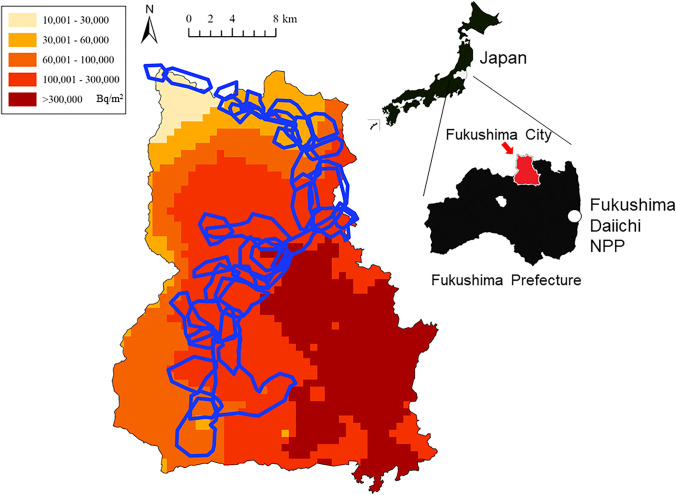
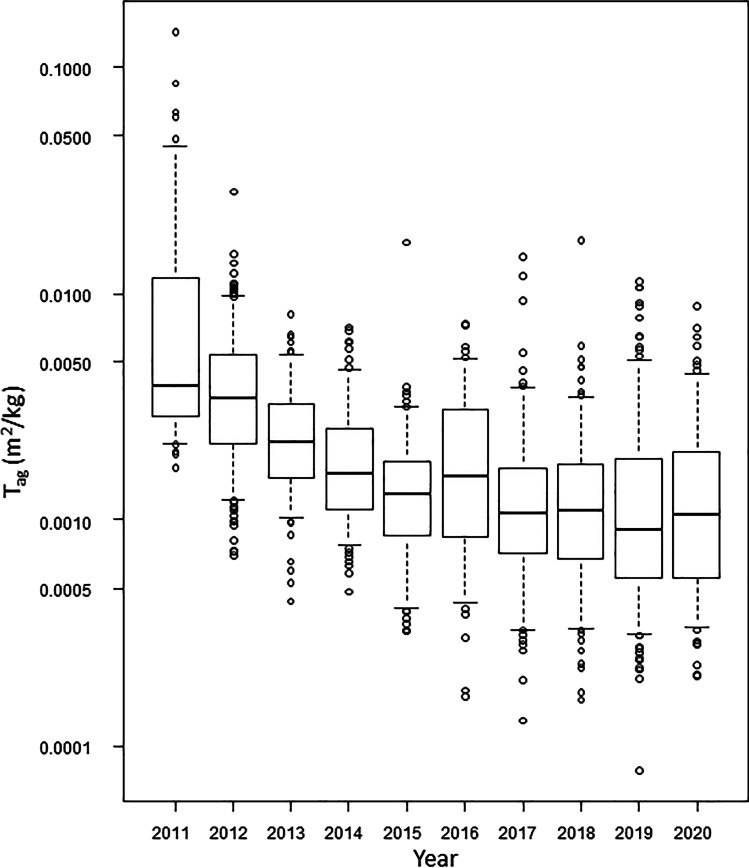
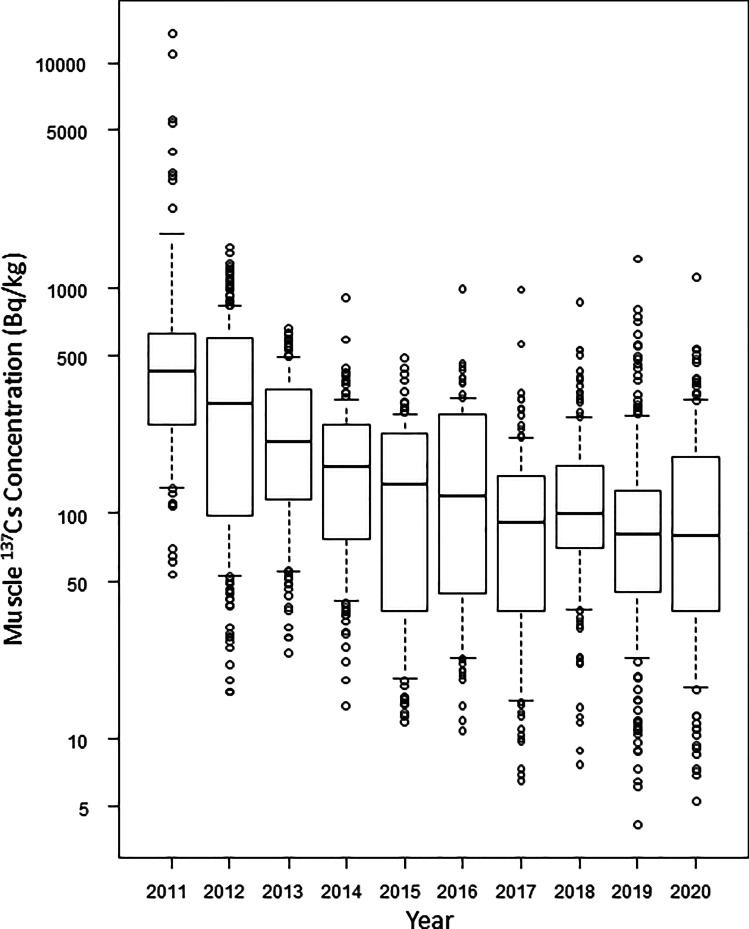
Over the 10 years immediately after the Fukushima Daiichi nuclear accident, we measured the changes in the muscle Cs concentration (Bq/kg) of wild Japanese monkeys living in Fukushima City, which is located approximately 70 km from the Fukushima Daiichi Nuclear Power Plant. The muscleCsconcentration, which was observed at a maximum of 13,500 Bq/kg immediately after the accident, had decreased to several hundred Bq/kg 10 years later. The muscle Cs concentration was significantly related to the soil contamination levels (10,000-30,000, 30,000-60,000, 60,000-100,000, and 100,000-300,000 Bq/m), sex, age class (immature, mature), body weight (> 5000 g, 5000-10,000 g, < 10,000 g), and seasons (the cold period from December to April, the warm period from May to November).The value of muscle Cs concentration and the aggregated transfer factor (T: calculated by dividing muscle Cs concentration [Bq/kg] by soil Cs deposition density at the capture site [Bq/m]) apparently decreased with time for several years. However, post hoc pairwise comparisons showed no difference from 2017 to 2020, and the accumulation of Cs in muscle may continue for some time.
在福岛第一核电站事故发生后的 10 年内,我们测量了生活在距离福岛第一核电站约 70 公里的福岛市的野生日本猕猴肌肉中的 Cs 浓度(Bq/kg)的变化。事故发生后,肌肉中的 Cs 浓度最高达到 13500 Bq/kg,10 年后已降至数百 Bq/kg。肌肉中的 Cs 浓度与土壤污染水平(10000-30000、30000-60000、60000-100000、100000-300000 Bq/m)、性别、年龄组(幼体、成熟)、体重(>5000g、5000-10000g、<10000g)和季节(12 月至 4 月的寒冷期和 5 月至 11 月的温暖期)显著相关。肌肉中 Cs 浓度和总转移因子(T:通过将肌肉中 Cs 浓度(Bq/kg)除以捕获点的土壤 Cs 沉积密度(Bq/m)计算得出)的值在几年内随着时间的推移明显下降。然而,事后两两比较显示 2017 年至 2020 年之间没有差异,肌肉中 Cs 的积累可能会持续一段时间。