Program in Molecular and Cellular Oncogenesis, The Wistar Institute, Philadelphia Pennsylvania, USA; Graduate Group in Biochemistry and Molecular Biophysics, The University of Pennsylvania Perelman School of Medicine, Philadelphia, Pennsylvania, USA.
Program in Molecular and Cellular Oncogenesis, The Wistar Institute, Philadelphia Pennsylvania, USA.
J Biol Chem. 2022 Dec;298(12):102637. doi: 10.1016/j.jbc.2022.102637. Epub 2022 Oct 26.
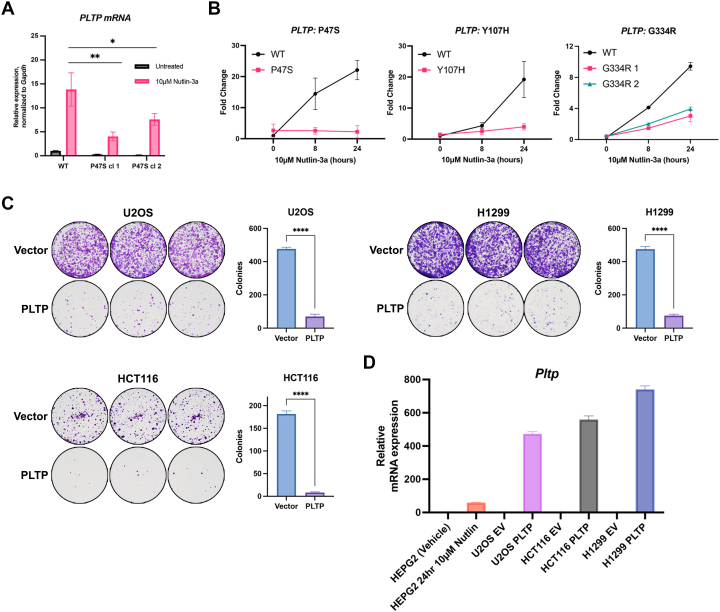
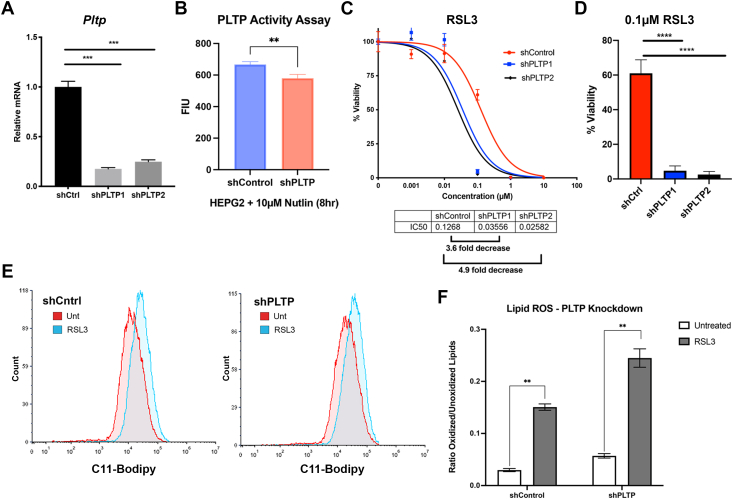
The tumor suppressor protein p53 suppresses cancer by regulating processes such as apoptosis, cell cycle arrest, senescence, and ferroptosis, which is an iron-mediated and lipid peroxide-induced cell death pathway. Whereas numerous p53 target genes have been identified, only a few appear to be critical for the suppression of tumor growth. Additionally, while ferroptosis is clearly implicated in tumor suppression by p53, few p53 target genes with roles in ferroptosis have been identified. We have previously studied germline missense p53 variants that are hypomorphic or display reduced activity. These hypomorphic variants are associated with increased risk for cancer, but they retain the majority of p53 transcriptional function; as such, study of the transcriptional targets of these hypomorphs has the potential to reveal the identity of other genes important for p53-mediated tumor suppression. Here, using RNA-seq in lymphoblastoid cell lines, we identify PLTP (phospholipid transfer protein) as a p53 target gene that shows impaired transactivation by three different cancer-associated p53 hypomorphs: P47S (Pro47Ser, rs1800371), Y107H (Tyr107His, rs368771578), and G334R (Gly334Arg, rs78378222). We show that enforced expression of PLTP potently suppresses colony formation in human tumor cell lines. We also demonstrate that PLTP regulates the sensitivity of cells to ferroptosis. Taken together, our findings reveal PLTP to be a p53 target gene that is extremely sensitive to p53 transcriptional function and which has roles in growth suppression and ferroptosis.
抑癌蛋白 p53 通过调节细胞凋亡、细胞周期停滞、衰老和铁死亡等过程来抑制癌症,铁死亡是一种由铁介导和脂质过氧化物诱导的细胞死亡途径。虽然已经鉴定出许多 p53 靶基因,但只有少数几个似乎对抑制肿瘤生长至关重要。此外,虽然铁死亡显然与 p53 抑制肿瘤有关,但鉴定出的具有铁死亡作用的 p53 靶基因很少。我们之前研究了胚系错义 p53 变体,这些变体呈功能低下或活性降低。这些功能低下的变体与癌症风险增加相关,但它们保留了 p53 转录功能的大部分;因此,研究这些功能低下变体的转录靶标有可能揭示对 p53 介导的肿瘤抑制很重要的其他基因的身份。在这里,我们使用淋巴母细胞系中的 RNA-seq 鉴定出 PLTP(磷脂转移蛋白)是 p53 的靶基因,它显示出三种不同的与癌症相关的 p53 功能低下变体的转录激活受损:P47S(Pro47Ser,rs1800371)、Y107H(Tyr107His,rs368771578)和 G334R(Gly334Arg,rs78378222)。我们表明,强制表达 PLTP 可强力抑制人肿瘤细胞系的集落形成。我们还证明 PLTP 调节细胞对铁死亡的敏感性。总之,我们的发现揭示了 PLTP 是 p53 的靶基因,对 p53 转录功能极其敏感,并且在生长抑制和铁死亡中具有作用。