
类风湿关节炎和动脉粥样硬化的免疫浸润的共性:筛选中心靶点——微阵列数据分析。
The commonness in immune infiltration of rheumatoid arthritis and atherosclerosis: Screening for central targets microarray data analysis.
机构信息
Department of Cardiology, The First Affiliated Hospital of Soochow University, Suzhou, China.
Department of Dermatology, The First Affiliated Hospital of Nanjing Medical University, Nanjing, China.
出版信息
Front Immunol. 2022 Oct 13;13:1013531. doi: 10.3389/fimmu.2022.1013531. eCollection 2022.
BACKGROUND
Although increasing evidence has reported an increased risk of atherosclerosis (AS) in rheumatoid arthritis (RA), the communal molecular mechanism of this phenomenon is still far from being fully elucidated. Hence, this article aimed to explore the pathogenesis of RA complicated with AS.
METHODS
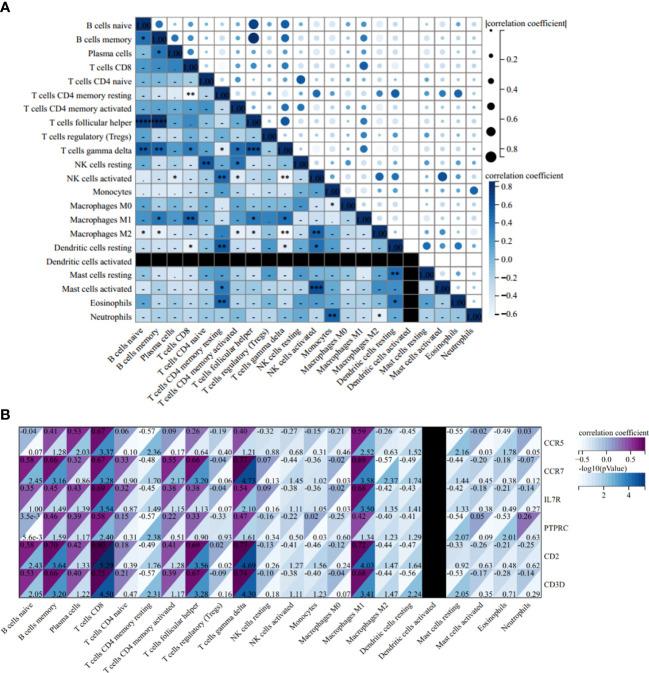
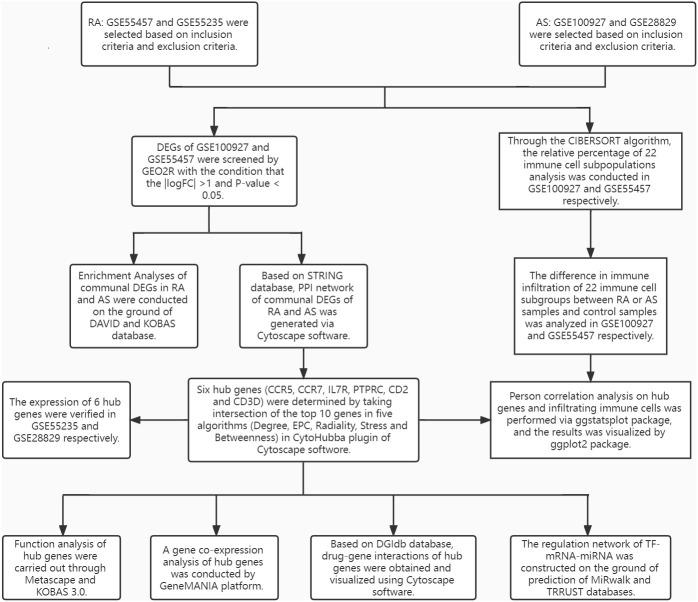
Based on the strict inclusion/exclusion criteria, four gene datasets were downloaded from the Gene Expression Omnibus (GEO) database. After identifying the communal differentially expressed genes (DEGs) and hub genes, comprehensive bioinformatics analysis, including functional annotation, co-expression analysis, expression validation, drug-gene prediction, and TF-mRNA-miRNA regulatory network construction, was conducted. Moreover, the immune infiltration of RA and AS was analyzed and compared based on the CIBERSORT algorithm, and the correlation between hub genes and infiltrating immune cells was evaluated in RA and AS respectively.
RESULTS
A total of 54 upregulated and 12 downregulated communal DEGs were screened between GSE100927 and GSE55457, and functional analysis of these genes indicated that the potential pathogenesis lies in immune terms. After the protein-protein interaction (PPI) network construction, a total of six hub genes (, and ) were determined as hub genes, and the subsequent comprehensive bioinformatics analysis of the hub genes re-emphasized the importance of the immune system in RA and AS. Additionally, three overlapping infiltrating immune cells were found between RA and AS based on the CIBERSORT algorithm, including upregulated memory B cells, follicular helper T cells and γδT cells.
CONCLUSIONS
Our study uncover the communal central genes and commonness in immune infiltration between RA and AS, and the analysis of six hub genes and three immune cells profile might provide new insights into potential pathogenesis therapeutic direction of RA complicated with AS.
背景
尽管越来越多的证据表明类风湿关节炎(RA)患者发生动脉粥样硬化(AS)的风险增加,但这一现象的共同分子机制仍远未完全阐明。因此,本文旨在探讨 RA 合并 AS 的发病机制。
方法
基于严格的纳入/排除标准,从基因表达综合数据库(GEO)下载了四个基因数据集。在确定共同差异表达基因(DEGs)和枢纽基因后,进行了全面的生物信息学分析,包括功能注释、共表达分析、表达验证、药物-基因预测和 TF-mRNA-miRNA 调控网络构建。此外,基于 CIBERSORT 算法分析和比较 RA 和 AS 的免疫浸润,并分别评估枢纽基因与 RA 和 AS 中浸润免疫细胞的相关性。
结果
共筛选出 GSE100927 和 GSE55457 之间 54 个上调和 12 个下调的共同 DEGs,这些基因的功能分析表明,潜在的发病机制与免疫有关。在构建蛋白质-蛋白质相互作用(PPI)网络后,确定了 6 个枢纽基因(、和)作为枢纽基因,随后对枢纽基因进行的综合生物信息学分析再次强调了免疫系统在 RA 和 AS 中的重要性。此外,基于 CIBERSORT 算法,在 RA 和 AS 之间发现了三种重叠的浸润免疫细胞,包括上调的记忆 B 细胞、滤泡辅助 T 细胞和 γδT 细胞。
结论
本研究揭示了 RA 和 AS 之间共同的核心基因和免疫浸润的共性,对 6 个枢纽基因和 3 个免疫细胞谱的分析可能为 RA 合并 AS 的潜在发病机制治疗方向提供新的思路。


 Zotero 插件