Division of Theoretical Systems Biology, German Cancer Research Center (DKFZ), 69120 Heidelberg, Germany.
Division of Cellular Immunology, German Cancer Research Center (DKFZ), 69120 Heidelberg, Germany.
Cell Rep Methods. 2022 Oct 6;2(10):100315. doi: 10.1016/j.crmeth.2022.100315. eCollection 2022 Oct 24.
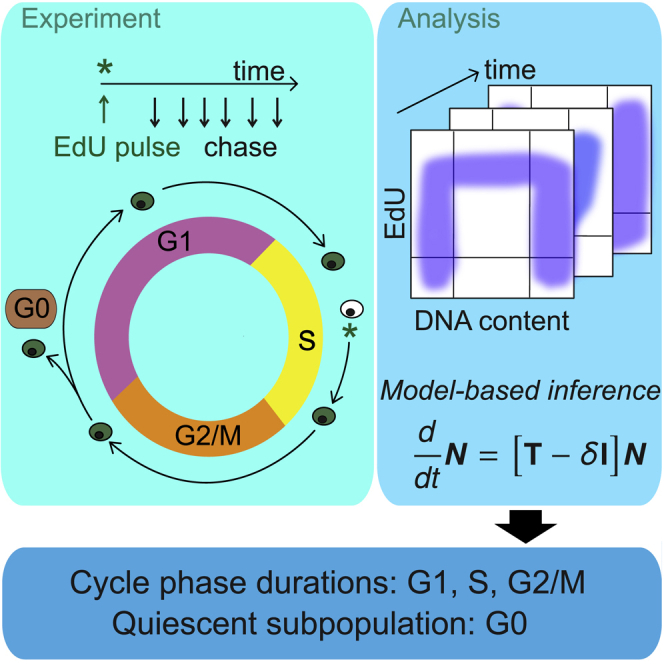
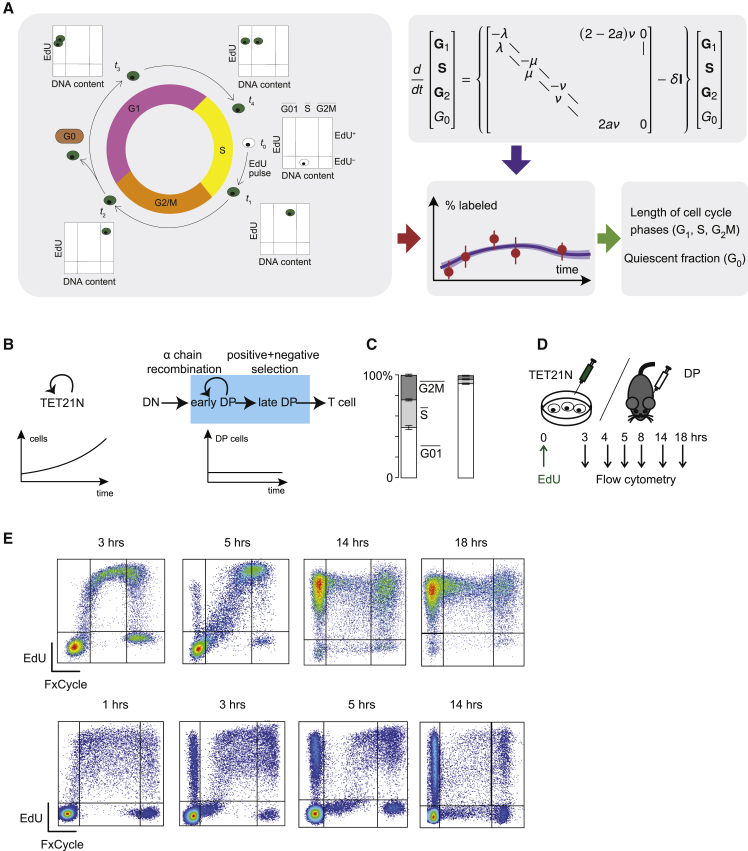
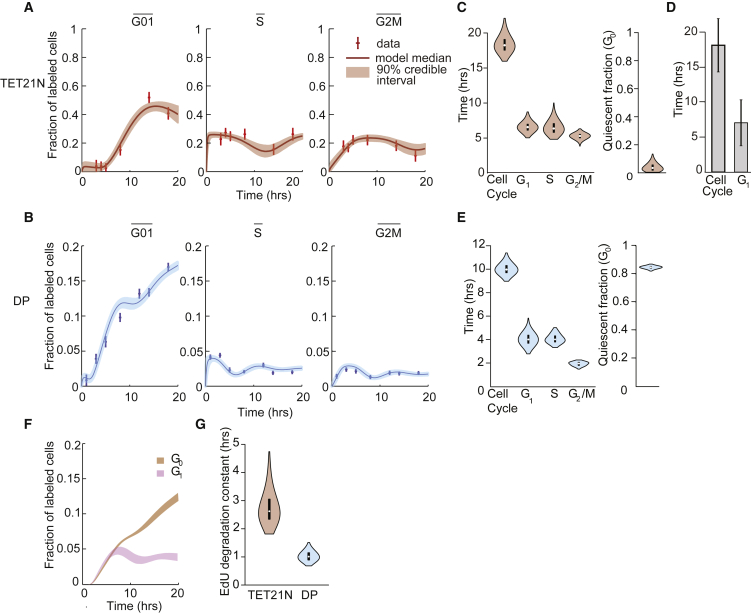
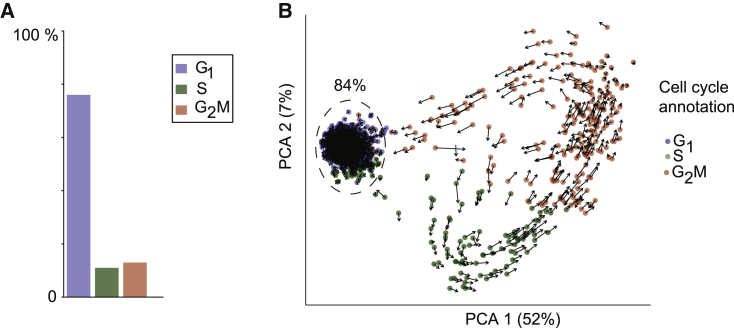
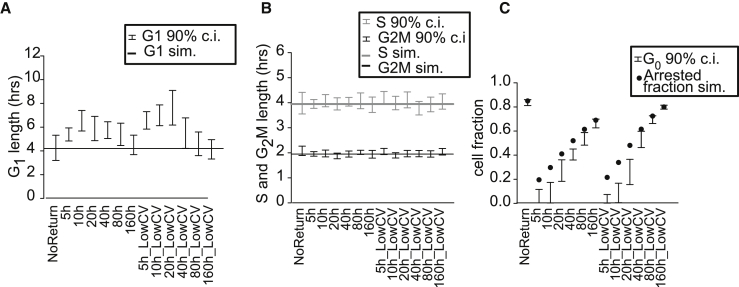
Populations of stem, progenitor, or cancer cells show proliferative heterogeneity , comprising proliferating and quiescent cells. Consistent quantification of the quiescent subpopulation and progression of the proliferating cells through the individual phases of the cell cycle has not been achieved. Here, we describe CycleFlow, a method that robustly infers this comprehensive information from standard pulse-chase experiments with thymidine analogs. Inference is based on a mathematical model of the cell cycle, with realistic waiting time distributions for the G, S, and G/M phases and a long-term quiescent G state. We validate CycleFlow with an exponentially growing cancer cell line . Applying it to T cell progenitors in steady state , we uncover strong proliferative heterogeneity, with a minority of CD4CD8 T cell progenitors cycling very rapidly and then entering quiescence. CycleFlow is suitable as a routine method for quantitative cell-cycle analysis.
干细胞、祖细胞或癌细胞群体表现出增殖异质性,包括增殖细胞和静止细胞。静止亚群的一致量化和增殖细胞通过细胞周期的各个阶段的进展尚未实现。在这里,我们描述了 CycleFlow,一种从胸腺嘧啶类似物的标准脉冲追踪实验中稳健推断此综合信息的方法。推断基于细胞周期的数学模型,具有用于 G、S 和 G/M 阶段的现实等待时间分布以及长期静止的 G 状态。我们使用指数增长的癌细胞系验证了 CycleFlow。将其应用于稳定状态的 T 细胞祖细胞,我们发现了很强的增殖异质性,少数 CD4CD8T 细胞祖细胞快速循环,然后进入静止状态。CycleFlow 适合作为定量细胞周期分析的常规方法。