Department of Refractory Viral Diseases, National Center for Global Health and Medicine Research Institute, Tokyo, Japan.
Department of Regenerative Medicine, Research Institute, National Center for Global Health and Medicine, Tokyo, Japan.
Microbiol Spectr. 2022 Dec 21;10(6):e0349022. doi: 10.1128/spectrum.03490-22. Epub 2022 Oct 31.
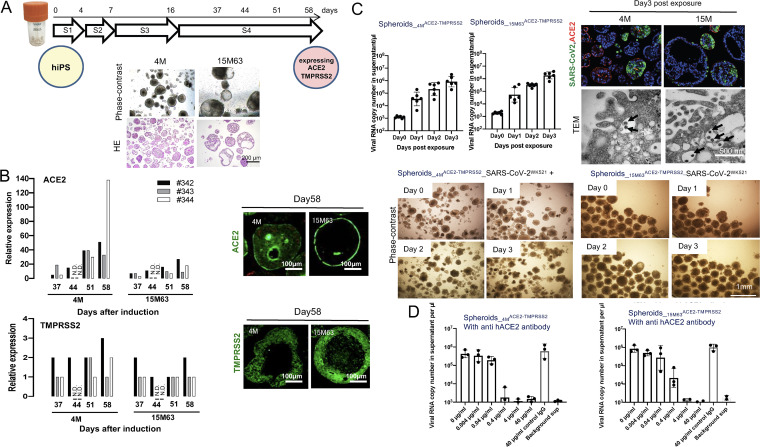
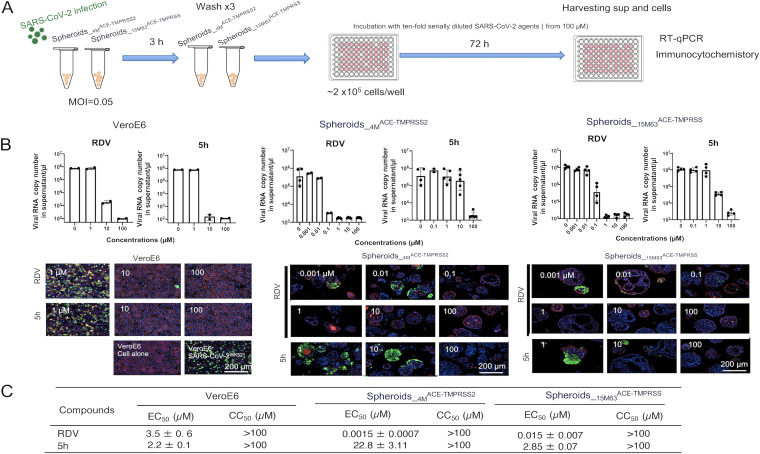
We newly generated two human induced pluripotent stem cell (hiPSC)-derived spheroid lines, termed Spheroids_ and Spheroids_, both of which express angiotensin-converting enzyme 2 (ACE2) and transmembrane protease serine 2 (TMPRSS2), which are critical for severe acute respiratory syndrome coronavirus 2 (SARS-CoV-2) infection. Both spheroids were highly susceptible to SARS-CoV-2 infection, and two representative anti-SARS-CoV-2 agents, remdesivir and 5h (an inhibitor of SARS-CoV-2's main protease), inhibited the infectivity and replication of SARS-CoV-2 in a dose-dependent manner, suggesting that these human-derived induced spheroids should serve as valuable target cells for the evaluation of anti-SARS-CoV-2 activity. The hiPSC-derived spheroids we generated are more expensive to obtain than the human cell lines currently available for anti-SARS-CoV-2 drug evaluation, such as Calu-3 cells; however, the spheroids have better infection susceptibility than the existing human cell lines. Although we are cognizant that there are human lung (and colonic) organoid models for the study of SARS-CoV-2, the production of those organoids is greatly more costly and time consuming than the generation of human iPSC-derived spheroid cells. Thus, the addition of human iPSC-derived spheroids for anti-SARS-CoV-2 drug evaluation studies could provide the opportunity for more comprehensive interpretation of the antiviral activity of compounds against SARS-CoV-2.
我们新生成了两条人诱导多能干细胞(hiPSC)衍生的球体系,分别命名为 Spheroids_和 Spheroids_,它们均表达血管紧张素转换酶 2(ACE2)和跨膜丝氨酸蛋白酶 2(TMPRSS2),这对于严重急性呼吸综合征冠状病毒 2(SARS-CoV-2)感染至关重要。这两种球体对 SARS-CoV-2 感染均高度敏感,两种代表性的抗 SARS-CoV-2 药物,瑞德西韦和 5h(SARS-CoV-2 主要蛋白酶抑制剂),以剂量依赖性方式抑制了 SARS-CoV-2 的感染性和复制,表明这些人源诱导球体应该作为评估抗 SARS-CoV-2 活性的有价值的靶细胞。与目前用于抗 SARS-CoV-2 药物评估的 Calu-3 细胞等人类细胞系相比,我们生成的 hiPSC 衍生球体获得成本更高;然而,球体比现有的人类细胞系具有更好的感染易感性。尽管我们意识到有用于 SARS-CoV-2 研究的人类肺(和结肠)类器官模型,但这些类器官的产生比生成人类 iPSC 衍生球体细胞成本更高、耗时更长。因此,添加人 iPSC 衍生球体用于抗 SARS-CoV-2 药物评估研究,可以为更全面地解释化合物对 SARS-CoV-2 的抗病毒活性提供机会。