Bacigalupo Ilaria, Lombardo Flavia L, Bargagli Anna Maria, Cascini Silvia, Agabiti Nera, Davoli Marina, Scalmana Silvia, Palma Annalisa Di, Greco Annarita, Rinaldi Marina, Giordana Roberta, Imperiale Daniele, Secreto Piero, Golini Natalia, Gnavi Roberto, Lovaldi Franca, Biagini Carlo A, Gualdani Elisa, Francesconi Paolo, Magliocchetti Natalia, Fiandra Teresa Di, Vanacore Nicola
National Center for Disease Prevention and Health Promotion Italian National Institute of Health Rome Italy.
Department of Epidemiology Lazio Regional Health Service Rome Italy.
Alzheimers Dement (N Y). 2022 Oct 29;8(1):e12327. doi: 10.1002/trc2.12327. eCollection 2022.
The identification of dementia cases through routinely collected health data represents an easily accessible and inexpensive method to estimate the prevalence of dementia. In Italy, a project aimed at the validation of an algorithm was conducted.
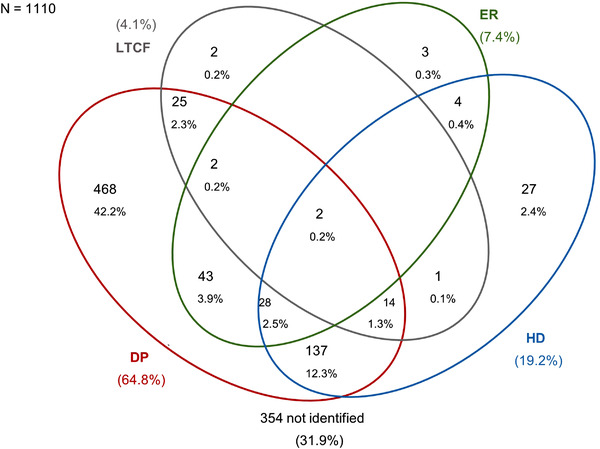
The project included cases (patients with dementia or mild cognitive impairment [MCI]) recruited in centers for cognitive disorders and dementias and controls recruited in outpatient units of geriatrics and neurology. The algorithm based on pharmaceutical prescriptions, hospital discharge records, residential long-term care records, and information on exemption from health-care co-payment, was applied to the validation population.
The main analysis was conducted on 1110 cases and 1114 controls. The sensitivity, specificity, and positive and negative predictive values in discerning cases of dementia were 74.5%, 96.0%, 94.9%, and 79.1%, respectively, whereas in detecting cases of MCI these values were 29.7%, 97.5%, 92.2%, and 58.1%, respectively. The variables associated with misclassification of cases were also identified.
This study provided a validated algorithm, based on administrative data, which can be used to identify cases with dementia and, with lower sensitivity, also early onset dementia but not cases with MCI.
通过常规收集的健康数据识别痴呆病例是一种易于获取且成本低廉的估计痴呆患病率的方法。在意大利,开展了一个旨在验证一种算法的项目。
该项目纳入了在认知障碍和痴呆症中心招募的病例(患有痴呆症或轻度认知障碍[MCI]的患者)以及在老年病科和神经科门诊招募的对照。基于药品处方、医院出院记录、长期护理记录以及医疗费用共付豁免信息的算法应用于验证人群。
对1110例病例和1114例对照进行了主要分析。识别痴呆病例时的灵敏度、特异度、阳性预测值和阴性预测值分别为74.5%、96.0%、94.9%和79.1%,而检测MCI病例时这些值分别为29.7%、97.5%、92.2%和58.1%。还确定了与病例误分类相关的变量。
本研究提供了一种基于行政数据的经过验证的算法,可用于识别痴呆病例,对于早发性痴呆也有较低的灵敏度,但无法识别MCI病例。