Chrzastek Alina, Thanasi Ioanna A, Irving James A, Chudasama Vijay, Baker James R
Department of Chemistry, University College London 20 Gordon Street WC1H OAJ London UK
UCL Respiratory, Rayne Institute, University College London WC1E 6JF London UK.
Chem Sci. 2022 Sep 27;13(39):11533-11539. doi: 10.1039/d2sc04531a. eCollection 2022 Oct 12.
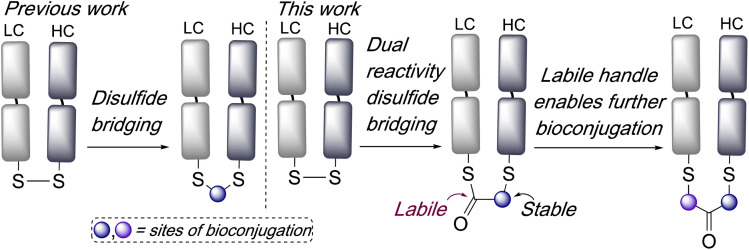
Disulfide bridging, also known as disulfide stapling, is a powerful strategy for the construction of site-selective protein bioconjugates. Here we describe the first examples of a new class of such reagents, containing a 'stable-labile' design. These dual-reactive reagents are designed to form a stable bond to one cysteine and a labile bond to the second; resulting in a robust attachment to the protein with one end of the bridge, whilst the other end serves as a reactive handle for subsequent bioconjugation. By incorporating thioesters into these bridges, we demonstrate that they are primed for native chemical ligation (NCL) with N-terminal cysteines; offering an alternative to the requirement for C-terminal thioesters for use in such ligations. Alternatively, the use of hydrazine as the ligating nucleophile enables a separate cargo to be attached to each cysteine residue, which are exploited to insert variably cleavable linkers. These methodologies are demonstrated on an antibody fragment, and serve to expand the scope of disulfide bridging strategies whilst offering a convenient route to the construction of multifunctional antibody fragment conjugates.
二硫键桥连,也称为二硫键钉合,是构建位点选择性蛋白质生物共轭物的一种强大策略。在此,我们描述了一类新型试剂的首个实例,这类试剂采用了“稳定-不稳定”设计。这些双反应性试剂旨在与一个半胱氨酸形成稳定键,与另一个半胱氨酸形成不稳定键;从而使桥连的一端牢固地连接到蛋白质上,而另一端则作为后续生物共轭反应的反应性手柄。通过将硫酯纳入这些桥连结构中,我们证明它们可用于与N端半胱氨酸进行天然化学连接(NCL);为在这种连接中使用C端硫酯的需求提供了一种替代方案。或者,使用肼作为连接亲核试剂能够将一个单独的货物连接到每个半胱氨酸残基上,利用这一点来插入可变可裂解的连接子。这些方法在一个抗体片段上得到了验证,有助于扩大二硫键桥连策略的范围,同时为构建多功能抗体片段共轭物提供了一条便捷途径。