Wyckhuys Kris Ag, Zhang Wei, Colmenarez Yelitza C, Simelton Elisabeth, Sander Bjorn O, Lu Yanhui
State Key Laboratory for Biology of Plant Diseases and Insect Pests, Institute of Plant Protection, Chinese Academy of Agricultural Sciences, Beijing, China.
University of Queensland, Brisbane, Australia.
Curr Opin Environ Sustain. 2022 Oct;58:101208. doi: 10.1016/j.cosust.2022.101208. Epub 2022 Sep 8.
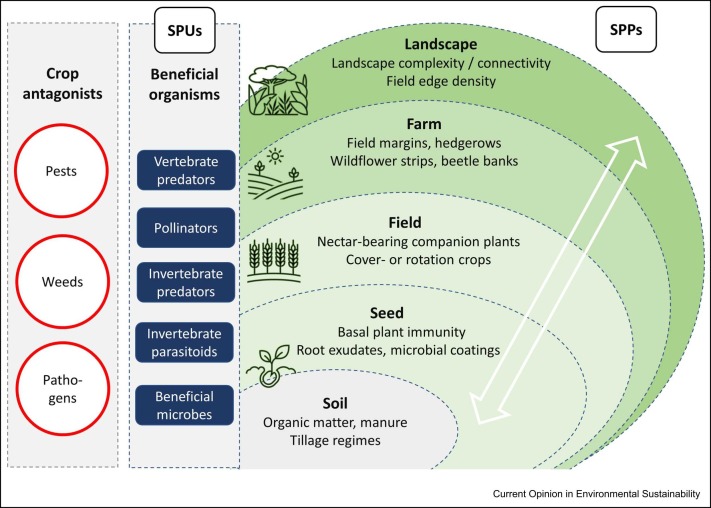
The ongoing COVID-19 pandemic has spotlighted the intricate connections between human and planetary health. Given that pesticide-centered crop protection degrades ecological resilience and (in-)directly harms human health, the adoption of ecologically sound, biodiversity-driven alternatives is imperative. In this Synthesis paper, we illuminate how ecological forces can be manipulated to bolster 'tritrophic defenses' against crop pests, pathogens, and weeds. Three distinct, yet mutually compatible approaches (habitat-mediated, breeding-dependent, and epigenetic tactics) can be deployed at different organizational levels, that is, from an individual seed to entire farming landscapes. Biodiversity can be harnessed for crop protection through ecological infrastructures, diversification tactics, and reconstituted soil health. Crop diversification is ideally guided by interorganismal interplay and plant-soil feedbacks, entailing resistant cultivars, rotation schemes, or multicrop arrangements. Rewarding opportunities also exist to prime plants for enhanced immunity or indirect defenses. As tritrophic defenses spawn multiple societal cobenefits, they could become core features of healthy, climate-resilient, and low-carbon food systems.
持续的新冠疫情凸显了人类健康与地球健康之间的复杂联系。鉴于以农药为中心的作物保护会降低生态恢复力并(直接或间接)损害人类健康,采用生态健全、由生物多样性驱动的替代方法势在必行。在这篇综述论文中,我们阐明了如何操控生态力量以加强针对作物害虫、病原体和杂草的“三级营养防御”。三种不同但相互兼容的方法(栖息地介导法、育种依赖法和表观遗传策略)可在不同组织层面应用,即从单个种子到整个农业景观。生物多样性可通过生态基础设施、多样化策略和恢复土壤健康来用于作物保护。作物多样化理想情况下由生物体间的相互作用和植物 - 土壤反馈来引导,包括抗性品种、轮作方案或多作物种植安排。激发植物增强免疫力或间接防御的有益机会也存在。由于三级营养防御产生多种社会协同效益,它们可能成为健康、气候适应型和低碳食品系统的核心特征。