Awadi Sajeda, Khamees Almu'atasim, Almdallal Walaa, Alzoubi Mai, Talafha Lana, Alsheikh Ahmad M, Faiyoumi Baha Aldin, Al-Zoubi Raed M, Al Zoubi Mazhar S
Faculty of Medicine Yarmouk University Irbid Jordan.
King Hussein Cancer Center Amman Jordan.
Health Sci Rep. 2022 Oct 28;5(6):e896. doi: 10.1002/hsr2.896. eCollection 2022 Nov.
Since the declaration of the COVID-19 pandemic on 11th March 2020, the public health recommendations have applied lockdowns and restrictions to limit the spread of the disease. These measures determined outdoor activities and access to many forms of exercise.
The primary objective of this study was to examine the impact of the COVID-19 pandemic on the physical activity (PA) of the Jordanian population.
A cross-sectional online survey was designed using Google Forms services and distributed on social media platforms during the first two weeks of November 2020 to evaluate the exercise activity changes during the COVID-19 pandemic in the study population. In this research, we included those who perform any form of physical activity (n = 1103). The data collected were analyzed using the Statistical Package for the Social Sciences (SPSS) version 26 (IBM SPSS Corp, SPSS Statistics ver. 26, USA). The categorical variables were summarized as frequencies and proportions and were compared using the Chi-square. For all analyses, P-value less than 0.05 was considered statistically significant.
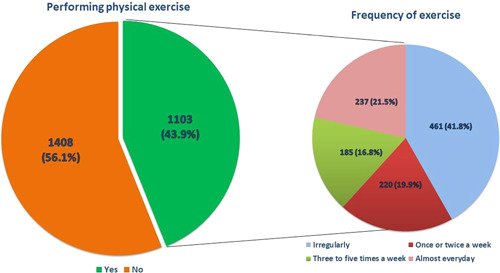
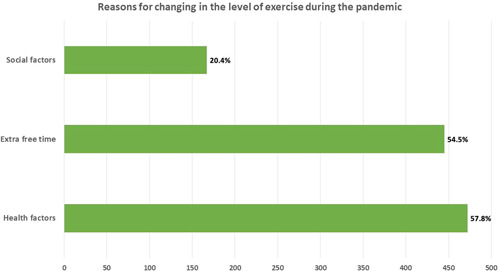
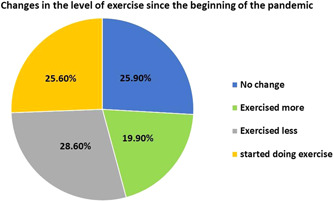
A total of 1103 out of 2,511 (43.9%) respondents who participated in the survey were physically exercising during the COVID-19 pandemic. 41.8% were exercising at an irregular frequency, while 21.5% were exercising daily, 16.8% were exercising three to five times a week, and 19.9% were exercising once or twice a week. Moreover, 282 (25.6%) respondents started doing some form of exercise during the pandemic. Those significantly were less than 18-year-old, male gender, were single, were non-smokers, and had a diploma or bachelor's degree in a health-related major. These changes in the level of exercise have been attributed by 57.8% of respondents to the health aspects where they realized the importance of exercising in strengthening the immune system against diseases, including COVID-19.
The current study showed that lockdown, due to the COVID-19 pandemic, had a positive impact on the healthy lifestyle of the Jordanian population which was attributed to their feeling of the importance of sports practice on the immune system and the availability of time for those activities. However, the younger and individuals were more aware of the importance of these practices which highlights the importance of considering other age groups in future studies of healthy behaviors.
自2020年3月11日宣布新冠疫情大流行以来,公共卫生建议实施了封锁和限制措施以遏制疾病传播。这些措施决定了户外活动以及进行多种形式锻炼的机会。
本研究的主要目的是考察新冠疫情大流行对约旦人口身体活动(PA)的影响。
采用谷歌表单服务设计了一项横断面在线调查,并于2020年11月的前两周在社交媒体平台上发布,以评估研究人群在新冠疫情大流行期间的锻炼活动变化。在本研究中,我们纳入了进行任何形式身体活动的人群(n = 1103)。收集到的数据使用社会科学统计软件包(SPSS)第26版(IBM SPSS公司,SPSS Statistics ver. 26,美国)进行分析。分类变量以频率和比例进行汇总,并使用卡方检验进行比较。对于所有分析,P值小于0.05被认为具有统计学意义。
在参与调查的2511名受访者中,共有1103人(43.9%)在新冠疫情大流行期间进行体育锻炼。41.8%的人锻炼频率不规律,而21.5%的人每天锻炼,16.8%的人每周锻炼三至五次,19.9%的人每周锻炼一至两次。此外,282名(25.6%)受访者在疫情期间开始进行某种形式的锻炼。这些人显著地年龄小于18岁、为男性、单身、不吸烟,并且拥有健康相关专业的文凭或学士学位。57.8%的受访者将锻炼水平的这些变化归因于健康方面,他们意识到锻炼在增强包括新冠病毒在内的疾病免疫系统方面的重要性。
当前研究表明,由于新冠疫情大流行实施的封锁对约旦人口的健康生活方式产生了积极影响,这归因于他们感受到体育锻炼对免疫系统的重要性以及有时间进行这些活动。然而,年轻人和个体更意识到这些做法的重要性,这凸显了在未来健康行为研究中考虑其他年龄组的重要性。