Giuliana Vinci, Lucia Maddaloni, Marco Ruggeri, Simone Vieri
Department of Management, University of Rome, Via del Castro Laurenziano 9, 00161 Sapienza, Italy.
Int J Life Cycle Assess. 2022 Oct 26:1-18. doi: 10.1007/s11367-022-02109-x.
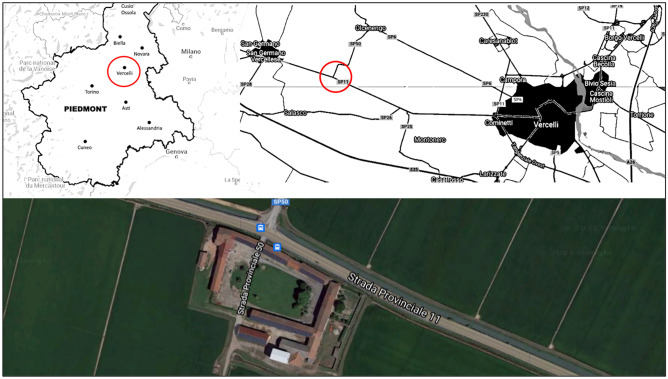
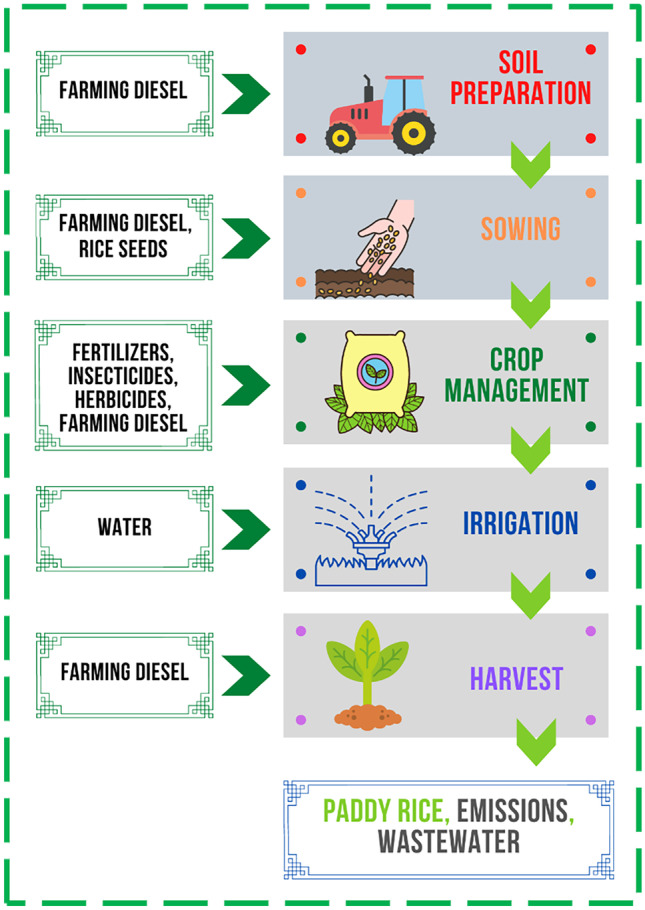
The study's objective is to assess the environmental performance of rice production in Northern Italy, in particular in Piedmont, the first Italian and European district for the rice-growing area, and thus identify the most critical hotspots and agricultural processes. In particular, as a case study, a farm located in Vercelli (VC) has been chosen. Subsequently, the study results were compared with other different cultivation practices to evaluate the most sustainable choice.
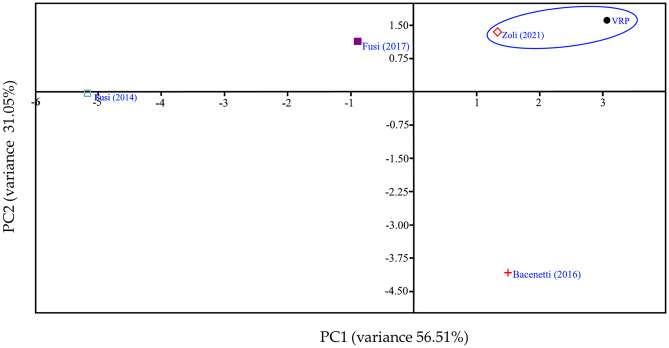
The application of the LCA has been performed, highlighting the phases of rice production that have the most significant impact. Then, uncertainty and sensitivity analyses have been made to estimate the robustness of the results and assess the influence of changing some input variables on emission reduction. Finally, multivariate statistical, specifically a principal component analysis (PCA), was conducted to aid the interpretation of the output dataset of this case study. LCA, uncertainty analysis, and sensitivity analysis were performed with SimaPro 9.2.0, using ReCiPe 2016 Midpoint (H) methodology, and PCA with R software.
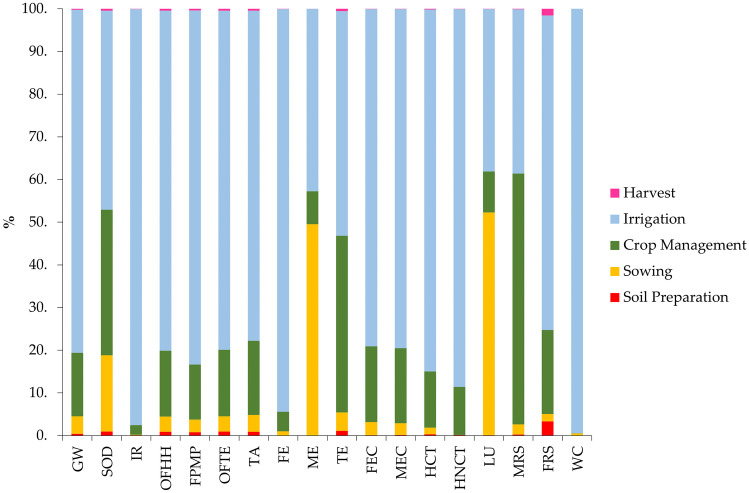
The hotspot with the highest environmental load is irrigation, which compared to the other phases impacts more in 15 out of 18 categories, including 12 with impacts greater than + 75%. This is because irrigation causes direct impacts, related to the methanogenesis in rice fields, but also indirect impacts related mainly to the production of the energy mix required to move the large masses of irrigation water. Therefore, different water management systems were compared and results show that the irrigation systems based on intermittent paddy submergence (DSI) could result in - 40% lower impacts, resulting to be the preferable technique over the other irrigation systems analyzed, including the traditional one used in this study.
In order to reduce the environmental impacts related to the irrigation process, a water management system characterized by intermittent flooding of the paddy field (DSI) could be used as it reduces the environmental impacts the most (- 40%), while the least suitable system is one characterized by continuous flooding without drought periods, as it causes the highest impacts.
The online version contains supplementary material available at 10.1007/s11367-022-02109-x.
本研究的目的是评估意大利北部,特别是皮埃蒙特地区水稻生产的环境绩效。皮埃蒙特是意大利和欧洲首个水稻种植区,从而确定最关键的热点问题和农业生产过程。具体而言,作为案例研究,选取了位于韦尔切利(VC)的一个农场。随后,将研究结果与其他不同的种植方式进行比较,以评估最具可持续性的选择。
开展了生命周期评价(LCA),突出了水稻生产中影响最为显著的阶段。然后,进行了不确定性和敏感性分析,以估计结果的稳健性,并评估改变一些输入变量对减排的影响。最后,进行了多元统计分析,具体为进行主成分分析(PCA),以辅助解读本案例研究的输出数据集。使用SimaPro 9.2.0软件,采用ReCiPe 2016中点(H)方法进行LCA、不确定性分析和敏感性分析,使用R软件进行PCA分析。
环境负荷最高的热点是灌溉,与其他阶段相比,在18个类别中的15个类别中影响更大,其中12个类别的影响大于+75%。这是因为灌溉不仅会产生与稻田甲烷生成相关的直接影响,还会产生主要与输送大量灌溉水所需的能源组合生产相关的间接影响。因此,对不同的水管理系统进行了比较,结果表明基于间歇性稻田淹灌(DSI)的灌溉系统可使影响降低40%,是所分析的其他灌溉系统(包括本研究中使用的传统灌溉系统)中更优的技术。
为了减少与灌溉过程相关的环境影响,可以采用以稻田间歇性淹灌为特征的水管理系统(DSI),因为它能最大程度地减少环境影响(-40%),而最不合适的系统是以无干旱期的持续淹灌为特征的系统,因为它造成的影响最大。
在线版本包含可在10.1007/s11367-022-02109-x获取的补充材料。