Drocaş Ileana, Crăiţoiu Ştefania, Stepan Alex Emilian, Drocaş Ioan Andrei, Stepan Mioara Desdemona
PhD Student, Department of Histology, University of Medicine and Pharmacy of Craiova, Romania.
Department of Histology, University of Medicine and Pharmacy of Craiova, Romania.
Curr Health Sci J. 2022 Apr-Jun;48(2):187-195. doi: 10.12865/CHSJ.48.02.08. Epub 2022 Jun 30.
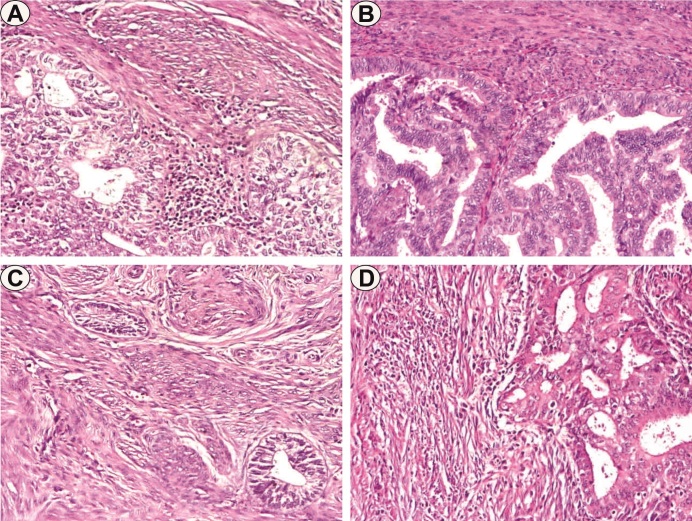
Endometrioid endometrial carcinomas (EEC) are common malignant lesions of the female genital tract, with incidence and risk factors that raise issues to improve histopathological prognostic factors. The study included 50 EEC cases, for which the clinicopathological parameters represented by age, risk factors, tumor grade, histological differences, invasion pattern, tumor stage and association of endometrial hyperplasia were analyzed statistically. The results indicated the predominance of EEC in the 7th decade of life, with associated risk factors (78%), more frequently well differentiated (52%), with no other specifications related to differentiation (NOS, 60%), with irregular invasion pattern (66%) in<50% of the myometrial wall (48%). Irregular pattern, microcystic, elongated, and fragmented (MELF) pattern and myoinvasion associated with vascular invasion (MVI) pattern were significantly associated with high grade and advanced stage tumors. With the exception of EEC-NOS and squamous differentiation, all other tumors were associated with low grade (G1). In this study there was a tendency to associate the age group of 60-69 years with the presence of endometrial hyperplasia and with high grade and advanced stage. Apart from the high grade and advanced stage, in the aggressive profile of the EEC can be included as the clinicopathological parameters the 7th decade of life and the irregular, MELF and MVI invasion patterns.
子宫内膜样腺癌(EEC)是女性生殖道常见的恶性病变,其发病率和危险因素引发了对改善组织病理学预后因素的关注。该研究纳入了50例EEC病例,对以年龄、危险因素、肿瘤分级、组织学差异、浸润模式、肿瘤分期及子宫内膜增生相关性所代表的临床病理参数进行了统计学分析。结果显示,EEC在70岁年龄段最为常见,伴有相关危险因素(78%),高分化者更为常见(52%),无其他与分化相关的特殊情况(未特殊说明,60%),浸润模式不规则(66%),累及子宫肌层壁不到50%(48%)。不规则模式、微囊状、细长及碎片化(MELF)模式以及与血管浸润相关的肌层浸润(MVI)模式与高级别和晚期肿瘤显著相关。除EEC-未特殊说明及鳞状分化外,所有其他肿瘤均与低级别(G1)相关。在本研究中,60 - 69岁年龄组有与子宫内膜增生、高级别和晚期相关的倾向。除高级别和晚期外,EEC的侵袭性特征还可包括70岁年龄段以及不规则、MELF和MVI浸润模式等临床病理参数。