Ma Sai, Gao Ming, Ma Su, Wang Jun, Sun Yue, Wang Hanyu, Wang Huili, Wang Xuedong
School of Environmental Science and Engineering, Suzhou University of Science and Technology Suzhou 215009 China
School of Chemistry and Life Sciences, Suzhou University of Science and Technology Suzhou 215009 China.
RSC Adv. 2022 Oct 19;12(46):29915-29927. doi: 10.1039/d2ra02488h. eCollection 2022 Oct 17.
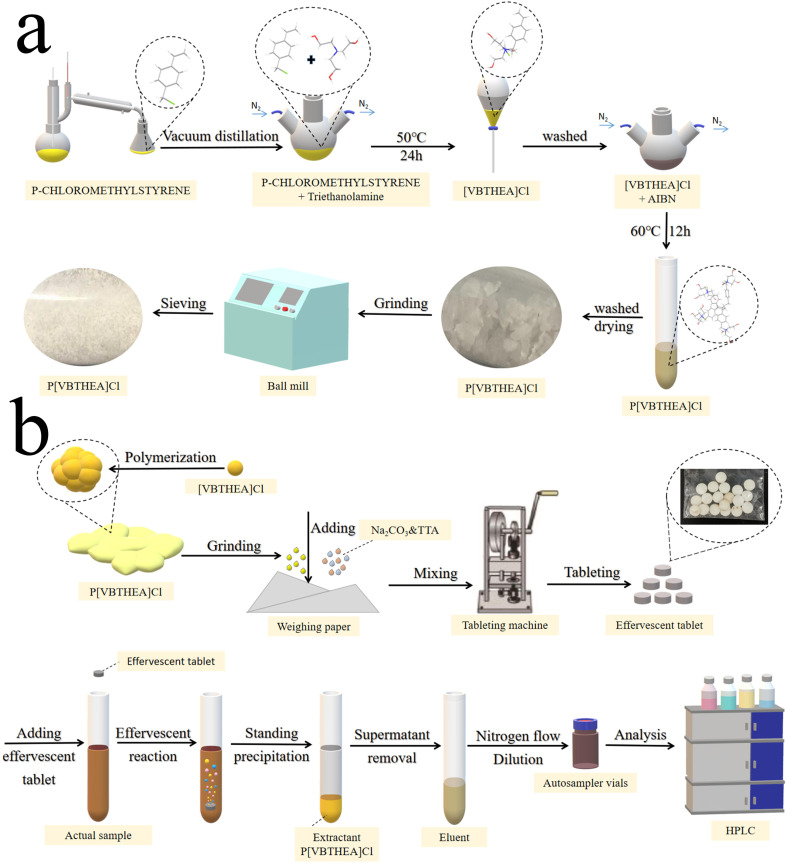
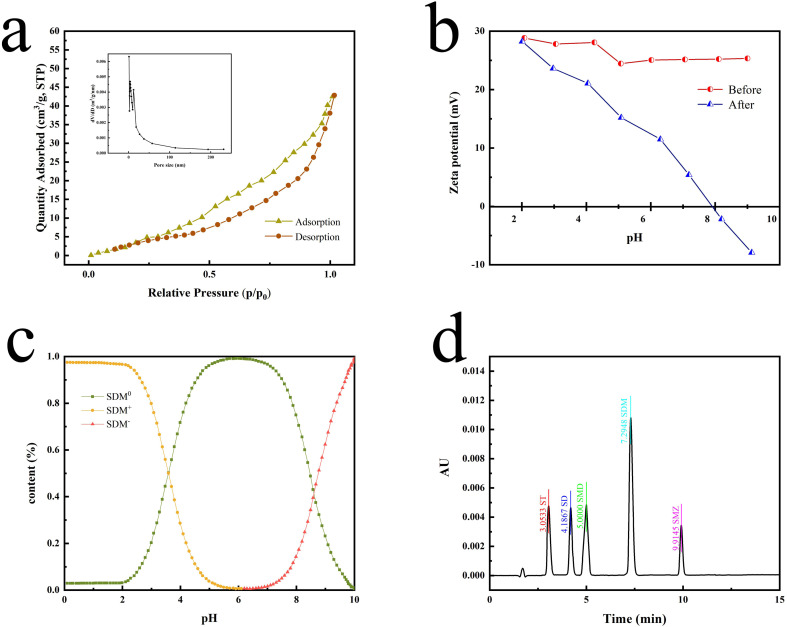
Conventional ionic liquids possess several disadvantages, such as high viscosity, difficult sampling/retrieval, and great loss in aqueous solution, limiting their wide applications in the pretreatment field. To solve these drawbacks, we synthesized a quaternary ammonium polymeric ionic liquid (PIL) and pressed it into an effervescent tablet for developing an effervescence-enhanced dispersive solid-phase extraction method (QAP-EDSE). The pressed effervescent tablet was composed of PIL as an extractant, tartaric acid as an acidic source, NaHCO as an alkaline source, and water-soluble starch as a filler, respectively. Under the CO-driven dispersion, the QAP-EDSE method integrated rapid enrichment, extraction, and dispersion into one synchronous step. Employing the one-factor-at-a-time approach, several important variables were optimized as follows: 200 mg of P[VBTHEA]Cl as sorbent, 400 μL of acetone as elution solvent, 5 min of elution, solution pH 9.0, and 1 : 1.25 molar ratio of alkaline to acidic sources. Combining LC-DAD analysis, this proposed approach offered the limits of detection as low as 0.11-0.31 μg L and satisfactory recoveries of 81.40-102.62% for five sulfonamides (SAs) in environmental waters. The lower relative standard deviations (1.9-6.7%) evidenced the higher intraday and interday experimental precision by this method. Overall, the newly developed method is environmentally benign, time-saving, and easy to operate with low detection limit and high recovery and thus shows excellent prospects in the trace-level detection of SAs in environmental waters.
传统离子液体存在诸多缺点,如高粘度、采样/回收困难以及在水溶液中损失较大,这限制了它们在预处理领域的广泛应用。为了解决这些缺点,我们合成了一种季铵型聚合离子液体(PIL),并将其压制成泡腾片,以开发一种泡腾增强分散固相萃取方法(QAP-EDSE)。压制的泡腾片分别由作为萃取剂的PIL、作为酸性源的酒石酸、作为碱性源的NaHCO和作为填充剂的水溶性淀粉组成。在CO驱动的分散作用下,QAP-EDSE方法将快速富集、萃取和分散整合为一个同步步骤。采用单因素法,对几个重要变量进行了如下优化:200 mg的P[VBTHEA]Cl作为吸附剂,400 μL丙酮作为洗脱溶剂,洗脱5 min,溶液pH 9.0,碱性与酸性源的摩尔比为1∶1.25。结合LC-DAD分析,该方法对环境水样中5种磺胺类药物(SAs)的检测限低至0.11 - 0.31 μg L,回收率为81.40 - 102.62%,令人满意。较低的相对标准偏差(1.9 - 6.7%)证明了该方法具有较高的日内和日间实验精密度。总体而言,新开发的方法环境友好、省时且易于操作,具有低检测限和高回收率,因此在环境水样中SAs的痕量检测方面显示出优异的前景。