Centre for Musculoskeletal Surgery, Department of Orthopaedics, Charité Universitaetsmedizin Berlin, Charitéplatz 1, 10117, Berlin, Germany.
Arch Orthop Trauma Surg. 2023 Jul;143(7):4481-4490. doi: 10.1007/s00402-022-04671-3. Epub 2022 Nov 3.
The impact of the prior fixation mode on the treatment outcome of chronic periprosthetic joint infection (PJI) of the hip is unclear. Removal of cemented total hip arthroplasty (THA) is particularly challenging and residual cement might be associated with reinfection. This study seeks to compare the results of two-stage revision for PJI in cemented and cementless THA.
We reviewed 143 consecutive patients undergoing two-stage revision THA for PJI between 2013 and 2018. Thirty-six patients with a fully cemented (n = 6), hybrid femur (n = 26) or hybrid acetabulum (n = 4) THA (cemented group) were matched 1:2 with a cohort of 72 patients who underwent removal of a cementless THA (cementless group). Groups were matched by sex, age, number of prior surgeries and history of infection treatment. Outcomes included microbiological results, interim re-debridement, reinfection, all-cause revision, and modified Harris hip scores (mHHS). Minimum follow-up was 2 years.
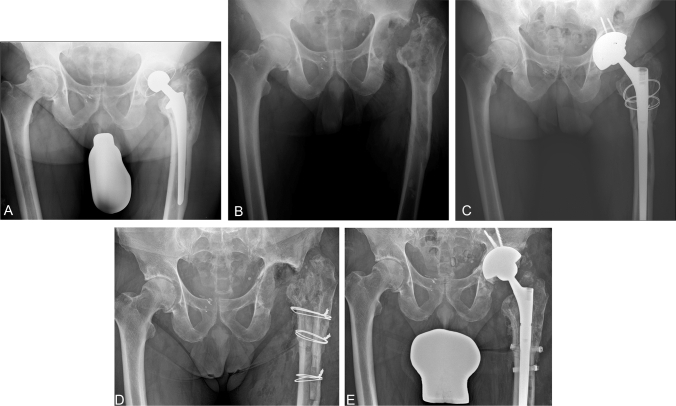
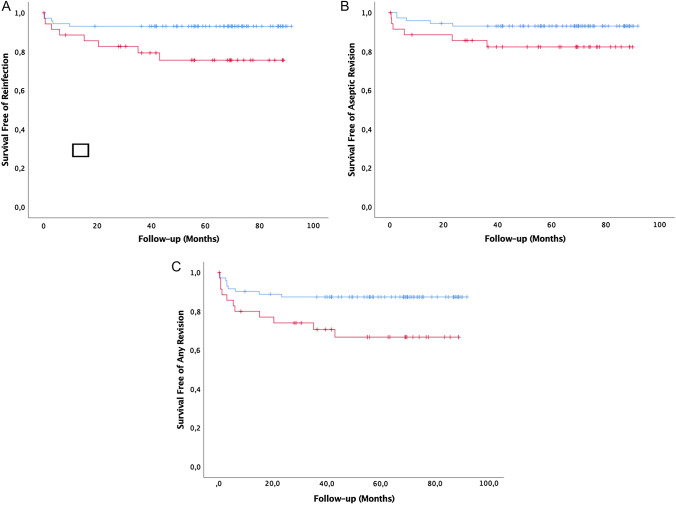
Compared with PJI in cementless THA, patients undergoing removal of cemented THA had increasingly severe femoral bone loss (p = 0.004). Patients in the cemented group had an increased risk for positive cultures during second-stage reimplantation (22% compared to 8%, p = 0.043), higher rates of reinfection (22% compared to 7%, p = 0.021) and all-cause revision (31% compared to 14%, p = 0.039) compared to patients undergoing two-stage revision of cementless THA. Periprosthetic femoral fractures were more frequent in the group of patients with prior cementation (p = .004). Mean mHHS had been 37.5 in the cemented group and 39.1 in the cementless group, and these scores improved significantly in both groups (p < 0.01).
This study shows that chronic infection in cemented THA might be associated with increased bone loss, higher rates of reinfection and all-cause revision following two-stage revision. This should be useful to clinicians counselling patients with hip PJI and can guide treatment and estimated outcomes.
先前固定方式对髋关节慢性假体周围关节感染(PJI)治疗结果的影响尚不清楚。去除骨水泥型全髋关节置换术(THA)尤其具有挑战性,且残留的骨水泥可能与再感染有关。本研究旨在比较骨水泥型和非骨水泥型 THA 行二期翻修治疗 PJI 的结果。
我们回顾了 2013 年至 2018 年间行二期翻修 THA 治疗 PJI 的 143 例连续患者。36 例采用完全骨水泥固定(n=6)、混合股骨(n=26)或混合髋臼(n=4)THA(骨水泥组)的患者与同期 72 例行非骨水泥 THA 去除术的患者进行 1:2 匹配(非骨水泥组)。两组按性别、年龄、手术次数和感染治疗史进行匹配。结果包括微生物学结果、中期清创、再感染、全因翻修和改良 Harris 髋关节评分(mHHS)。最低随访时间为 2 年。
与非骨水泥型 THA 中的 PJI 相比,行骨水泥型 THA 去除术的患者股骨骨丢失程度更严重(p=0.004)。骨水泥组患者在二期再植入时发生阳性培养的风险增加(22%比 8%,p=0.043),再感染率(22%比 7%,p=0.021)和全因翻修率(31%比 14%,p=0.039)均高于行非骨水泥型 THA 二期翻修的患者。在先前接受骨水泥固定的患者中,股骨假体周围骨折更为常见(p=0.004)。骨水泥组的平均 mHHS 为 37.5,非骨水泥组为 39.1,两组评分均显著改善(p<0.01)。
本研究表明,骨水泥型 THA 中的慢性感染可能与二期翻修后骨丢失增加、再感染和全因翻修率增加有关。这将有助于为髋关节 PJI 患者提供临床咨询,并指导治疗和预后评估。