Section of Orthopedic Surgery, Department of Surgical Sciences, Uppsala University Hospital , Uppsala.
The Swedish Hip Arthroplasty Register , Gothenburg.
Acta Orthop. 2019 Oct;90(5):421-426. doi: 10.1080/17453674.2019.1624336. Epub 2019 Jun 3.
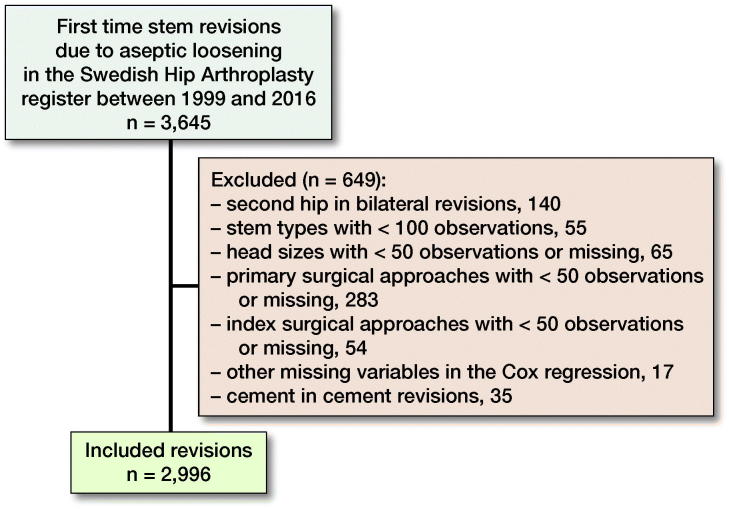
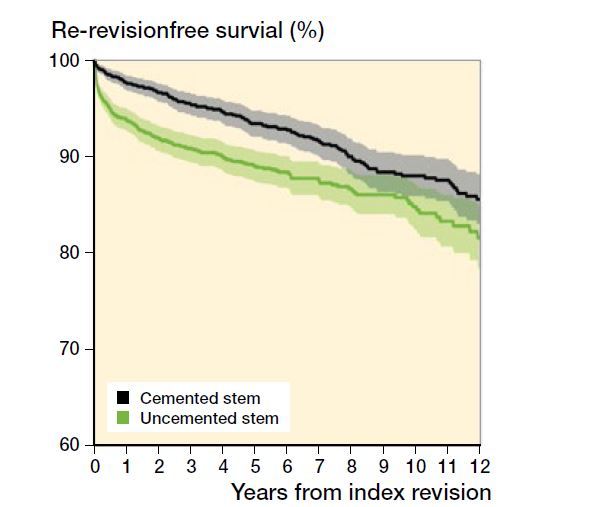
Background and purpose - Uncemented stems are increasingly used in revision hip arthroplasty, but only a few studies have analyzed the outcomes of uncemented and cemented revision stems in large cohorts of patients. We compared the results of uncemented and cemented revision stems. Patients and methods - 1,668 uncemented and 1,328 cemented revision stems used in first-time revisions due to aseptic loosening between 1999 and 2016 were identified in the Swedish Hip Arthroplasty Register. Kaplan-Meier analysis was used to investigate unadjusted implant survival with re-revision for any reason as the primary outcome. Hazard ratios (HR) for the risk of re-revision were calculated using a Cox regression model adjusted for sex, age, head size, concomitant cup revision, surgical approach at primary and at index revision surgery, and indication for primary total hip arthroplasty. Results - Unadjusted 10-year survival was 85% (95% CI 83-87) for uncemented and 88% (CI 86-90) for cemented revision stems. The adjusted HR for re-revision of uncemented revision stems during the first year after surgery was 1.3 (CI 1.0-1.6), from the second year the HR was 1.1 (CI 0.8-1.4). Uncemented stems were most often re-revised early due to infection and dislocation, whereas cemented stems were mostly re-revised later due to aseptic loosening. Interpretation - Both uncemented and cemented revision stems had satisfactory long-term survival but they differed in their modes of failure. Our conclusions are limited by the fact that femoral bone defect size could not be investigated within the setting of the current study.
非骨水泥型假体在髋关节翻修术中的应用日益增多,但仅有少数研究对大量患者中非骨水泥型和骨水泥型翻修假体的疗效进行了分析。本研究比较了非骨水泥型和骨水泥型翻修假体的结果。
在瑞典髋关节翻修登记系统中,我们检索了 1999 年至 2016 年间因无菌性松动而初次行翻修术且使用非骨水泥型或骨水泥型假体的患者资料,共纳入 1668 例非骨水泥型和 1328 例骨水泥型翻修假体。采用 Kaplan-Meier 分析法对所有原因导致的再次翻修作为主要终点的无调整假体生存率进行分析。采用 Cox 回归模型对性别、年龄、股骨头直径、同期髋臼翻修、初次全髋关节置换术和翻修术的手术入路以及初次全髋关节置换术的适应证进行调整后,计算再次翻修的风险比(HR)。
非骨水泥型和骨水泥型翻修假体的 10 年无调整生存率分别为 85%(95%CI:83%-87%)和 88%(95%CI:86%-90%)。术后 1 年内,非骨水泥型翻修假体再次翻修的 HR 为 1.3(95%CI:1.0-1.6),术后第 2 年 HR 为 1.1(95%CI:0.8-1.4)。非骨水泥型翻修假体通常因感染和脱位而早期翻修,而骨水泥型翻修假体则多因无菌性松动而晚期翻修。
非骨水泥型和骨水泥型翻修假体均有较好的长期生存率,但失败模式不同。本研究的局限性在于无法在当前研究中探讨股骨骨缺损的大小。